


















Lesson 21 of 47 · Faults and Protection
Chapter 5 overview: faults and protection
Why short circuits happen, what they do to equipment, and how zones of protection, relays and circuit breakers isolate a fault in a few cycles.
A power system is built to carry current in a controlled way. A fault is any event that breaks that control: a tree falls on a line, lightning flashes over an insulator, an animal bridges two bus bars, a cable insulation fails. The result is a short circuit, an almost zero impedance path in which current can rise to ten or twenty times its normal value within a fraction of a cycle. Left alone, that current melts conductors, bends bus bars with magnetic force and starts fires. It also drags the voltage down over a wide area.
Protection is the discipline of detecting a fault quickly and removing only the faulted piece. This chapter first teaches you how to calculate fault currents (including unbalanced faults, which need symmetrical components) and then how relays and breakers use those numbers.
What you will learn
- Explain why faults happen and why they must be cleared within a few cycles.
- Describe the five requirements of a protection system: reliability, selectivity, speed, sensitivity and economy.
- Draw zones of protection around the main elements of a system.
- Know what each lesson in the chapter covers.
Key terms
Fault: an abnormal connection that carries a large current, such as a short circuit between phases or to ground.
Relay: a device that measures currents and voltages and decides whether to trip.
Circuit breaker (CB): a switch able to interrupt fault current on command.
Zone of protection: the part of the system that a given relay and its breakers are responsible for.
Selectivity: the property that only the breakers closest to a fault open.
Why faults matter
What a fault does
What protection needs
In this chapter
Three effects make a fault dangerous. Heating is proportional to I²t: a conductor that carries ten times its rating heats a hundred times faster. Mechanical force between conductors grows with the square of current, so a bus bar that is fine at 600 A can be thrown apart at 40 kA. And the voltage sag spreads: a fault close to a substation can pull the voltage of every connected customer down to a fraction of normal, stalling motors and tripping sensitive equipment, while generators near the fault, suddenly unable to deliver power, speed up and risk losing synchronism (the topic of the next chapter).
Most faults on overhead lines are temporary, such as lightning flashover or a branch brushing a conductor. That is why many utilities use automatic reclosing: the breaker opens, waits a fraction of a second for the arc to clear, and closes again. Roughly speaking, the majority of line faults are single line-to-ground faults; three-phase faults are rare but are the most severe for equipment ratings, so they are usually the design case for breaker interrupting capacity.
The five requirements
Protection engineers judge a scheme by five qualities, and every design is a compromise among them.
- Reliability has two halves. Dependability is the probability that the protection operates when it should; security is the probability that it does not operate when it should not. A scheme that trips too readily is as bad as one that fails to trip.
- Selectivity (discrimination) means isolating the smallest possible part of the system. Opening the breaker for the whole city because of a fault on one street is a failure of selectivity.
- Speed limits equipment damage and keeps generators in step. Transmission systems aim to clear faults in two to six cycles (about 40 to 120 ms at 50 Hz); distribution systems often tolerate longer times so that fuses and relays can coordinate.
- Sensitivity is the ability to detect the weakest fault that must be cleared, for example a high-resistance ground fault with a current close to the load current.
- Economy: the cost of protection must match the value of what it protects.
Notice the built-in conflict: speed and security pull in opposite directions, because a relay that decides faster has less data to be sure. Good design uses redundancy, such as two independent relays for important lines, rather than asking one device to do everything.
Zones of protection
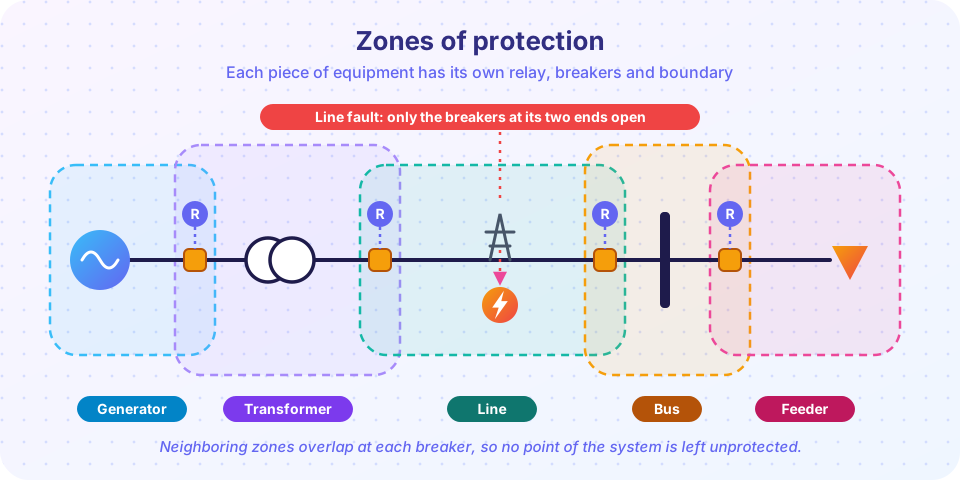
The standard way to organize protection is to divide the system into zones, one per major element: each generator, transformer, bus, line and feeder gets its own zone, shown as dashed outlines in the figure at the top of the lesson. A fault inside a zone causes every breaker bounding that zone to open and nothing else. Adjacent zones overlap around the breaker so that a fault right at the breaker lies inside at least one zone: if the zones merely touched, a fault at the boundary could fall in a gap.
Different zones use different relay types. Overcurrent relays are cheap and common on feeders. Distance relays protect transmission lines. Differential relays, which compare the current going in with the current coming out, protect transformers, buses and generators. Backup protection adds a second line of defense: if a primary relay or breaker fails, a slower relay further upstream (remote backup) or a second relay at the same site (local backup) clears the fault. Breaker failure schemes trip all neighboring breakers when a breaker does not open.
Your route through the chapter
- Symmetrical components: the mathematical tool that turns an unbalanced three-phase problem into three balanced single-phase problems.
- Fault types and fault current calculation: how to connect the networks and compute the current for each fault type.
- Relays, breakers and coordination: overcurrent, distance and differential protection, and how to make relays take turns.
- Chapter 5 review: a one-picture summary, a recap table and a ten-question quiz.
Common misconceptions
"A bigger breaker is safer." A breaker must be rated for the worst-case fault current at its location, not for the load. A breaker with too low an interrupting rating can explode when it tries to open.
"Protection exists to prevent faults." It does not. It limits the damage after a fault has started. Preventing faults is the job of insulation, tree trimming and lightning shielding.
Try it
The first example connects fault current to conductor damage. A 11 kV bus fed from a 500 MVA source has a three-phase fault level of 500 MVA, so the fault current is Ssc / (√3·V). The adiabatic equation t = (k·S/I)² then gives how long a 240 mm² XLPE copper cable survives. The constant k = 143 is the standard value for XLPE-insulated copper (from 90 °C to 250 °C).
Press Run (or Ctrl + Enter) to see the result here.
Program input · what you'd type while the program runs
Type the answers before you press Run, one per line. Each time the program reads a line (with input()), it gets the next line from this box.
The second example is a zone explorer. Pick where the fault is; the breakers bounding that zone open and the rest stay closed. It is a teaching illustration of the logic, not a protection simulator.
Check your understanding
Quick check · 5 questions
of 5 answered You scored / 5 · perfect!
-
1. Why do adjacent zones of protection overlap at breakers?
If zones only touched, a fault at the boundary could fall into a gap. Overlap guarantees that every point is protected. -
2. What does selectivity mean?
Selectivity (discrimination) isolates the smallest possible part of the system. -
3. A conductor carries ten times its rated current. Roughly how much faster does it heat?
Resistive heating is I squared R, so ten times the current gives a hundred times the heating rate. -
4. Which pair describes the two halves of reliability?
Dependability is operating when required; security is not operating when not required. -
5. What is the purpose of backup protection?
Backup relays are slower and cover wider areas; they act only when the primary protection does not clear the fault.
Summary
- A fault is a short circuit; its heat, force and voltage sag demand rapid clearing.
- Protection must be reliable (dependable and secure), selective, fast, sensitive and economical.
- The system is divided into overlapping zones, each bounded by breakers and guarded by relays; backup protection covers failures.
- The next lessons give you the mathematics of fault currents and the logic of relays.
Next: Symmetrical components
Track your progress
Create a free account to tick off lessons and pick up where you left off on any device.
of Electric Power Systems lessons completed