


















Lesson 26 of 47 · Stability and Control
Chapter 6 overview: stability and control
Meet the three classical stability problems of a power grid, rotor angle, frequency and voltage, and the controls that keep a system running after a disturbance.
Clearing a fault is only half of the story. When the fault is gone, the system is not the same as it was: a line may be out of service, generators have accelerated while the voltage was low, and the balance between supply and demand has been disturbed. Power system stability is the ability of the system to return to a stable operating point after such a disturbance. Whether it does depends on physics that unfolds in fractions of a second to minutes, and on controls that must be faster than the problem.
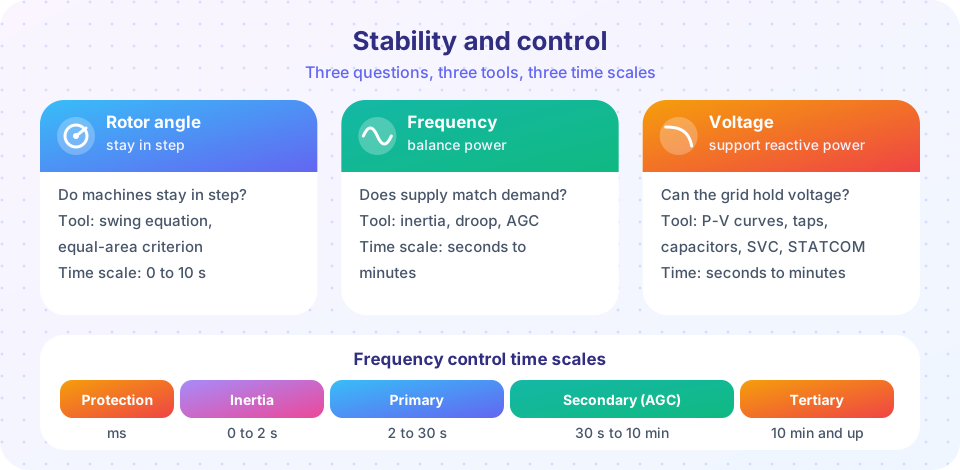
This chapter explains three kinds of stability and the standard tool for each: the swing equation for rotor angle, the power-balance and droop model for frequency, and the P-V curve for voltage.
What you will learn
- Define power system stability and distinguish rotor angle, frequency and voltage stability.
- Tell small-signal stability from large-disturbance (transient) stability.
- Place the main controls on a time scale from milliseconds to hours.
- Know what each lesson of the chapter covers.
Key terms
Stability: the ability of the system to reach an acceptable steady state after a disturbance.
Synchronism: all generators in an interconnection rotating at the same electrical frequency.
Inertia constant (H): kinetic energy at rated speed divided by the machine's rating, in seconds (typically 2 to 9 s for large machines).
Droop: the rule by which a governor changes output in proportion to the frequency deviation.
Voltage collapse: a progressive, uncontrollable fall in voltage after a disturbance.
The big picture
Three ways to lose stability
Small or large
How fast
Rotor angle stability
A synchronous generator delivers electrical power through the angle δ between its internal voltage and the grid voltage. In steady state the turbine's mechanical power equals the electrical power. During a nearby fault, the electrical power drops, the turbine keeps pushing, and the rotor accelerates, increasing δ. If the fault is cleared quickly enough the electrical power returns and the rotor decelerates; if not, δ keeps growing, the machine loses synchronism and must be tripped. The question is whether the machines remain in step: transient stability for large disturbances, small-signal stability for the slow oscillations (0.1 to 2 Hz) that grow or damp after tiny disturbances.
Frequency stability
Frequency is the same everywhere in a synchronous interconnection, and it measures the instantaneous balance between generation and load. If load exceeds generation, the rotating machines give up kinetic energy and the frequency falls at a rate set by the system's total inertia. Governors then raise generation and, minutes later, automatic generation control restores 50 or 60 Hz. When too much generation is lost at once, frequency can fall past the thresholds at which under-frequency load shedding disconnects customers to save the grid.
Voltage stability
Voltage is a local quantity that depends on reactive power. A heavily loaded line absorbs reactive power; when the generators and capacitors cannot supply it, the voltage falls, motors draw even more current and the downward spiral can end in a blackout. This is what the P-V (nose) curve describes: there is a maximum power that a network can deliver at any voltage.
The three problems overlap in real events. In the 2003 north-eastern North American blackout a series of line trips caused heavy loading, low voltages and finally cascading outages and frequency problems; a stability study would have to consider all three at once. Newer classifications also recognize converter-driven and resonance stability, which arise when many inverter-based sources interact with each other and with the network.
Your route through the chapter
- The swing equation and the equal-area criterion: the motion of a machine after a fault, and the critical clearing time.
- Frequency control: inertia, droop, governors and AGC with a time-domain simulation.
- Voltage and reactive power control: why reactive power matters, P-V and Q-V curves, and the devices that support voltage.
- Chapter 6 review: a cheat sheet, a recap table and a ten-question quiz.
Common misconceptions
"Stability means the voltage stays at 1.0 pu." Voltage and frequency may move a lot after a disturbance; stability means they settle at a new acceptable steady state.
"Frequency is a local measurement like voltage." In a synchronous grid frequency is one system-wide quantity; voltage is local.
"Fast protection alone guarantees stability." Quick clearing helps rotor angle stability but does nothing for a slow voltage collapse, which needs reactive power resources and sometimes load shedding.
Try it
The first example is a first look at transient stability. A generator delivering Pm = 0.8 pu through a line (Pmax = 2.0 pu, H = 5 s, 50 Hz) suffers a fault at its terminals at t = 0, during which the electrical power is zero. It simulates the swing equation, clearing the fault after 0.2 s and after 0.4 s. It is an undamped numerical simulation.
Press Run (or Ctrl + Enter) to see the result here.
Program input · what you'd type while the program runs
Type the answers before you press Run, one per line. Each time the program reads a line (with input()), it gets the next line from this box.
The second example is a sorting drill: given an event, decide which stability problem is the main concern. It is a self-check, not a model of the grid.
Check your understanding
Quick check · 5 questions
of 5 answered You scored / 5 · perfect!
-
1. Which kind of stability is mainly about whether generators stay in synchronism after a fault?
Rotor angle stability concerns the ability of synchronous machines to remain in step. -
2. Frequency is
All synchronous machines in an interconnection run at one common electrical frequency in steady state. -
3. What causes the rotor to accelerate during a fault near a generator?
The fault reduces the electrical power the machine can deliver, but the turbine still supplies mechanical power, so the surplus accelerates the rotor. -
4. Which control acts on the longest time scale?
Dispatch and commitment work over minutes to hours. -
5. What is voltage collapse?
Voltage collapse is a self-reinforcing fall in voltage, typically driven by a shortage of reactive power.
Summary
- Stability is the ability to reach an acceptable steady state after a disturbance; the three classical forms are rotor angle, frequency and voltage.
- Rotor angle stability depends on how fast faults are cleared; frequency stability on the supply-demand balance and inertia; voltage stability on reactive power.
- Controls span milliseconds (protection) to hours (dispatch); each must be faster than the problem it addresses.
- Inverter-based sources add converter-driven and resonance stability problems.
Track your progress
Create a free account to tick off lessons and pick up where you left off on any device.
of Electric Power Systems lessons completed