


















Lesson 36 of 47 · Smart Grids and Economics
Chapter 8 overview: smart grids and economics
See how sensors, communications, markets and prices turn a one-way power system into a smart grid, and what economic dispatch, markets and demand response add.
For most of the twentieth century the electricity system was one-way and almost blind below the transmission level. Power flowed from a few big stations to many customers, utilities read meters once a month, and a distribution engineer learned about an outage when customers phoned. That model cannot manage a system with millions of rooftop solar panels, electric vehicles, batteries and flexible loads. The smart grid adds two-way flows of power and of information to the physical network, and it uses prices to coordinate what people and machines do.
This chapter covers the economic logic of running a system at least cost (economic dispatch), how electricity markets turn that logic into prices, how demand can respond to those prices, and the smart-grid technology and microgrids that make it all possible.
What you will learn
- Define the smart grid and its main building blocks.
- Explain how markets, dispatch and control fit together.
- Understand why cybersecurity and standards are part of power engineering.
- Know what each lesson of the chapter covers.
Key terms
Smart grid: an electricity network that uses digital sensing, communication and control to manage supply and demand in both directions.
AMI: advanced metering infrastructure, meters that record usage at short intervals and communicate it.
SCADA: supervisory control and data acquisition, the system that lets operators see and control substations remotely.
DER: distributed energy resources, small generators, batteries and flexible loads connected to the distribution network.
Economic dispatch: choosing generator outputs that meet demand at the lowest cost.
The big picture
From one-way to two-way
The building blocks
The economics
Four layers
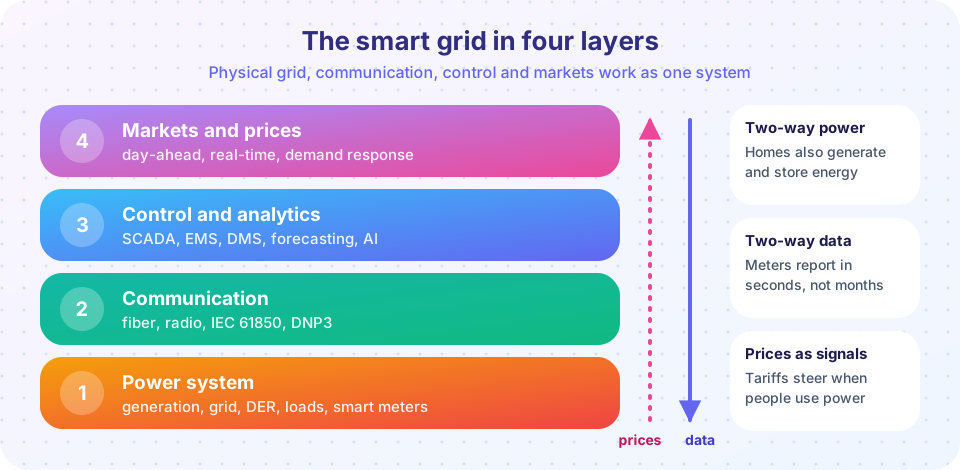
A useful way to think about a smart grid is as four layers. At the bottom is the power system itself: generators, lines, transformers, DER and loads, with sensors added. Above it is the communication layer: fiber, microwave and radio links, cellular networks and mesh radios that carry measurements and commands, plus the protocols (IEC 61850 for substations, DNP3 and IEC 60870-5-104 for SCADA, OpenADR for demand response) that make devices from different vendors speak the same language. Then comes the control and analytics layer: SCADA and energy management systems (EMS) for the transmission network, advanced distribution management systems (ADMS) for distribution feeders, forecasting of load, wind and solar, and optimization tools. At the top are the markets and prices: day-ahead and real-time wholesale markets, retail tariffs and incentive programs.
Data flows up the stack and prices and commands flow down. A smart meter measures a household's consumption every 15 minutes; the price in the market reflects the scarcity of the system; a time-of-use tariff or an automatic signal tells the household's water heater when to run.
What smart technology can do
- Visibility: phasor measurement units (PMUs) sample voltage and current angles many times per second, tagged with GPS time, so operators can watch oscillations and stress across a whole interconnection instead of inferring them from slow SCADA scans.
- Automation: fault location, isolation and service restoration (FLISR) lets a distribution feeder detect a fault, open switches on either side and restore power to unaffected customers in seconds.
- Efficiency: voltage optimization, loss reduction and condition-based maintenance of transformers and breakers.
- Integration of DER: DER management systems coordinate thousands of rooftop inverters and batteries as a "virtual power plant".
- Engagement: customers see their usage, respond to prices and sell flexibility.
The price of connectivity
Everything that makes the grid smart also gives an attacker a way in. In December 2015, attackers remotely opened breakers at several Ukrainian distribution companies and left roughly a couple of hundred thousand customers without power for hours; the lesson, now built into standards such as IEC 62351 and national frameworks, is that control systems need authentication, network segmentation, monitoring and manual fallback. Privacy is another concern: fine-grained meter data reveals when people are at home.
Your route through the chapter
- Economic dispatch: equal incremental cost, limits, losses and unit commitment, with a worked three-unit example.
- Electricity markets and demand response: merit order, locational prices, capacity markets, tariffs and how flexible demand changes the picture.
- Smart grid technology and microgrids: AMI, SCADA, PMUs, automation, microgrids, droop sharing and resilience.
- Chapter 8 review: a cheat sheet, a recap table and a ten-question quiz.
Common misconceptions
"A smart grid is just smart meters." Meters are one component. The value comes from using data and prices to operate, plan and protect the network differently.
"Smart means fully automatic." Operators remain in the loop for critical decisions; automation handles the fast and routine tasks.
"More data always means better decisions." Data without analytics, standards and secure communications is a cost, not a benefit.
Try it
The first example prices a household's day under a flat tariff and a time-of-use (TOU) tariff, and shows what shifting electric-vehicle charging from the evening to the night saves. The numbers are illustrative, not a real tariff.
Press Run (or Ctrl + Enter) to see the result here.
Program input · what you'd type while the program runs
Type the answers before you press Run, one per line. Each time the program reads a line (with input()), it gets the next line from this box.
The second example is a layer explorer. Click a layer of the smart grid to see what it contains and what it does.
Check your understanding
Quick check · 5 questions
of 5 answered You scored / 5 · perfect!
-
1. What does AMI stand for?
AMI is the system of smart meters and communications that records and reports interval consumption. -
2. Which device measures voltage and current phasors with GPS time stamps?
PMUs give synchronized measurements across the grid, many times per second. -
3. What does FLISR do?
Fault location, isolation and service restoration automate switching to restore customers quickly. -
4. Why does cybersecurity belong to power engineering?
Compromised control systems can open breakers or hide faults, so security is part of reliability. -
5. A household shifts 10 kWh of EV charging from a 0.38 $/kWh period to a 0.10 $/kWh period. How much does it save per day?
10 kWh x (0.38 - 0.10) = $2.80.
Summary
- A smart grid adds two-way power and information flows and uses prices to coordinate producers and consumers.
- It can be seen as four layers: power system, communication, control and analytics, and markets.
- Key technologies: smart meters, SCADA and PMUs, distribution automation such as FLISR, DER management and secure communications standards.
- Economics enter through least-cost dispatch, market prices and demand response, the subjects of the next lessons.
Next: Economic dispatch
Track your progress
Create a free account to tick off lessons and pick up where you left off on any device.
of Electric Power Systems lessons completed