


















Lesson 16 of 47 · Per-Unit Analysis and Load Flow
Chapter 4 Overview: Per-Unit Analysis and Load Flow
Preview chapter 4: why engineers use the per-unit system, how to build the bus admittance matrix and what a load-flow study computes, with a slide overview.
So far you have analyzed one generator, one transformer or one line at a time. Real networks have hundreds or thousands of buses, several voltage levels and transformers everywhere. Two ideas make such networks manageable: the per-unit system, which removes the voltage-level bookkeeping, and load flow, which finds the voltage and power at every bus. This chapter introduces both.
What you will learn
- Why per-unit quantities simplify system studies.
- The main steps of a load-flow study and what it produces.
- How the lessons of this chapter build on each other.
- The kinds of questions load flow answers.
Key terms
- Per-unit (pu) value: a quantity expressed as a fraction of its base value.
- Bus: a node of the network where lines, generators and loads connect.
- Load flow (power flow): a steady-state calculation of bus voltages and line power flows.
- Slack bus: the reference bus that balances power and sets the angle reference.
- Jacobian: the matrix of partial derivatives used by Newton-Raphson.
Why a new unit system?
A transmission network with 400 kV, 132 kV, 33 kV and 0.4 kV sections has numbers spanning six orders of magnitude. Currents are in amperes at one level and kiloamperes at another; impedances in ohms differ depending on which side of a transformer you measure from. Every conversion is a chance for a mistake.
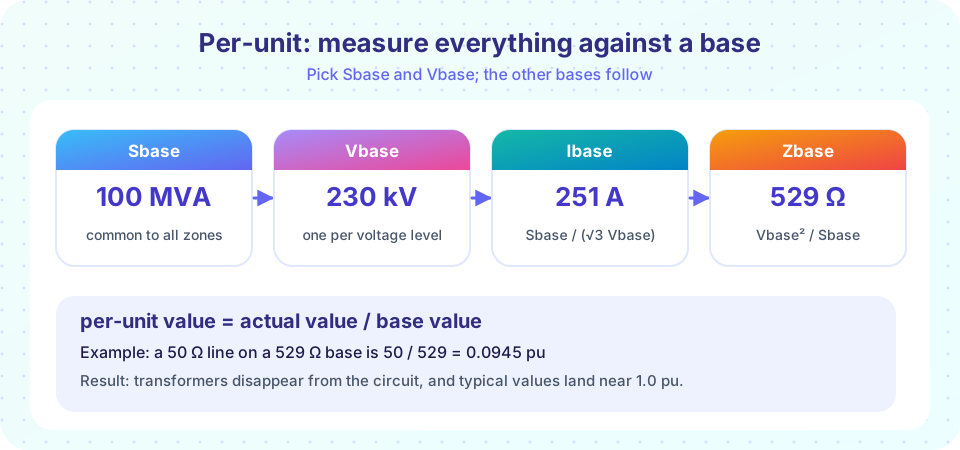
In the per-unit system you pick a single power base for the whole network and a voltage base for each voltage zone, tied together by the transformer ratios. Then:
- Transformers become simple series impedances with ratio 1 (no ideal transformer to track).
- Normal voltages are close to 1.0 pu in every zone, so a value of 0.85 or 1.15 pu stands out immediately as a problem.
- Typical impedance values of equipment of the same kind (a generator, a transformer) fall in a narrow range regardless of size, so you can sanity-check data and use typical values when none are given.
What a load-flow study does
A load flow finds the steady-state operating point of the network for given generation and load. The inputs are the network's impedances and, at each bus, two known quantities out of the four: real power P, reactive power Q, voltage magnitude |V| and voltage angle δ. The outputs are the missing two at each bus, plus the power flowing on every line and the losses.
It answers questions such as: does any line overload? Is any voltage too low or too high? How much will a new generator change the flows? What if this line is out? Planners run thousands of load flows to study future years and outage scenarios, and operators run them every few minutes.
Because the power injected at a bus depends on the product of voltages and nonlinear trigonometric terms, a load flow is a set of nonlinear equations. There is no formula; it must be solved iteratively. The standard methods are Gauss-Seidel (simple, slow), Newton-Raphson (fast and robust, the industry workhorse) and fast-decoupled (faster still, with some approximation). A DC load flow linearizes the problem for quick screening.
Chapter 4 in four steps
First prepare the network.
Solve the equations
Then read the results.
Three bus types
Each bus knows two of four.
The lessons in this chapter
- The Per-Unit System defines the bases, converts between bases and handles transformers.
- The Bus Admittance Matrix builds
Ybusfrom the network and shows how power injections relate to voltages. - Newton-Raphson Load Flow explains bus types, the power-flow equations and the iterative solution, and the DC approximation.
- Chapter 4 Review pulls it together with a poster and a quiz.
Common misconceptions
- "Per-unit is just a way to hide the units." It is a systematic scaling that makes equipment data comparable and removes the need to track transformer ratios.
- "A load flow predicts what happens in the next second." It is a steady-state snapshot. Dynamics are the subject of chapter 6.
- "The solution of a load flow is always unique." Real networks can have more than one mathematical solution, and a solution may not exist when the network is stressed. Only one is the physically meaningful high-voltage solution.
Try it
First, a quick base calculator. Enter a power base and a voltage base to get the current and impedance bases, and convert a few real values to per unit.
Press Run (or Ctrl + Enter) to see the result here.
Program input · what you'd type while the program runs
Type the answers before you press Run, one per line. Each time the program reads a line (with input()), it gets the next line from this box.
Second, a self-check. For each bus description, decide whether it is a slack, PV or PQ bus, then reveal the answer.
Check your understanding
Quick check · 4 questions
of 4 answered You scored / 4 · perfect!
-
1. Why do engineers use the per-unit system for multi-voltage networks?
Per-unit scaling lets transformers appear as simple impedances and makes abnormal values easy to spot. -
2. Which quantities are known at a PQ bus?
At a PQ (load) bus, P and Q are specified; |V| and δ are computed. -
3. What does a load-flow study provide?
Load flow is a steady-state calculation; faults and dynamics need other tools. -
4. Why is a load-flow problem solved iteratively?
Power injections involve products of voltages and trigonometric terms, so there is no closed-form solution.
Summary
- The per-unit system scales every quantity by a base, so transformers vanish into series impedances.
- Load flow finds bus voltages and line flows for a given network, generation and load.
- Each bus knows two of
P,Q,|V|,δ: slack, PV or PQ. - Newton-Raphson is the standard iterative solver.
Next: The Per-Unit System
Track your progress
Create a free account to tick off lessons and pick up where you left off on any device.
of Electric Power Systems lessons completed