


















Lesson 39 of 47 · Smart Grids and Economics
Smart grid technology and microgrids
Explore smart meters, SCADA, synchrophasors, distribution automation, reliability indices and microgrids with droop sharing, islanding and hierarchical control.
The previous lessons described the economic logic of the system. This one is about the machinery that observes and steers it: the meters, sensors, communication networks and controllers that make a smart grid smart, and the microgrid, a small, self-contained piece of grid that can run with or without the main network.
Technology choices here are driven by two measurable goals: a higher reliability for customers and a more efficient use of the assets already in the ground. Learning the standard indices, such as SAIDI and SAIFI, lets you see what each technology is worth.
What you will learn
- Describe AMI, SCADA, PMUs and distribution automation and what each measures or controls.
- Compute SAIFI, SAIDI and CAIDI and see how FLISR improves them.
- Explain how a microgrid operates in grid-connected and islanded modes.
- Use droop control to share load among sources in an islanded microgrid.
Key terms
SAIFI / SAIDI / CAIDI: average number of interruptions per customer, total interruption minutes per customer, and average duration per interruption.
PMU: phasor measurement unit, a time-stamped measurement of voltage and current phasors.
FLISR: fault location, isolation and service restoration.
Microgrid: a group of loads and distributed resources that can operate connected to the main grid or as an island.
Droop control: a decentralized rule by which each source lowers its frequency as its load rises, so that sources share load without communication.
Sensing and control technology
Advanced metering infrastructure (AMI) replaces the monthly meter reading with a meter that records consumption every 15 minutes or less and reports it through a radio mesh, cellular or power-line network. Its uses go well beyond billing: it enables time-of-use tariffs, remote connection and disconnection, instant outage detection (a meter reports "last gasp" when it loses power), voltage monitoring at the customer's door and load-profile analytics. A utility with a million meters receives about 100 million readings a day, which is why data management and privacy are central issues.
SCADA (supervisory control and data acquisition) is the long-established backbone for the transmission and sub-transmission network. Remote terminal units and intelligent electronic devices in substations measure voltages, currents, breaker status and alarms; a master station in the control room polls them every few seconds and lets operators open or close breakers remotely. The EMS (energy management system) adds state estimation, contingency analysis (what if this line trips?), economic dispatch and automatic generation control on top.
Phasor measurement units (PMUs) are a step beyond. Synchronized by GPS to within about a microsecond, they measure the angle as well as the magnitude of voltage and current, typically 30 to 60 times per second, in some systems up to 120 (IEEE C37.118 defines the format). With synchronized phasors from many substations, operators see inter-area oscillations, angle stress across the network and the dynamics of disturbances in real time, rather than inferring them from state estimates every few seconds. They also feed disturbance analysis and wide-area protection schemes.
Distribution automation brings the same visibility to feeders. Remote-controlled switches and reclosers divide a feeder into sections. When a fault occurs, FLISR determines the faulted section from the pattern of fault indicators, opens the switches on both sides to isolate it, and restores supply to the healthy sections from the main source or from a neighboring feeder through a normally open tie switch, all within seconds to a minute and without waiting for a crew. Volt/var optimization and conservation voltage reduction lower the feeder voltage within the allowed band at times of high load; a common rule of thumb is that each percent of voltage reduction saves a fraction of a percent of energy, though the effect depends strongly on the load type.
Distributed energy resource management systems (DERMS) coordinate rooftop solar, batteries and electric vehicles. Aggregated, they act as a virtual power plant that offers capacity and regulation to the market. Vehicle-to-grid concepts let car batteries discharge to the grid when needed. Communication standards (IEC 61850 inside substations, DNP3 and IEC 60870-5-104 for SCADA, IEEE 2030.5 and OpenADR for customer devices, IEEE 1547 for inverter interconnection) and security measures (authentication, encryption, segmentation, intrusion detection) hold the whole structure together.
Reliability indices
Utilities measure customer experience with three standard indices (IEEE 1366). With Ni customers interrupted in event i, duration ri (minutes) and NT total customers served:
SAIFI = Σ Ni / NT                (interruptions per customer per year)
SAIDI = Σ (ri · Ni) / NT         (interruption minutes per customer per year)
CAIDI = SAIDI / SAIFI            (average minutes per interruption)
Typical values vary widely by country and by how storms are counted: a SAIFI between 0.5 and 2 and a SAIDI from tens of minutes to a few hundred minutes per year are common. Automation mostly reduces SAIDI, since it does not prevent faults but shortens the outage for customers outside the faulted section.
Microgrids
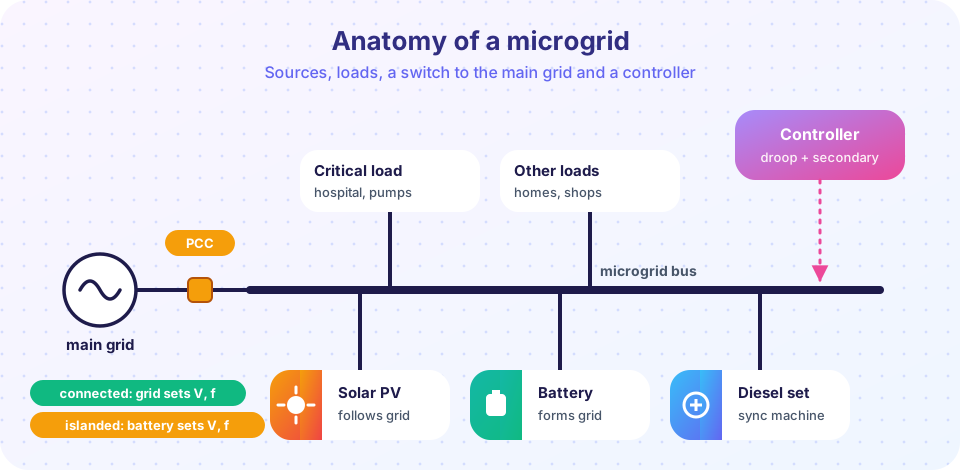
A microgrid has defined electrical boundaries, one or more distributed sources (solar, batteries, a generator, a small turbine or fuel cell), controllable loads and a controller. It is connected to the main grid at a point of common coupling (PCC) through a switch that can open quickly, letting the microgrid island when the main grid fails and resynchronize when it returns. Typical customers are hospitals, military bases, campuses, remote villages and industrial plants that value resilience; in areas without grid at all, microgrids are the only supply.
In grid-connected mode the main grid sets voltage and frequency and the microgrid sources follow, as grid-following inverters do. In islanded mode some source must form the grid: a battery inverter or a generator sets the frequency, and the others share the load. Three layers of control are used:
- Primary control: fast, local droop control of each source. In the P-f droop, the frequency falls as active power rises:
f = f0 − mp·P. A matching Q-V droop adjusts voltage with reactive power. With the same droop in per unit, sources share the load in proportion to their ratings, without any communication. - Secondary control: a slower central controller shifts the droop set-points so that frequency and voltage return to nominal, removing the offset that droop leaves.
- Tertiary control: optimizes the dispatch (economics, battery state of charge, fuel use) and the exchange with the main grid.
For two inverters rated 100 kW and 50 kW, both with a 3 % frequency droop at rated power, m1 = 0.03 × 50 Hz / 100 kW = 0.015 Hz/kW and m2 = 0.03 Hz/kW. A 90 kW load is shared 60 kW and 30 kW, and the common frequency is 50 − 0.015 × 60 = 49.1 Hz. Secondary control then raises both set-points so that the frequency returns to 50 Hz while the shares stay in the same 2:1 ratio. Microgrid sizing, which weighs the cost of fuel, batteries and solar against the value of lost load, is the topic of the project lessons.
Common misconceptions
"A microgrid is just a backup generator." A true microgrid has multiple sources, an intelligent controller and the ability to operate connected or islanded, and to reconnect seamlessly.
"Automation prevents outages." It shortens them for most customers; the fault itself still interrupts the customers in the faulted section until repair.
"PMUs replace SCADA." They complement it: PMUs give fast synchronized dynamics, SCADA gives broad status and control.
Try it
The first example simulates two droop-controlled sources in an island. It shows the power sharing, the frequency offset and the effect of the secondary control, as the load steps from 60 to 120 kW. This is a steady-state model of the droop laws, not a full inverter simulation.
Press Run (or Ctrl + Enter) to see the result here.
Program input · what you'd type while the program runs
Type the answers before you press Run, one per line. Each time the program reads a line (with input()), it gets the next line from this box.
The second example is a toy FLISR (fault location, isolation and service restoration) on a feeder with two substations and a normally open tie switch. Each section has a number of customers, and each source has limited spare capacity. A fault trips its breaker; the logic isolates the faulted section and restores what it can from either end.
Press Run (or Ctrl + Enter) to see the result here.
Program input · what you'd type while the program runs
Type the answers before you press Run, one per line. Each time the program reads a line (with input()), it gets the next line from this box.
The third example turns this into reliability indices. With and without automation, it computes SAIFI, SAIDI and CAIDI for a feeder system with 10,000 customers.
Check your understanding
Quick check · 5 questions
of 5 answered You scored / 5 · perfect!
-
1. A utility has 50,000 customers. In a year, 5,000 customers are interrupted for 60 minutes and 20,000 for 30 minutes. What is its SAIFI?
SAIFI = (5,000 + 20,000) / 50,000 = 0.5 interruptions per customer. -
2. For the same utility, what is SAIDI in minutes?
SAIDI = (5,000 x 60 + 20,000 x 30) / 50,000 = 900,000 / 50,000 = 18 minutes. -
3. What do PMUs measure that ordinary SCADA scans do not provide in real time?
GPS time-stamped phasors give a synchronized view of angles and oscillations across the network. -
4. In an island with two inverters of ratings 100 kW and 50 kW and equal per-unit droop, a 90 kW load is shared
Shares are proportional to ratings (2:1): 60 and 30 kW. -
5. What does secondary control do in a microgrid?
It shifts the droop set-points to remove the steady-state offset.
Summary
- AMI gives interval data and remote services; SCADA and EMS monitor and control the transmission system; PMUs give synchronized phasors for real-time dynamic views; distribution automation with FLISR shortens outages.
- SAIFI, SAIDI and CAIDI measure reliability; automation mainly reduces SAIDI.
- A microgrid can island at the PCC; primary droop control shares load in proportion to ratings, secondary control restores frequency and voltage, tertiary control optimizes.
- DERMS, virtual power plants, standards and cybersecurity tie the technologies together.
Next: Chapter 8 review
Track your progress
Create a free account to tick off lessons and pick up where you left off on any device.
of Electric Power Systems lessons completed