


















Lesson 25 of 47 · Faults and Protection
Chapter 5 review: faults and protection
Review sequence components, fault current calculation, relays, breakers and coordination with a one-picture summary, a recap table, a breaker rating check and a ten-question quiz.
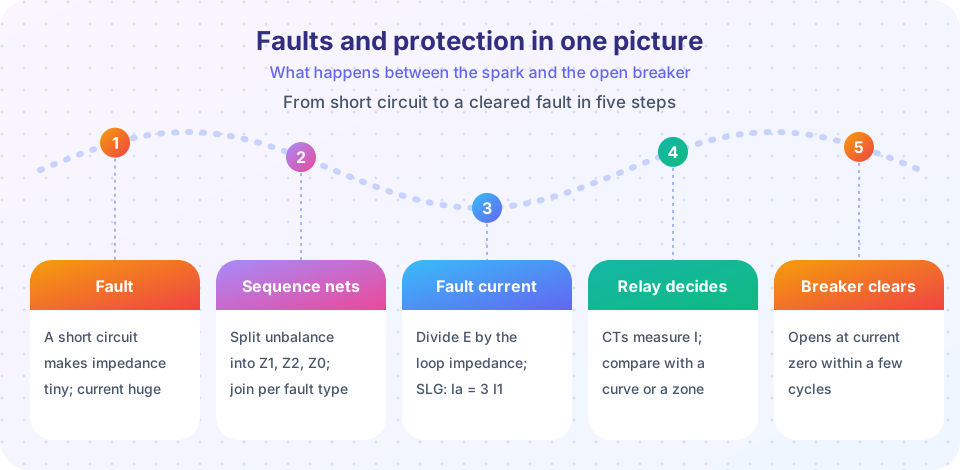
This chapter followed one event from start to finish. A short circuit appears; you model it with sequence networks; you compute the current; a relay compares it with a setting and a breaker opens. Each step has one or two formulas you should be able to write from memory and one idea you should be able to explain in a sentence. Use the picture and the table below as a checklist, try the calculator on your own numbers and then test yourself with the quiz.
What you will learn
- Recall the key formulas and ideas of the chapter in one place.
- Check a breaker rating against all fault types at a bus.
- Find the weak spots to revisit before moving on to stability and control.
Recap table
| Topic | Key formula or rule | Remember |
|---|---|---|
| Operator a | a = 1∠120°, 1 + a + a² = 0 |
Rotates by 120°; the sum of the three unit phasors is zero |
| Decomposition | V0 = (Va+Vb+Vc)/3, V1 = (Va + aVb + a²Vc)/3, V2 = (Va + a²Vb + aVc)/3 |
V0 is the average; neutral current is 3·I0 |
| Sequence impedances | Z1 = Z2 (static); Z0 of lines is about 2 to 4 times Z1 |
Delta windings block zero sequence |
| Three-phase fault | I = E/(Z1 + Zf) |
Uses the positive network only |
| SLG fault | Ia = 3E/(Z1+Z2+Z0+3Zf) |
Series; larger than three-phase when Z0 < Z1 |
| LL fault | Ib = √3·E/(Z1+Z2+Zf) |
0.866 of the three-phase current when Z1 = Z2 |
| LLG fault | I1 = E/(Z1 + Z2‖(Z0+3Zf)) |
All three networks in parallel |
| Asymmetry | ip = κ·√2·I''k, κ = 1.02 + 0.98e^(−3R/X) |
Sets making current and bus bar stress |
| Overcurrent relay | t = TMS·k/((I/Is)^α − 1) |
Coordinate with a CTI of 0.2 to 0.5 s |
| Distance relay | Zone 1 about 80 to 85 %, zone 2 about 120 % with delay | Impedance is proportional to distance |
| Differential relay | Iop = abs(I1+I2) against Imin + slope × Ires |
Selective with no coordination; restraint stops false trips |
Common misconceptions
"Fault level depends on the load." It depends on the source and network impedance.
"Sequence networks are separate systems." They are three views of one system, joined at the fault point in a way that depends on the fault type.
"The fastest relay is the best." A relay that is faster but less secure causes unnecessary outages. Speed, security and selectivity must be balanced.
Try it
The first example is a breaker rating check. Given the sequence impedances at a 33 kV bus, it calculates every fault type, finds the worst case and compares it with the breaker's interrupting rating. It is a calculation, using the formulas of the chapter.
Press Run (or Ctrl + Enter) to see the result here.
Program input · what you'd type while the program runs
Type the answers before you press Run, one per line. Each time the program reads a line (with input()), it gets the next line from this box.
The second example is a quick drill. It picks a random fault type and asks which sequence connection applies. It is a self-test, not a simulator.
Check your understanding
Quick check · 10 questions
of 10 answered You scored / 10 · perfect!
-
1. Three phase currents are Ia = 120 A, Ib = 0, Ic = 0. What is the neutral current?
In = Ia + Ib + Ic = 120 A, which equals 3 x I0 (I0 = 40 A). -
2. Which sequence networks are connected in series for a single line-to-ground fault?
All three carry the same current I1 = I2 = I0, so they are in series. -
3. At a bus Z1 = Z2 = j0.05 pu and Z0 = j0.20 pu. Which fault current is larger, SLG or three-phase?
Three-phase: 1/0.05 = 20 pu. SLG: 3/(0.05+0.05+0.20) = 10 pu. Z0 is larger than Z1, so the three-phase fault wins. -
4. A relay with k = 0.14 and alpha = 0.02 is operated at I/Is = 10, TMS = 0.5. What is its operating time?
t = 0.5 x 0.14 / (10^0.02 - 1) = 0.07/0.0471 = 1.49 s. -
5. Why are zones of protection overlapped?
Overlap around breakers guarantees coverage. -
6. A bolted LL fault compared with a bolted three-phase fault (Z1 = Z2) is
The LL current is sqrt(3)/2 = 0.866 of the three-phase value. -
7. What does a differential relay compare?
Kirchhoff's current law: in a healthy zone the sum of currents is zero. -
8. An ungrounded system suffers a line-to-ground fault. The healthy phase voltages relative to ground become about
With no return path the neutral shifts; the sound phases are at line-to-line voltage relative to earth. -
9. What makes the first peak of a fault current larger than sqrt(2) times the rms value?
The inductive network cannot change current instantly, creating a DC offset that decays with L/R. -
10. Why should zone 1 of a distance relay stop short of the remote end?
An overreaching zone 1 would trip instantly for faults on the next line, losing selectivity.
Summary
- A fault is modeled with sequence networks, joined according to its type, then solved for
I1,I2andI0. - Fault current depends on network impedance, not on load; ground faults can exceed three-phase faults when
Z0 < Z1. - DC offset raises the first peak to about
κ·√2times the rms value. - Protection is a chain of CT, relay, trip coil and breaker, coordinated with time or by zones and differential comparison.
- The next chapter asks what happens when the fault is cleared too slowly, or when the disturbance is not a fault: stability and control.
Track your progress
Create a free account to tick off lessons and pick up where you left off on any device.
of Electric Power Systems lessons completed