


















Lesson 3 of 47 · Getting Started
Three-Phase Power: Wye, Delta and Balanced Systems
Learn why the grid is three-phase, how wye and delta connections relate line and phase quantities, and how to solve a balanced system on a single-phase basis.
Almost every generator, transmission line and large motor in the world uses three-phase alternating current. A single-phase supply is enough for a lamp, but it has a flaw: the power it delivers pulses to zero twice every cycle. Three phases fix that. Three voltages of equal size, shifted by one third of a cycle, together deliver a perfectly steady stream of power and need less copper for the same job.
What you will learn
- Why three phases beat one phase for power delivery.
- How line and phase quantities relate in wye and delta connections.
- How to compute three-phase power from line values.
- How to analyze a balanced system with a single-phase equivalent.
Key terms
- Phase voltage: the voltage across one winding or one load branch.
- Line voltage (line-to-line): the voltage between two of the three conductors.
- Wye (Y) connection: three branches joined at a common neutral point.
- Delta (Δ) connection: three branches joined end to end in a triangle.
- Balanced: equal magnitudes, 120° apart, with identical loads in each phase.
Three voltages, 120 degrees apart
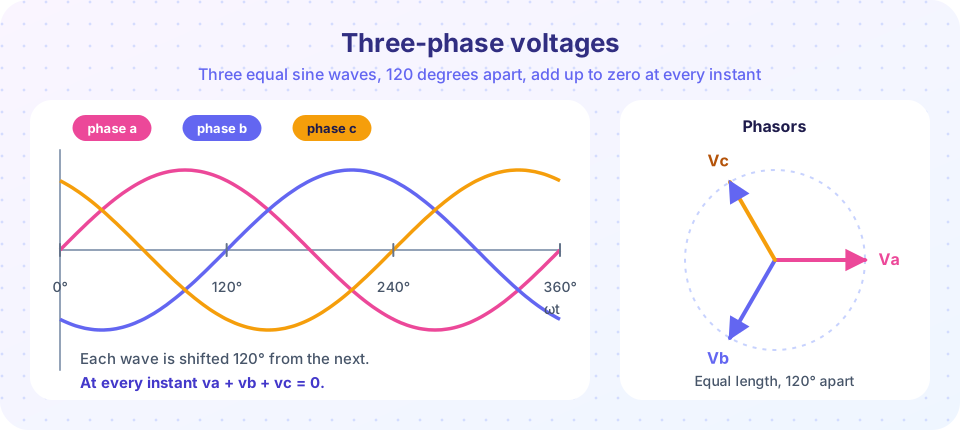
In a balanced system the phase voltages are
va = Vm sin(ωt), vb = Vm sin(ωt − 120°), vc = Vm sin(ωt + 120°)
where Vm is the peak value. As phasors, with rms magnitude V, they are V∠0°, V∠−120° and V∠+120°. The two common orders are abc (a, then b 120° later, then c) and acb. If you swap two conductors, the order reverses and a motor runs backward.
The key fact is va + vb + vc = 0 at every instant. The three currents of a balanced load also add to zero, so the neutral conductor carries nothing. That is why many transmission lines have only three conductors and no neutral wire.
Wye and delta
Wye (Y). The three phase windings share a neutral point. The line current equals the phase current. The line voltage is the difference of two phase voltages, which for equal magnitudes gives
VLL = √3 × Vphase, with the line voltage leading the phase voltage by 30°.
In a 400 V low-voltage system, the phase voltage is 400 / 1.732 = 231 V, which is the 230 V you get between a live wire and neutral.
Delta (Δ). Each winding sits between two lines. The line voltage equals the phase voltage. The line current is the difference of two phase currents:
IL = √3 × Iphase, with the line current lagging the phase current by 30°.
The √3 is the geometry of two vectors of equal length 120° apart: their difference has length 2 cos 30° = √3 times the original.
Three-phase power
For a balanced load with line voltage VL, line current IL and power factor angle φ (the angle between phase voltage and phase current),
S = √3 × VL × IL (apparent power)
P = √3 × VL × IL × cos φ (real power)
Q = √3 × VL × IL × sin φ (reactive power)
These formulas hold for both wye and delta, because they use line quantities. They are the ones you will use most.
Example. A motor draws 30 kW at 400 V line-to-line with a power factor of 0.85 lagging. The line current is
IL = P / (√3 × VL × cos φ) = 30000 / (1.732 × 400 × 0.85) = 50.9 A
and the apparent power is S = 35.3 kVA. A single-phase motor of the same rating at 230 V would draw 30000 / (230 × 0.85) = 153 A, three times as much.
Constant power
For a single-phase load the instantaneous power is p(t) = V I [cos φ − cos(2ωt − φ)], which swings between positive and negative at twice the line frequency. Add the three phases and the oscillating terms cancel exactly:
p(t) = 3 V I cos φ (constant)
A constant power flow means smooth torque in motors and generators, less vibration and less stress on shafts. Copper savings add to the case: with the same voltage to neutral and the same current per wire, three wires carry 3 V I against V I for a two-wire single-phase circuit, so each conductor does twice the work. Together these advantages are why three-phase won.
Single-phase equivalent
Balanced systems are easy to solve because all three phases behave identically, only shifted in time. You can analyze one phase, as if it were an ordinary single-phase circuit from line to neutral, and then shift the answers by ∓120° to get the other two phases. Procedure:
- Convert any delta load to an equivalent wye: each impedance
ZΔbecomesZY = ZΔ / 3. - Use the line-to-neutral voltage
VLL / √3for the source. - Solve the one-phase circuit for current and power.
- Multiply real and reactive power by 3 for the total.
Example. A wye-connected load has ZY = 8 + j6 Ω per phase on a 400 V system. Phase voltage 231 V, |Z| = 10 Ω, so I = 23.1 A, the power factor is 8/10 = 0.8 lagging and the total real power is 3 × 23.1² × 8 = 12.8 kW.
Common misconceptions
- "The neutral carries the sum of the line currents, so it must be heavy." For a balanced load that sum is zero. The neutral only carries the imbalance.
- "VLL = √3 Vphase always." That is the wye relation. In delta the line and phase voltages are equal.
- "The power factor angle is the angle between line voltage and line current." It is the angle between phase voltage and phase current. The line voltage leads the phase voltage by 30° in a wye, which shifts the apparent angle.
Try it
First, compare the instantaneous power of a single-phase load with a three-phase load of the same total rating. Notice that the three-phase total is a flat line. The model assumes ideal sine waves and a balanced load.
Press Run (or Ctrl + Enter) to see the result here.
Program input · what you'd type while the program runs
Type the answers before you press Run, one per line. Each time the program reads a line (with input()), it gets the next line from this box.
Second, check the wye and delta relations with complex numbers. The code builds three line-to-neutral phasors, subtracts them to get the line voltages, and confirms the magnitude and the 30 degree shift.
Press Run (or Ctrl + Enter) to see the result here.
Program input · what you'd type while the program runs
Type the answers before you press Run, one per line. Each time the program reads a line (with input()), it gets the next line from this box.
Third, a visual check. Drag the slider to rotate the three phasors and watch the projections on the horizontal axis trace the instantaneous voltages. The three values always add to zero.
Check your understanding
Quick check · 5 questions
of 5 answered You scored / 5 · perfect!
-
1. In a wye-connected system the phase voltage is 127 V. What is the line-to-line voltage?
VLL = √3 × 127 = 220 V. -
2. In a delta connection with phase current 10 A, what is the line current?
IL = √3 × Iphase = 17.3 A in a balanced delta. -
3. A balanced three-phase load takes 20 A at 400 V line-to-line with pf 0.9. What is its real power?
P = √3 × 400 × 20 × 0.9 = 12.47 kW. -
4. Why does the neutral carry no current in a balanced wye system?
Three equal currents 120° apart sum to zero, so nothing returns through the neutral. -
5. Which result makes three-phase power attractive for motors?
Constant instantaneous power gives smooth torque and less vibration.
Summary
- Three equal voltages 120° apart add to zero and deliver constant power.
- Wye:
VLL = √3 Vph,IL = Iph. Delta:VLL = Vph,IL = √3 Iph. - Total power from line values:
S = √3 VL IL,P = S cos φ,Q = S sin φ. - A balanced system can be solved on a per-phase (single-phase equivalent) basis; convert delta loads with
ZY = ZΔ / 3. - The neutral carries only the imbalance.
Track your progress
Create a free account to tick off lessons and pick up where you left off on any device.
of Electric Power Systems lessons completed