


















Lesson 35 of 47 · Renewables and Storage
Chapter 7 review: renewables and storage
Review solar, wind, inverter-based resources and storage with a cheat sheet, a recap table, a hybrid-plant energy calculator and a ten-question quiz.
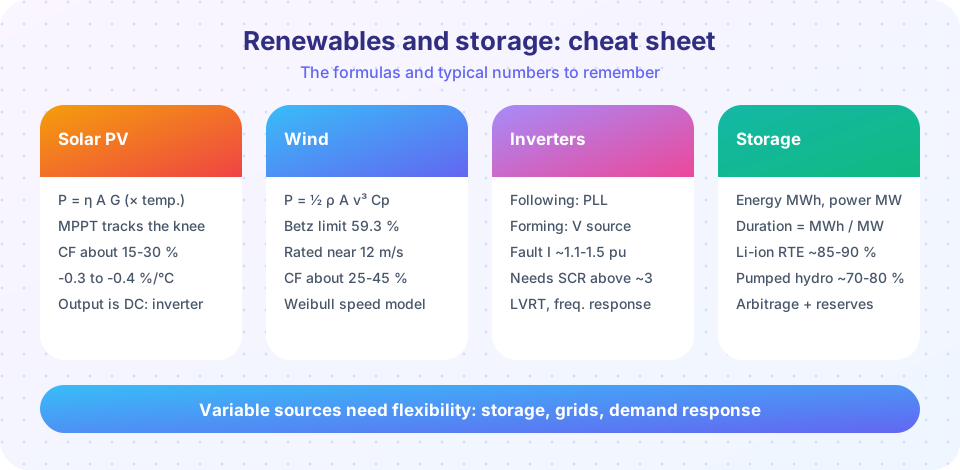
Wind, solar and storage form a small family of ideas. Each source has a resource (sun or wind), a conversion law (the diode equation or the cube law), a connection (an inverter) and a limit (temperature, Betz, grid strength). Storage then moves energy between the hours where the resource is plentiful and the hours where it is needed. If you can write the key formula of each element and say in a sentence what it limits, you have the chapter.
What you will learn
- Recall the key formulas and typical numbers for solar, wind, inverters and storage.
- Combine them in a small hybrid-plant energy estimate.
- Decide which parts of the chapter to revisit.
Recap table
| Topic | Key formula or idea | Typical numbers |
|---|---|---|
| Capacity factor | CF = annual energy / (rated power × 8,760 h) |
Solar 15 to 30 %, onshore wind 25 to 45 % |
| PV module | I = Iph − I0(exp(V/a) − 1); FF = Pmp/(Voc·Isc); η = Pmp/(G·A) |
η about 18 to 23 %; power −0.3 to −0.4 % per °C |
| PV energy | E = P × peak sun hours × 365 × PR |
PR 0.75 to 0.85 |
| Wind power | P = ½ρA·v³·Cp; Betz Cp ≤ 16/27 |
Real Cp 0.40 to 0.50; rated near 12 m/s |
| Wind statistics | Weibull f(v), mean c·Γ(1 + 1/k) |
k about 2 |
| Grid-following | PLL + current controller, acts as a current source | Needs SCR above about 3 |
| Grid-forming | Voltage source behind impedance with droop | Can black-start, adds synthetic inertia |
| IBR fault current | Limited by semiconductors | About 1.1 to 1.5 times rated |
| Inertia | RoCoF = ΔP·f0/(2H); H falls with the inverter share |
Fast frequency response compensates |
| Storage | Duration = MWh / MW; RTE = energy out / energy in | Li-ion 85 to 90 %, pumped hydro 70 to 80 %, hydrogen 30 to 40 % |
| Arbitrage | Margin per MWh charged = η·ph − pl |
Needs a spread above pl(1/η − 1) |
Common misconceptions
"Nameplate power is what the plant delivers." Annual delivery is nameplate × capacity factor × hours.
"All inverters behave the same." Control makes the difference: grid-following units depend on grid strength, grid-forming ones can provide it.
"Storage is a power plant." It is a time-shifter with losses, limited by both power and energy.
Try it
The first example is a hybrid-plant estimator. It combines a PV plant, a wind plant and a battery, and reports the annual energy, the capacity factors and the evening energy the battery can supply, using the formulas of the chapter. The inputs are illustrative.
Press Run (or Ctrl + Enter) to see the result here.
Program input · what you'd type while the program runs
Type the answers before you press Run, one per line. Each time the program reads a line (with input()), it gets the next line from this box.
The second example is a recall drill: choose the formula for each concept.
Check your understanding
Quick check · 10 questions
of 10 answered You scored / 10 · perfect!
-
1. A 20 MW wind farm produces 52,560 MWh in a year. What is its capacity factor?
20 MW x 8,760 h = 175,200 MWh. 52,560 / 175,200 = 0.30. -
2. Wind speed at a site increases by 10 % (same Cp, below rated). Power rises by about
1.1 cubed = 1.331, so about 33 % more power. -
3. Why does a hot PV module produce less power?
Higher temperature lowers the semiconductor voltage while current rises only slightly. -
4. A grid-following plant of 100 MW connects at a bus with Ssc = 250 MVA. The SCR is
SCR = 250 / 100 = 2.5, which is a weak grid for grid-following inverters. -
5. Which statement about inverter fault current is correct?
Semiconductor limits keep the fault contribution small. -
6. A 25 MW / 100 MWh battery has a duration of
100 / 25 = 4 h. -
7. Which of the following is a typical round-trip efficiency for hydrogen storage?
Electrolysis, storage and reconversion lose a lot of energy. -
8. What is the net load on a sunny day with a lot of solar?
Net load is what the rest of the system must supply. -
9. A battery buys at 20 $/MWh and sells at 100 $/MWh with RTE 0.8. What is the margin per MWh bought?
0.8 x 100 - 20 = 60 dollars. -
10. The Betz limit says that
It is a limit on the power coefficient of any open-flow rotor.
Summary
- Solar and wind convert a variable resource with simple laws; capacity factor turns nameplate power into energy.
- Inverters connect them to the grid; control (following or forming), grid strength and grid codes decide how they behave.
- Storage shifts energy in time; duration, efficiency and degradation set its value.
- The system needs flexibility from storage, networks, demand and generation to use variable renewables.
- Chapter 8 turns to the markets and smart technologies that coordinate all of this.
Track your progress
Create a free account to tick off lessons and pick up where you left off on any device.
of Electric Power Systems lessons completed