


















Lesson 6 of 47 · Generation and the Grid
Chapter 2 Overview: Generation and the Grid
Preview chapter 2: how power plants, synchronous generators, load curves and transformers work together to meet demand, with a slide overview and lesson guide.
Chapter 1 gave you the system as a diagram. Chapter 2 opens the boxes. A grid needs sources that produce power on demand, a way to describe how much power customers want hour by hour, and transformers to move the power between voltage levels. These are the three big topics of this chapter.
What you will learn
- The roles of the lessons ahead and how they connect.
- The main types of generation and how they differ in behavior.
- Why a grid needs a mix of plants rather than one best technology.
- What to look for in the next four lessons.
Key terms
- Dispatchable: a source whose output can be raised or lowered on command.
- Inertia: the kinetic energy stored in spinning machines, which resists frequency changes.
- Baseload: demand that is present around the clock.
- Peak load: the highest demand of a period, usually for only a few hours.
- Capacity factor: actual energy produced divided by what the plant would produce at full output all the time.
The big picture
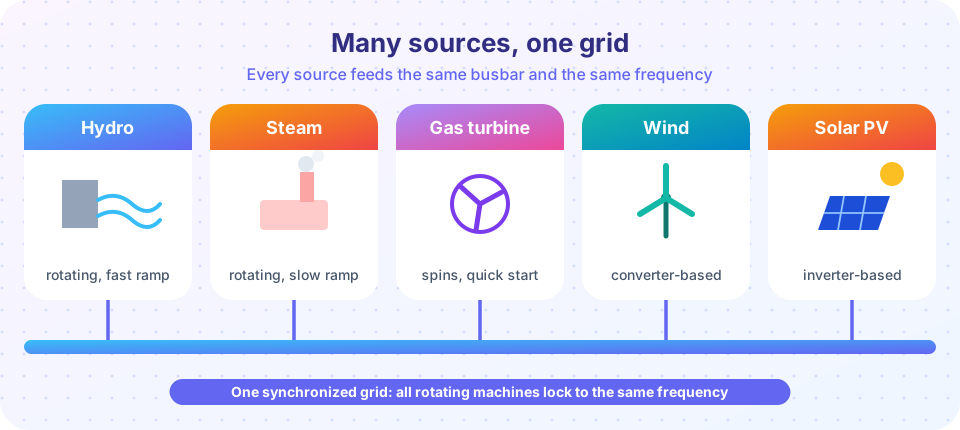
Electricity demand changes all day. It is low at night, rises as people wake, and peaks in the morning or the evening depending on the climate and the culture. Power plants must follow it. No single plant type does this well on its own, so every grid uses a portfolio.
Rotating machines (hydro, steam turbines, gas turbines) drive synchronous generators. Their spinning mass stores kinetic energy, called inertia, which makes the frequency change slowly when supply and demand are momentarily out of balance. Chapter 6 shows how important that is.
Converter-based sources (wind turbines with converters, solar photovoltaic panels, batteries) connect through electronic inverters. They have no natural inertia, and their output depends on weather. Chapter 7 covers them.
Different technologies fit different jobs:
- Baseload plants such as nuclear and large coal or hydro stations are costly to build but cheap to run, and are happiest at steady high output.
- Intermediate plants such as combined-cycle gas stations follow the daily rise and fall.
- Peaking plants such as simple gas turbines and hydro with storage start in minutes and run only a few hours a year.
- Variable renewables supply cheap energy when the wind blows or the sun shines.
Five lessons, one story
Start with the source.
Demand and supply
Match supply to demand.
Moving the power
Then test yourself.
The lessons in this chapter
- Synchronous Generators explains how a spinning magnet produces three-phase voltage, how speed sets frequency and how the field current controls voltage and reactive power.
- Load Curves and Power Plants covers daily load curves, duration curves, load factor, capacity factor and plant mix.
- Transformers develops the ideal transformer and the equivalent circuit, with efficiency and voltage regulation.
- Chapter 2 Review pulls everything into a poster, a table and a ten-question quiz.
Common misconceptions
- "Renewables are unreliable, so conventional plants are reliable." Every plant has outages. Reliability comes from the mix, reserves and the network, not from one technology.
- "A bigger generator is always better." Large units are efficient but a large unit tripping offline is a big shock. Operators keep reserve for the biggest single unit.
- "Generators make power from nothing." They convert mechanical power from a turbine to electrical power. The energy comes from fuel, water, wind or sunlight.
Try it
An alternator's speed, frequency and pole count are linked by one formula. This table lists the synchronous speeds for common pole counts at 50 and 60 Hz. The formula is Ns = 120 f / p revolutions per minute.
Press Run (or Ctrl + Enter) to see the result here.
Program input · what you'd type while the program runs
Type the answers before you press Run, one per line. Each time the program reads a line (with input()), it gets the next line from this box.
The second example is a flash-card tool. Choose a source and see its typical role and grid behavior. These are general characteristics, not data for a specific plant.
Check your understanding
Quick check · 4 questions
of 4 answered You scored / 4 · perfect!
-
1. What is inertia in a power system?
Rotating machines store kinetic energy that resists sudden changes in frequency. -
2. Which plant type is best suited to run only a few hours a year during demand peaks?
Peaking plants start quickly and have low capital cost, which suits rare, short use. -
3. Which is NOT a reason for a mix of plant types?
No single technology is cheapest and fastest and clean at once, which is why grids use a portfolio. -
4. A 4-pole machine produces 50 Hz. What is its speed?
Ns = 120 × 50 / 4 = 1500 rpm.
Summary
- Demand varies; a portfolio of base, intermediate and peaking plants follows it.
- Rotating machines supply inertia; converter-based sources do not.
- Synchronous speed is
Ns = 120 f / p. - Chapter 2 covers generators, load curves and plants, and transformers.
Next: Synchronous Generators
Track your progress
Create a free account to tick off lessons and pick up where you left off on any device.
of Electric Power Systems lessons completed