


















Lesson 1 of 47 · Getting Started
Course Map: Welcome to Electric Power Systems
Meet the electric power system: who this course is for, what you need first, how to study it, and a map of all nine chapters from generators to smart grids.
Flip a switch and a lamp lights. Behind that tiny action sits the largest machine humans have built: a network of generators, transformers, lines and loads that spans whole continents, runs at one frequency, and must balance supply and demand every second of every day. Electric power systems engineering is the study of how that machine is designed, analyzed, protected and operated.
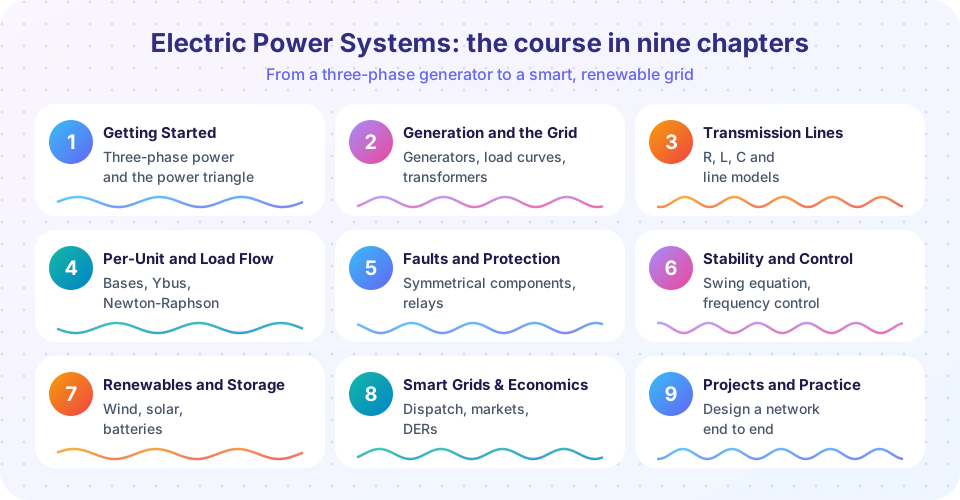
This course takes you from the basics of three-phase power to the questions engineers face today: how to connect wind and solar farms, how to keep the lights on when a line trips, and how to price electricity fairly. Every chapter starts with an overview, teaches through worked examples with numbers, and ends with a review page. You will meet equations, but each one is introduced with a picture and a runnable example first.
What you will learn
- What an electric power system is and why it is built the way it is.
- How the nine chapters fit together and in which order to study them.
- What background you need and how to study the course effectively.
- How to read the simulations and calculators in the lessons.
Key terms
- Power system: all the equipment that generates, transmits, distributes and uses electrical energy.
- Grid: the interconnected network of lines and substations that links generators and loads.
- Load: anything that consumes electric power, from a lamp to a steel mill.
- Frequency: how many times per second the alternating voltage repeats, 50 Hz or 60 Hz.
- Reliability: the ability to keep supplying customers despite faults and failures.
Who this course is for
The course suits three groups. Students in electrical engineering will find the ideas that lectures rush through, worked out slowly with numbers. Engineers moving from electronics, software or mechanical fields into energy get a structured tour of the vocabulary and methods. Curious readers who want to understand the blackout in the news, or the solar panels on the neighbor's roof, get the real physics rather than slogans.
What you should know first
You do not need advanced mathematics. These are enough:
- Ohm's law and power:
V = I × RandP = V × I. - Capacitors and inductors: a capacitor resists changes in voltage, an inductor resists changes in current.
- Sine waves: amplitude, frequency, and the difference between peak and rms values.
- Complex numbers: adding, multiplying and dividing numbers of the form
a + jb. If this is rusty, the first Python example below and the lessons in chapter 1 refresh it.
Power engineers use j for the imaginary unit (not i), because i stands for current. You will see j throughout.
The nine chapters
- Getting Started (this chapter): the grid at a glance, three-phase power, and the power triangle.
- Generation and the Grid: synchronous generators, load curves, power plants and transformers.
- Transmission Lines: line parameters R, L and C, short, medium and long line models.
- Per-Unit Analysis and Load Flow: the per-unit system, the admittance matrix and Newton-Raphson load flow.
- Faults and Protection: short circuits, symmetrical components, relays and breakers.
- Stability and Control: the swing equation, frequency control and voltage control.
- Renewables and Storage: wind, solar, batteries and inverter-based resources.
- Smart Grids and Economics: dispatch, electricity markets, demand response and distributed energy.
- Projects and Practice: design exercises that tie the whole course together.
Foundations
Learn the parts and the language.
Network models
Turn the network into equations.
Keeping it safe
What happens when things go wrong.
The modern grid
New sources, new rules.
Put it to work
Design a network end to end.
How to study this course
Read each lesson once for the story, then work the examples with a pencil. The Try it blocks are not decoration: change a number, run it again and predict the result before you look. Power systems is a subject where the hand calculation and the simulation agree, and seeing them agree builds trust.
Spend about one evening per lesson and two evenings for each review page. A chapter then takes about a week, and the full course takes a little over two months. If you already know a chapter, take its review quiz first and skip ahead if you score well.
How to read the simulations
Python blocks run real code in your browser with numpy and matplotlib. They are simplified models: they apply the same equations you see in the text, with idealized inputs. They teach how the physics behaves; they are not design tools for a real utility. Where a block is a calculator or a stand-in for a bigger program, the lesson says so.
Common misconceptions
- "Electricity flows out of the socket like water." The electrons in a wire barely drift; what travels is energy carried by the electric and magnetic fields around the conductors.
- "The grid stores power like a tank." Almost none is stored. Generation must match demand second by second, which is why this course spends so much time on control.
- "Higher voltage is more dangerous for the grid." Higher voltage is how the grid wastes less energy: the same power at ten times the voltage needs one tenth of the current, and losses fall with the square of current.
Try it
First, a warm-up in complex numbers. Power engineers describe a sine wave by one complex number (a phasor) holding its size and its angle. This example builds a 230 V phasor, a resistor and an inductor, and finds the current. It is a plain calculation, not a grid simulation.
Press Run (or Ctrl + Enter) to see the result here.
Program input · what you'd type while the program runs
Type the answers before you press Run, one per line. Each time the program reads a line (with input()), it gets the next line from this box.
Next, a log-scale chart of voltage levels along the path from generator to customer. It uses typical example values, not data from any one country.
Press Run (or Ctrl + Enter) to see the result here.
Program input · what you'd type while the program runs
Type the answers before you press Run, one per line. Each time the program reads a line (with input()), it gets the next line from this box.
Check your understanding
Quick check · 4 questions
of 4 answered You scored / 4 · perfect!
-
1. Why do power engineers write the imaginary unit as j?
The symbol i is reserved for current, so electrical engineers use j for the square root of minus one. -
2. Which statement about the grid is most accurate?
Electricity is hard to store at scale, so supply and demand must balance second by second. That is the central control problem. -
3. Why is long-distance transmission done at high voltage?
For a given power, raising the voltage lowers the current, and the I²R loss falls with the square of the current. -
4. In which chapter do you learn what happens when a short circuit occurs?
Chapter 5, Faults and Protection, covers short circuits, symmetrical components and protective relays.
Summary
- A power system generates, transmits, distributes and consumes electrical energy as one synchronized machine.
- The course has nine chapters: models first (1 to 4), then protection and stability (5 and 6), then modern topics (7 to 9).
- You need Ohm's law, sine waves and basic complex numbers; everything else is taught.
- Engineers use
jfor the imaginary unit and phasors for sine waves. - Run and modify every example; hand calculation and simulation should agree.
Next: The Grid at a Glance
Track your progress
Create a free account to tick off lessons and pick up where you left off on any device.
of Electric Power Systems lessons completed