


















Lesson 47 of 47 · Projects and Practice
Further study: where to go after power systems
Plan your next steps in power engineering: neighboring tracks on this site, classic textbooks and standards, open-source tools, open research problems and a simple self-assessment.
You now have a working picture of an electric power system: how energy is generated, carried, analyzed, protected, stabilized and traded, and how wind, solar, storage and digital technology are changing all of it. The field is large enough that nobody masters it all; engineers specialize. This lesson helps you choose a direction, points to the neighboring tracks on this site, and lists the kinds of resources that take you from course level to professional level.
What you will learn
- Choose a next topic according to what interested you most.
- Find the neighboring tracks that deepen specific parts of this course.
- Know which standards, textbooks and open-source tools professionals use.
- Identify the gaps to fill with a short self-assessment.
Key terms
Standard: a published technical specification (IEEE, IEC, national codes) that defines how equipment and systems must behave.
Open-source tool: freely available software for power system analysis, such as pandapower or PyPSA.
Research frontier: a problem for which no settled solution exists yet.
Specialization: a deep focus on one area, such as protection, markets or converters.
Where to go from here
If the hardware interested you
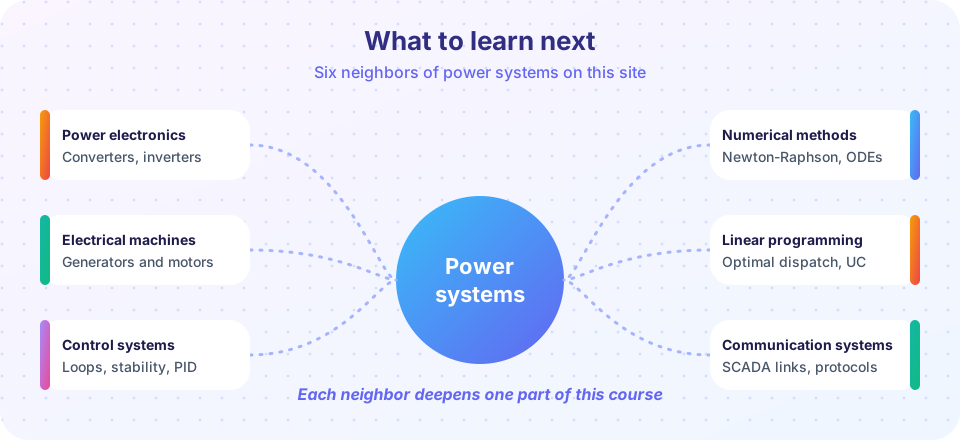
Generators, transformers and motors are the heart of the machine side of the grid. The electrical machines track covers induction and synchronous machines and transformers in depth, which complements the generator and inertia material of chapters 5 and 6. The power electronics track explains the converters behind every solar inverter, battery system and HVDC link of chapter 7, including PWM and control.
If the control and stability interested you
The swing equation, droop and AGC are examples of feedback control. The control systems track develops transfer functions, stability margins and compensators, the language of power system stabilizers, governors and inverter control loops. If circuits themselves attracted you, circuit analysis is the foundation under phasors, three-phase analysis and per-unit systems.
If the calculations and optimization interested you
Load flow, fault studies and unit commitment are large numerical problems. Numerical methods covers Newton-Raphson iteration, linear solvers and ODE integration, which are used inside every power system program. Linear programming is the toolbox for economic dispatch, unit commitment and market clearing. For the data and communication side of smart grids, see communication systems.
If you want the big picture
Return to the power systems track from the start and read the chapters on load flow and transmission lines again with what you now know about faults and stability: the pieces fit together differently the second time. Then pick one subject, such as protection, renewable integration or electricity markets, and study it in depth for a month.
Professional resources
- Standards: IEEE 1547 and IEEE 2800 (interconnection of distributed and large inverter-based resources), IEEE 1366 (reliability indices), IEC 60909 (short-circuit currents), IEC 61850 (substation communication), IEC 60255 (relays), and the grid codes of your country.
- Classic textbooks: Kundur's Power System Stability and Control for dynamics; Glover, Overbye and Sarma, Power System Analysis and Design, and Grainger and Stevenson for analysis; Wood, Wollenberg and Sheblé for generation, operation and control; Anderson for faulted systems and symmetrical components; Blackburn and Domin for protective relaying.
- Open-source tools: pandapower and MATPOWER for load flow and short circuits, PyPSA for capacity expansion and dispatch, OpenDSS for distribution studies, and general tools such as Python, NumPy, SciPy and optimization solvers. Each has tutorials and example networks that let you rerun the lessons of this course on larger systems.
- Open data: transmission operators and statistical agencies publish load, generation and price data, which is the best way to see the duck curve, frequency events and price spikes of real systems.
Open problems
Power engineering is not a finished subject. Active questions include: how to keep a grid stable when most generation is inverter-based and nobody agrees on how grid-forming converters should behave; how to protect networks whose sources deliver little fault current; how to store energy for weeks and seasons, not only hours; how to design markets that reward flexibility and reliability together; how to secure millions of connected devices against attack; and how to plan networks that serve electric vehicles, heat pumps and industrial electrification at once. These are real, funded and hiring areas for students who understand the basics you have just learned.
Common misconceptions
"Power systems is a mature field with nothing new to learn." The shift to inverter-based, digital and market-driven grids makes it one of the most active areas of engineering.
"You must study everything before specializing." Start from what interests you and follow its prerequisites; the neighboring tracks are designed for that.
"Software does the analysis, so theory is unnecessary." Software only answers the questions you ask; understanding tells you which questions to ask and whether to trust the answer.
Try it
The first example is a path picker: choose what interested you most and see which track to study next.
The second example is a self-assessment. Enter your confidence (0 to 5) for each chapter; the code lists the weakest chapters and what to review.
Press Run (or Ctrl + Enter) to see the result here.
Program input · what you'd type while the program runs
Type the answers before you press Run, one per line. Each time the program reads a line (with input()), it gets the next line from this box.
Check your understanding
Quick check · 4 questions
of 4 answered You scored / 4 · perfect!
-
1. Which neighboring track deepens the converters behind solar inverters and batteries?
Power electronics covers rectifiers, DC-DC converters, inverters and their control. -
2. Which standard defines short-circuit current calculation?
IEC 60909 covers short-circuit currents in three-phase AC systems; IEEE 1366 covers reliability indices and IEC 61850 substation communication. -
3. Which tool is best suited to optimal dispatch and capacity expansion studies in the open-source ecosystem?
PyPSA is an open-source framework for optimizing power system operation and investment. -
4. Which is an open research problem listed in the lesson?
Stability and protection of inverter-dominated grids are active research and standardization topics.
Summary
- Choose a direction from your interests: machines, converters, control, optimization, numerical methods or communications; each has a neighboring track.
- Professionals rely on standards (IEEE, IEC), classic textbooks, open-source tools and open data.
- Open problems include inverter-dominated stability, protection with low fault current, long-duration storage, market design and cybersecurity.
- Use a self-assessment to find the chapters to revisit before moving on.
You have reached the end of this course. Go back to the Power Systems track page whenever you want to review a chapter, and keep calculating: every number you check makes the next one easier.
Track your progress
Create a free account to tick off lessons and pick up where you left off on any device.
of Electric Power Systems lessons completed