


















Lesson 33 of 47 · Renewables and Storage
Inverter-based resources and grid codes
Understand how solar, wind and batteries connect through inverters: PLL control, grid-forming control, fault ride-through, limited fault current, weak grids and falling inertia.
A synchronous generator is wired to the grid by physics: its rotor is locked to the system frequency by magnetic forces, and it gives the grid inertia, voltage and fault current for free. A solar farm, a wind turbine with a full converter or a battery has none of that. Between its energy source and the grid sits an inverter, and the inverter behaves exactly as its software tells it to. Whether the result strengthens or weakens the grid depends entirely on how it is controlled.
This lesson explains the two main control philosophies, what grid codes require from inverter-based resources, and why the arrival of many inverters changes system strength, fault current and inertia.
What you will learn
- Distinguish grid-following from grid-forming control.
- Explain what a PLL does and why weak grids are a problem for it.
- Describe fault ride-through, reactive current support and frequency response requirements.
- Quantify the effect of inverters on fault current, system strength and inertia.
Key terms
Inverter-based resource (IBR): a generator or storage unit connected to the grid through a power-electronic converter.
PLL (phase-locked loop): a control loop that measures the angle of the grid voltage so the inverter can inject current in phase with it.
Short-circuit ratio (SCR): the short-circuit capacity at the connection point divided by the rated power of the plant, SCR = Ssc / Prated.
Fault ride-through (FRT): the requirement to stay connected, and keep supporting the grid, during voltage disturbances.
Grid code: the technical rules a generator must satisfy to connect to a network.
Grid-following inverters
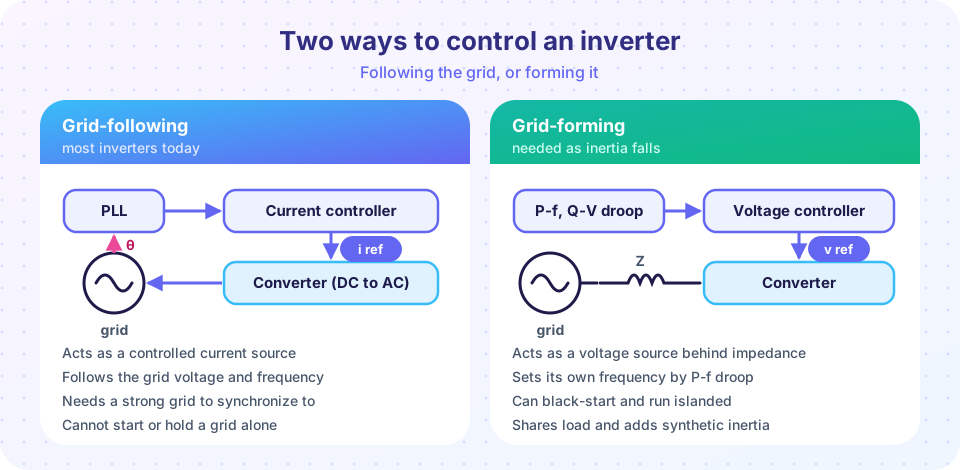
Nearly all of today's solar and wind inverters are grid-following. Inside, a fast current controller makes the converter output follow a current reference: the active-current reference comes from the maximum power point tracker or from the dispatch, the reactive-current reference from voltage or power-factor control. To place that current in the right phase relative to the grid voltage, the inverter needs the grid angle, which a phase-locked loop extracts from the measured voltage: it compares its own estimate of the angle with the measured one and adjusts until the error is zero.
Electrically, a grid-following inverter is a controlled current source. This works superbly when the grid is stiff, meaning the voltage is held up by large synchronous machines nearby. In a weak grid the story changes. The voltage at the connection point now moves when the inverter injects current, and the PLL, which relies on a clean voltage, can interact with the control loops and the network in ways that cause oscillation or even loss of synchronism. In the worst case the inverter cannot start a grid on its own, because there is no voltage for the PLL to follow.
Grid-forming inverters
A grid-forming inverter behaves as a voltage source behind an impedance: it holds a voltage magnitude and an angle on its own and lets the current be whatever the network demands. It does not need a PLL. To share power with other sources it uses droop laws that mimic a synchronous machine: the frequency is lowered when active power increases (f = f0 − mp·(P − P0)) and the voltage is lowered when reactive power increases. Because it sets its own frequency it can supply an island, black-start a network and respond instantly to changes. A virtual synchronous machine adds an emulated inertia and damping so that the converter acts, from the grid's point of view, like a rotating machine.
Grid-forming converters are limited by the power-electronic hardware: the semiconductor current rating restricts how much extra current they can deliver during a fault (see below), and a battery or an energy source is needed behind them to supply any inertia-like power.
Grid codes and ride-through
IBRs were once allowed to disconnect for any voltage dip. When they became a large share of generation, that behavior turned a single fault into the loss of thousands of megawatts. Modern grid codes (ENTSO-E's Requirements for Generators in Europe, IEEE 1547 for distributed resources and IEEE 2800 for large inverter-based plants in North America, and national codes) therefore require:
- Fault ride-through: stay connected through voltage dips for a specified time. A typical low-voltage ride-through envelope tolerates a voltage near zero for a short time (of the order of 150 ms) and a slower recovery, but the exact curve differs from country to country.
- Reactive current injection during the fault, often as a proportion of the voltage drop, to support the voltage and help protection recognize the fault.
- Active power recovery within a defined time after fault clearing.
- Frequency response: reduce output when frequency is high (frequency-watt), remain connected over a wide frequency range, and (for newer codes) provide fast frequency response or synthetic inertia.
- Voltage and reactive power control: volt-var curves or fixed power factor, within a capability range such as 0.95 leading to 0.95 lagging.
- Ramp-rate limits and power quality limits on harmonics and flicker.
Effects on the system
Fault current and protection
A synchronous machine feeds a short circuit with five to ten times its rated current. A converter is built from semiconductors that cannot tolerate such overloads, so its fault current is limited to about 1.1 to 1.5 times rated, and usually with an adjustable phase. The consequences are important: overcurrent relays, which rely on large fault currents to pick up, can fail to detect faults in an area dominated by inverters; distance and differential schemes behave differently when the sources are limited in current and in negative-sequence capability. Protection engineers are therefore revising settings and adding communication-based schemes.
System strength
The short-circuit ratio is a simple measure of grid stiffness at the point of connection. A 200 MW wind plant at a bus with a short-circuit capacity of 800 MVA has SCR = 4. As a rule of thumb, grid-following plants work well at SCR > 3, are weak between 2 and 3 and are very weak below 2. Retiring synchronous plants lowers Ssc and the SCR of every nearby inverter. The remedies are synchronous condensers, grid-forming inverters or reinforcing the network.
The voltage sensitivity also grows. For an X-dominated network, a reactive power swing ΔQ at the connection point changes the voltage by about ΔV ≈ ΔQ/Ssc (per unit): with Ssc = 800 MVA, a 40 MVAr swing moves the voltage by 5 %.
Inertia
Rotating inertia stores energy at no cost, and the converter decouples the energy source from the grid, so inverters add none by default. The system inertia, expressed in seconds on the total system base, falls roughly in proportion to the synchronous share. The initial rate of change of frequency for an imbalance ΔP grows as RoCoF = ΔP·f0/(2H). A system with 80 % inverter-based generation and synchronous plant with H = 5 s has an equivalent H near 1 s, five times the RoCoF of the same system when all machines are synchronous. Remedies: synchronous condensers, grid-forming inverters with an energy reserve and fast frequency response from batteries and wind turbines, which release stored energy within a fraction of a second after a frequency drop.
Common misconceptions
"Inverters make the grid weaker, full stop." Grid-following inverters need a strong grid; grid-forming inverters can provide voltage and frequency support. The control, not the hardware, decides.
"Synthetic inertia is the same as real inertia." It responds after measurement and control delays and needs available energy and headroom. It is fast, but not instantaneous and not free.
"Fault current doesn't matter; less is safer." Protection must detect the fault: relays need a measurable fault current to operate selectively.
Try it
The first example simulates a simple phase-locked loop. The grid voltage angle jumps by 40° at 0.1 s and the PLL, a PI controller on the phase error, re-locks. The gains give a bandwidth of 15 Hz and a damping ratio of 0.707. This is a simplified single-phase model, not a full converter.
Press Run (or Ctrl + Enter) to see the result here.
Program input · what you'd type while the program runs
Type the answers before you press Run, one per line. Each time the program reads a line (with input()), it gets the next line from this box.
The second example is a weak-grid checker. Enter the grid's short-circuit capacity, the plant rating and a reactive power swing; it gives the SCR, a classification and the voltage change.
The third example shows how inertia falls as the inverter share rises and how fast frequency response limits the damage. A 5 % loss of generation is applied to a system whose synchronous plant has H = 5 s.
Press Run (or Ctrl + Enter) to see the result here.
Program input · what you'd type while the program runs
Type the answers before you press Run, one per line. Each time the program reads a line (with input()), it gets the next line from this box.
Check your understanding
Quick check · 5 questions
of 5 answered You scored / 5 · perfect!
-
1. What does a grid-following inverter need in order to operate?
It injects current relative to the grid voltage angle, so it must track that angle. -
2. A 150 MW solar plant connects at a bus with Ssc = 300 MVA. What is the SCR?
SCR = 300 / 150 = 2, which is a weak grid. -
3. Why can overcurrent relays struggle in networks dominated by inverters?
The small fault current may be too close to load current to pick up reliably. -
4. Fault ride-through requires an inverter to
Staying connected avoids turning one fault into a large loss of generation. -
5. Which device is a grid-forming resource?
Grid-forming inverters act as voltage sources and can sustain a network.
Summary
- Inverters are controlled by software: grid-following units are current sources locked to the grid by a PLL; grid-forming units are voltage sources behind an impedance with droop.
- Grid codes require fault ride-through, reactive current support, frequency response and voltage control.
- Inverters limit fault current to about 1.1 to 1.5 times rated, which challenges protection.
SCR = Ssc/Pratedmeasures grid strength; below about 3 grid-following plants become difficult.- Inertia falls with synchronous share, raising RoCoF; fast frequency response, synchronous condensers and grid-forming control compensate.
Next: Energy storage
Track your progress
Create a free account to tick off lessons and pick up where you left off on any device.
of Electric Power Systems lessons completed