


















Lesson 40 of 47 · Smart Grids and Economics
Chapter 8 review: smart grids and economics
Review economic dispatch, electricity markets, demand response, smart grid technology and microgrids with a cheat sheet, a revenue-versus-cost exercise and a ten-question quiz.
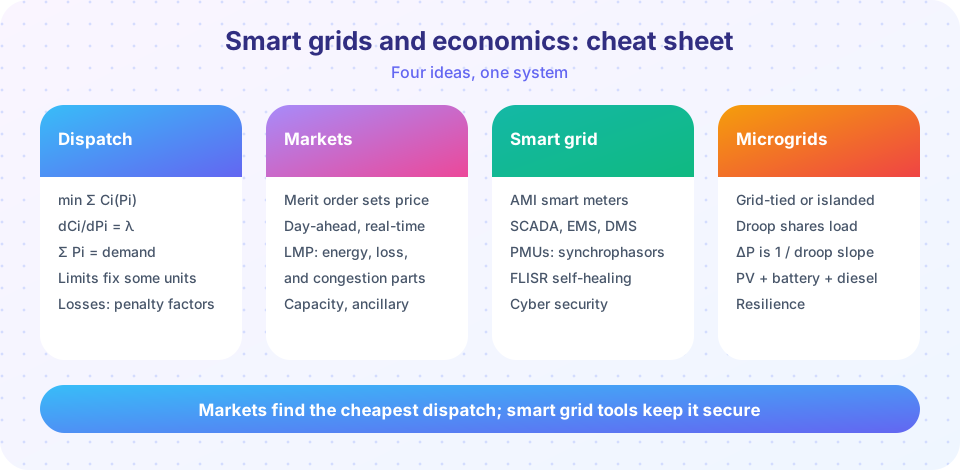
The chapter linked three views of the same problem. Economics says how to run the system at least cost (equal incremental cost). Markets turn that rule into prices that everyone can respond to (merit order, LMP, demand response). Technology supplies the data and control that make the response possible and keep it secure (AMI, SCADA, PMUs, automation, microgrids). Use the cheat sheet and the table to test whether you can move easily among the three.
What you will learn
- Recall the key formulas and ideas of dispatch, markets, smart grid technology and microgrids.
- See why marginal-cost pricing does not always cover a unit's total cost.
- Spot the parts of the chapter to revisit.
Recap table
| Topic | Key formula or idea | Remember |
|---|---|---|
| Cost curve | C = a + bP + cP²; IC = b + 2cP |
Convex: IC rises with output |
| Economic dispatch | dCi/dPi = λ for all units not at limits; ΣPi = D |
λ is the marginal cost of the system |
| Lambda iteration | Guess λ, clip outputs to limits, adjust by bisection | Robust with limits |
| Losses | PFi = 1/(1 − ∂PL/∂Pi); PFi·ICi = λ |
Units that add losses run less |
| Merit order | Offers sorted by cost; the last unit needed sets the price | Inframarginal rent covers fixed costs |
| LMP | Energy + loss + congestion | Congestion rent = price difference × flow |
| Demand response | Removes costly peak units | Small cuts at the peak lower prices for all |
| LCOE | (Capex × CRF + fixed O&M)/(8,760 × CF) + variable cost |
Ignores timing and integration |
| Reliability | SAIFI = ΣNi/NT; SAIDI = Σ(ri·Ni)/NT; CAIDI = SAIDI/SAIFI | Automation mostly cuts SAIDI |
| Microgrid droop | f = f0 − mp·P; shares proportional to rating |
Secondary control removes the offset |
Common misconceptions
"Marginal-cost pricing always pays every generator." Not necessarily: an expensive unit at the margin earns only its marginal cost and may not recover its fixed cost. Markets add capacity payments, scarcity pricing or start-up and no-load compensation.
"The cheapest technology by LCOE is the best for the system." Timing and firmness matter; value-adjusted costs differ from LCOE.
"Smart grid means less need for engineers." It means more: data, protection, security and market design all need power-system expertise.
Try it
The first example prices the three-unit dispatch at the uniform market price λ and compares each unit's revenue with its cost. The marginal unit at the top of the stack earns less than its total cost: this is the "missing money" problem that capacity payments and start-up compensation address. The figures come from the dispatch lesson.
Press Run (or Ctrl + Enter) to see the result here.
Program input · what you'd type while the program runs
Type the answers before you press Run, one per line. Each time the program reads a line (with input()), it gets the next line from this box.
The second example is a recall drill on the chapter's vocabulary.
Check your understanding
Quick check · 10 questions
of 10 answered You scored / 10 · perfect!
-
1. Units have IC1 = 12 and IC2 = 15 $/MWh at the current dispatch and neither is at a limit. What does economics suggest?
The unit with the lower incremental cost should produce more until the two ICs are equal. -
2. A unit has C = 200 + 5P + 0.02P^2. At P = 50 MW the incremental cost is
IC = 5 + 2 x 0.02 x 50 = 5 + 2 = 7 dollars per MWh. -
3. What are the three components of an LMP?
LMP = energy + loss + congestion components. -
4. A feeder serves 20,000 customers. One event interrupts 4,000 customers for 90 minutes. The SAIDI contribution is
SAIDI = 4,000 x 90 / 20,000 = 18 minutes. -
5. Which technology gives synchronized voltage and current angles tens of times per second?
Phasor measurement units use GPS time to synchronize their readings. -
6. In an islanded microgrid with equal per-unit droop, a source rated twice as large as another carries
Shares are proportional to rating. -
7. Why can a small demand response lower the price so strongly at the peak?
The marginal cost rises quickly at the peak, so small reductions in demand shift the clearing price a lot. -
8. A plant has CRF = 0.1, capital cost 1,500 $/kW, fixed O&M 30 $/kW-year and a capacity factor of 50 %. With no fuel cost its LCOE is about
(1,500 x 0.1 + 30) / (8.76 x 0.5) = 180 / 4.38 = 41 dollars per MWh. -
9. What does congestion rent measure?
It is the extra money collected because the line limit separates the prices. -
10. Secondary control in a microgrid
It adjusts the droop set-points to remove the steady-state offset.
Summary
- Least cost needs equal incremental cost; markets turn that into a uniform clearing price; LMPs show where the network binds.
- Demand response and storage flatten the load and lower prices for everyone.
- Smart meters, SCADA, PMUs and automation provide visibility and faster restoration, measured by SAIFI, SAIDI and CAIDI.
- Microgrids island at the PCC and share load by droop; secondary and tertiary control restore and optimize.
- The final chapter puts these tools to work in projects and practice problems.
Track your progress
Create a free account to tick off lessons and pick up where you left off on any device.
of Electric Power Systems lessons completed