


















Lesson 34 of 47 · Renewables and Storage
Energy storage
Compare grid storage technologies by power, energy and efficiency, learn the services storage provides, and size a battery with a linear-programming arbitrage model.
Electricity has always been the product that must be consumed the instant it is produced. Storage breaks that link. A battery or a reservoir lets you buy energy when it is abundant and cheap, such as a sunny noon or a windy night, and release it when it is scarce and expensive. It can also act in milliseconds to hold frequency or voltage. As wind and solar take a growing share of the energy mix, storage becomes the tool that turns their variability into a reliable supply.
This lesson explains what to measure in a storage system, how the technologies compare, which services they sell, and how to size one with a simple optimization.
What you will learn
- Distinguish power (MW) from energy (MWh) and compute discharge duration.
- Compare storage technologies by efficiency, duration, lifetime and cost structure.
- List the main services storage provides to a power system.
- Size a battery and estimate arbitrage revenue.
Key terms
Energy capacity (MWh): the amount of energy that can be stored.
Power rating (MW): how fast energy can be charged or discharged.
Duration: energy divided by power, in hours, the time the system can discharge at full power.
Round-trip efficiency (RTE): energy out divided by energy in over a full cycle.
State of charge (SoC): the stored energy as a fraction of capacity.
Power, energy and duration
Storage has two independent dimensions that are often confused. Power (MW) is the size of the "pipe": how quickly you can fill or empty. Energy (MWh) is the size of the "tank". A 100 MW / 400 MWh battery has a duration of 400/100 = 4 hours. Because the cost of a battery has a power part (inverters, transformers) and an energy part (cells), a service that needs a lot of power for a short time (frequency regulation) is best served by a short-duration system, while shifting solar into the evening needs hours.
Real systems also lose energy. If you charge 100 MWh and recover 88 MWh at the grid connection, the round-trip efficiency is 88 %. Losses split roughly evenly between charging and discharging, so each direction has an efficiency of √0.88 = 0.938. Operating limits matter as well: batteries are cycled between, say, 10 % and 90 % SoC to prolong life, so the usable energy is less than the nameplate, and cells degrade with each cycle and with age, losing a fraction of their capacity.
Technologies
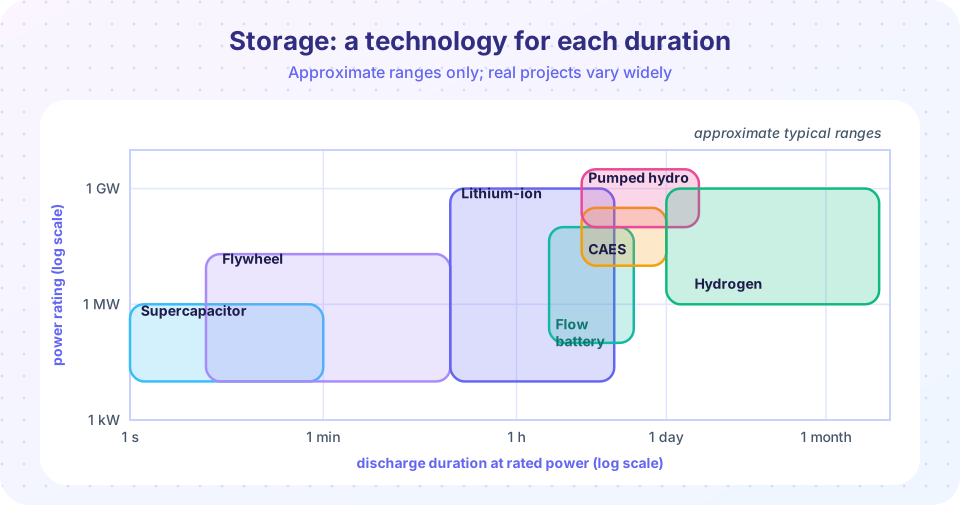
| Technology | Typical duration | Round-trip efficiency | Notes |
|---|---|---|---|
| Pumped hydro | 6 to 24 h | about 70 to 80 % | By far the largest installed storage; 50+ year life; needs geography |
| Lithium-ion battery | 0.5 to 8 h | about 85 to 90 % (AC-AC) | Fast, modular, falling costs; degrades with cycles and heat; thermal safety design |
| Flow battery (vanadium) | 4 to 12 h | about 65 to 80 % | Power and energy scale independently; long life; lower energy density |
| Compressed air (CAES) | 4 to 24 h | about 50 to 70 % | Needs caverns; adiabatic designs recover the heat |
| Hydrogen (electrolysis, storage, fuel cell or turbine) | days to months | about 30 to 40 % | Low efficiency, but the only candidate for seasonal storage |
| Flywheel | seconds to 15 min | about 85 to 95 % | Very fast, high cycle life; for regulation |
| Supercapacitor | seconds | above 90 % | Very high power, tiny energy |
| Thermal (molten salt, hot water) | hours to days | depends on use | Common with concentrated solar and district heating |
These figures are ranges, not specifications; they vary by design and by how the efficiency is measured.
What storage does for the grid
A single battery can sell several services, a practice known as value stacking:
- Energy arbitrage: charge at low prices, discharge at high ones.
- Frequency regulation and fast frequency response: absorb or inject power within a fraction of a second, which a battery can do far faster than a thermal plant.
- Reserves and capacity: be available for peak demand or for contingencies.
- Renewable firming and time-shifting: smooth wind and solar output or move midday solar to the evening.
- Transmission and distribution deferral: relieve a congested line or transformer instead of building a new one.
- Voltage support and black start: with grid-forming inverters, restart a dead network.
- Behind the meter: reduce a customer's peak demand charges or provide backup power.
Sizing example
Suppose a utility wants to shift solar to cover 3 hours of an evening peak at 100 MW. Energy needed is 100 MW × 3 h = 300 MWh at the output. With a usable depth of discharge of 90 % and a degradation reserve, the nameplate must be about 300 / 0.9 = 333 MWh or, allowing for end-of-life capacity at 80 % of new, about 417 MWh. Delivering 300 MWh at the grid connection takes about 300/0.88 ≈ 341 MWh of midday surplus.
Arbitrage economics
In net terms, buying one MWh at price pl and selling the η MWh that the battery returns at price ph earns η·ph − pl. With pl = 30 $/MWh, ph = 90 $/MWh and η = 0.88: 0.88 × 90 − 30 = 49.2 $ per MWh charged. The price spread must exceed pl·(1/η − 1) before the battery earns anything, which is about 4 $/MWh at these prices. The revenue depends heavily on how many cycles per year and on the price volatility, which is why arbitrage alone rarely pays for a battery and why stacking matters.
An optimizer finds the best schedule: it maximizes Σ price_t·(discharge_t − charge_t) subject to power limits, capacity limits and the SoC balance. That is a linear program, and the examples below solve it with SciPy.
Common misconceptions
"Storage generates electricity." It only shifts energy in time and loses part of it. It is a consumer on charge and a producer on discharge.
"A 100 MW battery can supply 100 MW for as long as needed." Only for its duration. A 100 MW / 100 MWh battery empties in one hour.
"Round-trip efficiency is the only cost." Degradation, the cost per cycle and availability usually matter more for the economics.
Try it
The first example finds the optimal daily arbitrage schedule with a linear program. The price shape is built from the duck-curve net load (illustrative, not market data): cheap at midday, expensive in the evening. It compares a 2 hour and a 4 hour battery of the same power.
Press Run (or Ctrl + Enter) to see the result here.
Program input · what you'd type while the program runs
Type the answers before you press Run, one per line. Each time the program reads a line (with input()), it gets the next line from this box.
The second example sizes a battery for peak shaving. A heuristic charges from midday surplus and discharges to cap the evening net load; a bisection search finds the lowest peak that a battery of a given power and capacity can achieve. Everything is in per unit of peak demand.
Press Run (or Ctrl + Enter) to see the result here.
Program input · what you'd type while the program runs
Type the answers before you press Run, one per line. Each time the program reads a line (with input()), it gets the next line from this box.
The third example is a quick sizing and revenue calculator for a battery with a given power, duration and efficiency.
Check your understanding
Quick check · 5 questions
of 5 answered You scored / 5 · perfect!
-
1. A battery is rated 50 MW / 200 MWh. What is its duration at full power?
Duration = energy / power = 200 / 50 = 4 hours. -
2. A battery with a round-trip efficiency of 90 % is charged with 100 MWh. How much energy can it return?
Energy out = 0.9 x 100 = 90 MWh. -
3. Which technology is the most common for seasonal storage, despite low efficiency?
Hydrogen can be stored for months, though round-trip efficiency is only about 30 to 40 %. -
4. Buying at 30 $/MWh and selling at 90 $/MWh with a round-trip efficiency of 0.88, the margin per MWh charged is
0.88 x 90 - 30 = 79.2 - 30 = 49.2 dollars. -
5. What does value stacking mean?
Combining arbitrage, regulation, capacity and other services improves the economics.
Summary
- Storage has independent power (MW) and energy (MWh) ratings; duration is energy divided by power.
- Round-trip efficiency, degradation, depth of discharge and cost structure decide the economics.
- Pumped hydro dominates today's capacity; lithium-ion leads new builds; flow, compressed air, thermal and hydrogen serve longer durations.
- Storage sells arbitrage, regulation, capacity, firming and deferral services; value stacking improves returns.
- Optimal operation is a linear program: maximize revenue within power, capacity and SoC limits.
Next: Chapter 7 review
Track your progress
Create a free account to tick off lessons and pick up where you left off on any device.
of Electric Power Systems lessons completed