


















Lesson 45 of 47 · Projects and Practice
Glossary of chapters 5 to 8
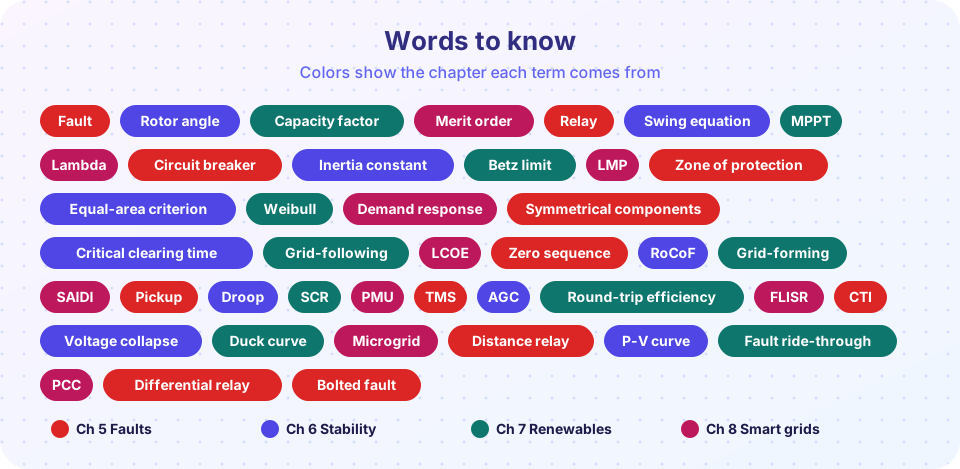
Forty-two key terms of faults and protection, stability and control, renewables and storage, and smart grids and economics, with short definitions and a searchable glossary.
Every field has its own vocabulary, and power systems has more than most: abbreviations, Greek letters, standards and terms borrowed from mechanics, economics and computing. This glossary collects the terms you met in chapters 5 to 8, grouped by chapter, with short definitions. Use the search box below to find a term quickly, and the flashcards to test your recall.
What you will learn
- Find and recall the definition of each key term of chapters 5 to 8.
- Connect each term to the chapter and formula where it appears.
- Test yourself with flashcards.
Key terms
Glossary entry: a term, a one-line definition and, where useful, the symbol or formula.
Symbol: the short notation used in equations, such as H for inertia constant or λ for marginal cost.
Acronym: an abbreviation formed from initial letters, such as SCR, LMP or PMU.
Per unit (pu): a quantity expressed as a fraction of a chosen base value.
Chapter 5: faults and protection
| Term | Meaning |
|---|---|
| Fault | An abnormal connection, such as a short circuit, that carries a large current |
| Relay | A device that measures system quantities and decides when to trip |
| Circuit breaker | A switch able to interrupt fault current on command |
| Zone of protection | The part of the system a given relay and its breakers are responsible for |
| Symmetrical components | The decomposition of unbalanced three-phase quantities into positive, negative and zero sequence sets |
| Zero sequence | Three equal phasors in phase with each other; neutral current is 3·I0 |
| Pickup | The current above which an overcurrent relay starts to operate |
| TMS | Time multiplier setting, which shifts an inverse-time curve up or down |
| CTI | Coordination time interval, the minimum time gap between a downstream and an upstream relay |
| Distance relay | A relay that measures V/I to find the impedance to a fault |
| Differential relay | A relay that compares the current entering and leaving a protected zone |
| Bolted fault | A fault with zero impedance, giving the maximum current |
Chapter 6: stability and control
| Term | Meaning |
|---|---|
| Rotor angle | The angle between a machine's internal emf and a synchronously rotating reference |
| Swing equation | (2H/ωs)·d²δ/dt² = Pm − Pe, the equation of motion of a rotor |
| Inertia constant H | Stored kinetic energy at rated speed divided by the rating, in seconds |
| Equal-area criterion | A transient stability test: the decelerating area must be able to equal the accelerating area |
| Critical clearing time | The longest fault duration for which the machine remains stable |
| RoCoF | Rate of change of frequency, ΔP·f0/(2H) right after an imbalance |
| Droop | The permanent frequency change that moves a governor from no load to full load, typically 4 to 5 % |
| AGC | Automatic generation control, which restores frequency and tie-line flows |
| Voltage collapse | A progressive and uncontrollable fall in voltage |
| P-V curve | Receiving-end voltage as a function of delivered power; its nose is the maximum power |
Chapter 7: renewables and storage
| Term | Meaning |
|---|---|
| Capacity factor | Actual energy divided by the energy at continuous rated power |
| MPPT | Maximum power point tracking, which keeps a PV array at its best operating point |
| Betz limit | The maximum fraction, 16/27, of wind power any rotor can capture |
| Weibull distribution | The usual statistical model of wind speed at a site |
| Grid-following | An inverter that follows the grid voltage angle (via a PLL) and injects current |
| Grid-forming | An inverter that creates its own voltage and frequency, acting as a voltage source |
| SCR | Short-circuit ratio, Ssc/Prated, a measure of grid strength |
| Round-trip efficiency | Energy out of a storage system divided by energy in over a full cycle |
| Duck curve | The shape of net load with high solar: a midday dip and a steep evening ramp |
| Fault ride-through | The requirement to stay connected and supportive during voltage disturbances |
Chapter 8: smart grids and economics
| Term | Meaning |
|---|---|
| Merit order | The ranking of generators by increasing marginal cost |
| Lambda (λ) | The system marginal cost, the common incremental cost at the dispatch optimum |
| LMP | Locational marginal price: energy, loss and congestion components at a bus |
| Demand response | Customers changing their consumption in response to prices or signals |
| LCOE | Levelized cost of energy, the lifetime cost of a plant per MWh |
| SAIDI | Average interruption minutes per customer per year |
| PMU | Phasor measurement unit, a GPS-synchronized phasor measurement |
| FLISR | Fault location, isolation and service restoration on a feeder |
| Microgrid | A group of sources and loads that can operate connected to or islanded from the main grid |
| PCC | Point of common coupling, where a microgrid or plant connects to the main grid |
Common misconceptions
"Terms with similar names mean the same thing." Inertia (stored energy), droop (a control law) and damping (loss of oscillation energy) are different things; so are capacity (MW) and energy (MWh), and SCR (a ratio) and short-circuit level (a quantity).
"Acronyms are universal." Names differ by region: AGC is also called load-frequency control, and reserves have different labels in Europe (FCR, aFRR) and in North America.
"Memorizing the glossary is enough." Each term is only useful with its formula and its example; return to the lesson where it appeared.
Try it
The first tool is a searchable glossary: type a word and the matching terms appear.
The second tool shows a term; guess the definition, then reveal it.
Check your understanding
Quick check · 4 questions
of 4 answered You scored / 4 · perfect!
-
1. Which term describes the maximum fraction of wind power a rotor can capture?
The Betz limit is 16/27, about 59 %. -
2. Inertia, droop and damping are
Inertia is stored kinetic energy, droop is a governor rule and damping removes oscillation energy. -
3. Which term refers to the point where a microgrid connects to the main grid?
PCC means point of common coupling. -
4. SAIDI measures
SAIDI is the system average interruption duration index; SAIFI counts interruptions.
Summary
- The glossary covers forty-two terms from chapters 5 to 8, in four tables.
- Related terms are often confused: inertia versus droop versus damping, capacity versus energy.
- Return to the lesson where a term first appeared to see its formula and an example.
Next: Cheat sheet
Track your progress
Create a free account to tick off lessons and pick up where you left off on any device.
of Electric Power Systems lessons completed