


















Lesson 5 of 47 · Getting Started
Chapter 1 Review: Getting Started
Review the grid path, three-phase relations and the power triangle with a recap table, a one-page poster, a practice calculator and a ten-question quiz.
You now have the four ideas that every later chapter builds on: the shape of the grid, the three-phase system, the relation between line and phase quantities, and the power triangle. This page pulls them together. Read the poster, check the table against what you remember, run the two practice tools, and take the quiz.
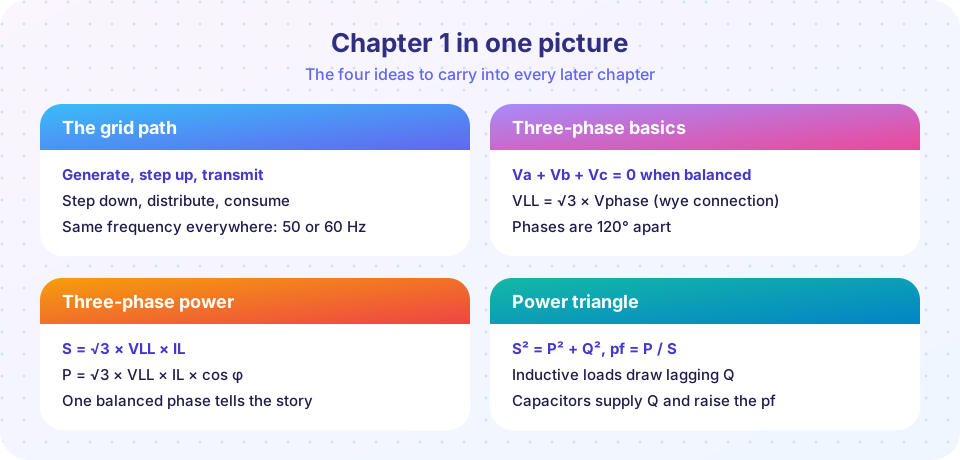
What you will review
- The path from generator to customer and why voltage is raised and lowered.
- Wye and delta relations for voltage, current and impedance.
- Three-phase power formulas and per-phase analysis.
P,Q,S, power factor and capacitor sizing.
Recap table
| Topic | Key relations | Lesson |
|---|---|---|
| Grid path | Generate, step up, transmit, step down, distribute; one frequency | The Grid at a Glance |
| Line loss | I = P / (√3 V), Ploss = 3 I² R |
The Grid at a Glance |
| Wye | VLL = √3 Vph, IL = Iph |
Three-Phase Power |
| Delta | VLL = Vph, IL = √3 Iph, ZY = ZΔ / 3 |
Three-Phase Power |
| Power | S = √3 VL IL, P = S cos φ, Q = S sin φ |
Three-Phase Power |
| Triangle | S² = P² + Q², pf = P / S |
Real, Reactive and Apparent Power |
| Correction | Qc = P (tan φ1 − tan φ2) |
Real, Reactive and Apparent Power |
Worked review example
A factory is fed at 400 V line-to-line. It uses 90 kW at a power factor of 0.75 lagging. Find the current, and the capacitors needed to reach pf 0.95.
S = P / pf = 90 / 0.75 = 120 kVA.IL = S / (√3 × 400) = 120000 / 692.8 = 173 A.Q1 = P tan φ1 = 90 × 0.882 = 79.4 kvar.- For pf 0.95,
tan φ2 = 0.3287, soQ2 = 29.6 kvarandQc = 49.8 kvar. - New
S = 90 / 0.95 = 94.7 kVA, so the new current is137 A, 21% lower.
Notice how the answer uses ideas from every lesson in the chapter. That is the pattern for the rest of the course: simple formulas, chained carefully.
Common misconceptions
- "Voltage and current relations are the same for wye and delta." The √3 appears in the current for delta and the voltage for wye.
- "Improving the power factor reduces the energy I use." Your meter counts real power. Correction reduces current and loss in the supply system, so it saves on penalties and equipment rather than on your kilowatt-hours.
- "Three-phase means three separate circuits." The three phases share the same system and interact; the balanced case just lets you analyze one.
Try it
First, a calculator that reproduces the worked example and lets you change the numbers. Edit the three inputs at the top and run it again.
Press Run (or Ctrl + Enter) to see the result here.
Program input · what you'd type while the program runs
Type the answers before you press Run, one per line. Each time the program reads a line (with input()), it gets the next line from this box.
Second, a practice generator. It creates a random balanced load, hides the answer, and reveals the line current and power factor when you press the button. Work it out on paper first.
Check your understanding
Quick check · 9 questions
of 9 answered You scored / 9 · perfect!
-
1. Which of these is the main reason transmission uses high voltage?
For fixed power, I = P / (√3 V), so a higher V means a lower current and much less resistive loss. -
2. A wye system has a line-to-line voltage of 11 kV. What is the phase voltage?
Vph = VLL / √3 = 11 / 1.732 = 6.35 kV. -
3. A delta load has 10 Ω in each branch. What is the equivalent wye impedance per phase?
ZY = ZΔ / 3 = 3.33 Ω. -
4. A balanced load draws 100 A at 400 V line-to-line with pf 0.8. Its real power is about:
P = √3 × 400 × 100 × 0.8 = 55.4 kW. -
5. If the three phase currents of a balanced load are 10 A each, the neutral current is:
Balanced currents 120° apart add to zero. -
6. What is the power factor of a load with P = 6 kW and Q = 8 kvar?
S = 10 kVA, so pf = 6/10 = 0.6. -
7. Adding capacitors in parallel with an inductive load causes:
Capacitors supply the reactive power locally, so the source supplies less reactive power and less current. -
8. Which statement about the grid frequency is correct?
A synchronous grid locks all machines to one frequency. Falling frequency, not rising, signals that demand exceeds supply, and transformers do not change frequency. -
9. The line voltage in a wye system relative to the phase voltage is:
VLL = √3 Vph and the line voltage leads the phase voltage by 30° in abc order.
Summary
- The grid raises voltage for transmission to cut
I²Rloss, then lowers it for customers, all at one frequency. - Three-phase systems give constant power; wye has
VLL = √3 Vph, delta hasIL = √3 Iph. S = √3 VL IL;P,QandSform the power triangle;pf = P / S.- Capacitors in parallel with inductive loads reduce reactive current and improve power factor.
- Chapter 2 moves from the system picture to the equipment: generators, load curves and transformers.
Track your progress
Create a free account to tick off lessons and pick up where you left off on any device.
of Electric Power Systems lessons completed