


















Lesson 44 of 47 · Projects and Practice
Practice problems: faults, stability, renewables and economics
Twelve worked-out practice problems on sequence components, faults, relays, stability, frequency, voltage, solar, wind, storage, dispatch and reliability, with a solution calculator.
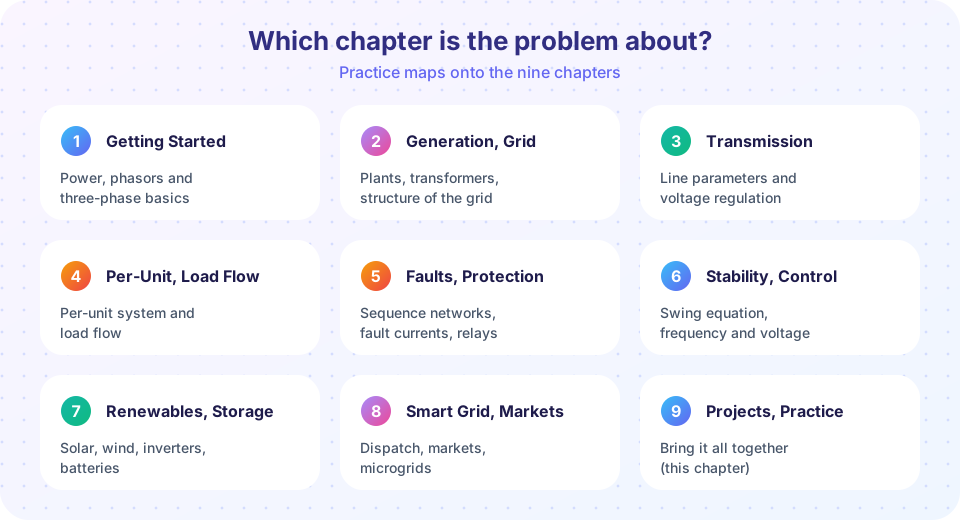
You learn calculation by doing calculation. The twelve problems below cover chapters 5 to 8, one or two per topic, with numbers chosen so that the answers come out reasonable. Try each one by hand with a calculator first, write down the answer with its unit, and only then run the solution code. If your answer differs, find the step where the two calculations part: that is where the learning is.
Use the habits of the previous lesson: write down the formula, convert to consistent units, sketch the situation, estimate the order of magnitude and check the result against typical values.
What you will learn
- Apply the formulas of chapters 5 to 8 to numerical problems.
- Check answers with units and plausibility.
- Use the solution calculator to verify your work and explore variations.
Key terms
Given and find: list the known data and the unknown quantity before choosing a formula.
Order of magnitude: a rough estimate within a factor of 10, used to catch gross errors.
Per unit: a quantity divided by its base; keep bases consistent.
Margin: how far a result is from a limit.
The problems
Chapter 5: faults and protection
- Sequence components. A fault leaves phase currents
Ia = 150 A,Ib = 0,Ic = 0. FindI0,I1,I2and the neutral current. - Fault current. At a 132 kV bus the Thevenin sequence reactances on 100 MVA are
Z1 = Z2 = j0.08 puandZ0 = j0.20 pu. Find the bolted three-phase and single line-to-ground fault currents in kA. - Relay time. A standard-inverse overcurrent relay (
k = 0.14,α = 0.02) hasIs = 300 AandTMS = 0.2. How long does it take to operate for a 3,000 A fault? - Coordination. A downstream relay operates in 0.30 s at a 3,000 A fault. The upstream relay has
Is = 400 Aand must be 0.4 s slower. What TMS does it need (standard inverse)?
Chapter 6: stability and control
- Equal area. A generator delivers
Pm = 0.6 puthrough a line withPmax = 1.5 pubefore, during (zero) and after a bolted terminal fault.H = 4 s, 50 Hz. Find the critical clearing angle and time. - Frequency. A 40 GW system with
H = 4.5 sloses 2 GW of generation. WithR = 0.05andD = 1.5, find the initial RoCoF and the steady-state frequency deviation. - Voltage. A load of 1.0 pu at 0.9 power factor lagging is fed through a lossless line with
X = 0.4 pufrom a source of 1.0 pu. Does a steady state exist? If not, what happens with capacitors that bring the power factor to unity?
Chapter 7: renewables and storage
- Solar energy. A 6 kW rooftop array in a location with 4.8 peak sun hours per day and a performance ratio of 0.78. Find the annual energy and the capacity factor.
- Wind power. A turbine with a 100 m rotor operates in a 9 m/s wind with
Cp = 0.42atρ = 1.225 kg/m³. Find its power. How does it compare with the Betz limit? - Storage. A 20 MW / 80 MWh battery has a round-trip efficiency of 0.86. It buys at 25 $/MWh and sells at 85 $/MWh. What is the profit of one full cycle (selling 80 MWh)?
Chapter 8: smart grids and economics
- Dispatch. Two units have costs
C1 = 0.01·P1² + 8·P1andC2 = 0.02·P2² + 6·P2($/h). Find the economic dispatch for 300 MW and λ. - Reliability. A utility serves 25,000 customers. In a year: 1,000 customers are out for 120 min, 4,000 for 45 min and 500 for 300 min. Compute SAIFI, SAIDI and CAIDI.
How to check your work
- Units: current in A or kA, power in MW or pu, time in s or min, never mixed.
- Limits: set
Z0 = Z1in problem 2 and check that SLG equals the three-phase current; set the load to zero in problem 7 and checkV = 1. - Plausibility: fault currents should be 5 to 50 times load current; RoCoF values below about 1 Hz/s; capacity factors 15 to 45 %.
Common misconceptions
"Copying the answer is the same as understanding it." Check yourself by changing one input and predicting the new answer before running the code.
"A negative or complex result means a bug." Sometimes it signals physics: in problem 7 a negative discriminant means no solution, which is the point of the question.
"The numbers must be exact." Engineering answers carry the precision of their inputs; quote two or three significant digits.
Try it
The first example is the solution calculator: it solves all twelve problems with the formulas of the chapters and prints the answers. Change any input and rerun to explore variations.
Press Run (or Ctrl + Enter) to see the result here.
Program input · what you'd type while the program runs
Type the answers before you press Run, one per line. Each time the program reads a line (with input()), it gets the next line from this box.
The second example is an answer checker for four of the problems. Type your answer and see whether it is within 2 %.
Check your understanding
Quick check · 5 questions
of 5 answered You scored / 5 · perfect!
-
1. In problem 1, what is the neutral current?
In = Ia + Ib + Ic = 150 A = 3 x I0. -
2. In problem 2, which fault is larger?
Z0 = 0.20 is larger than Z1 = 0.08, so I3 = 12.5 pu exceeds ISLG = 8.33 pu. -
3. In problem 7, why does no steady state exist at 0.9 pf lagging?
At that power factor Pmax = 0.78 pu, below the 1.0 pu load, so the voltage equation has no real solution. -
4. In problem 12, what is CAIDI?
CAIDI = SAIDI / SAIFI = 18 / 0.22 = 81.8 minutes. -
5. In problem 11, which unit produces more and why?
Unit 1 has the smaller quadratic coefficient, so more output is needed before its IC reaches lambda: 166.7 MW against 133.3 MW.
Summary
- Twelve problems exercise sequence components, fault currents, relays, stability, frequency, voltage, solar, wind, storage, dispatch and reliability.
- Check units, limiting cases and plausibility before trusting a number.
- A negative discriminant or no solution can be the physical answer, as in problem 7.
- Use the solution calculator to verify your work and then change inputs to explore.
Next: Glossary
Track your progress
Create a free account to tick off lessons and pick up where you left off on any device.
of Electric Power Systems lessons completed