


















Lesson 30 of 47 · Stability and Control
Chapter 6 review: stability and control
Review the swing equation, equal-area criterion, frequency control and voltage stability with a cheat sheet, a recap table, a stability dashboard calculator and a ten-question quiz.
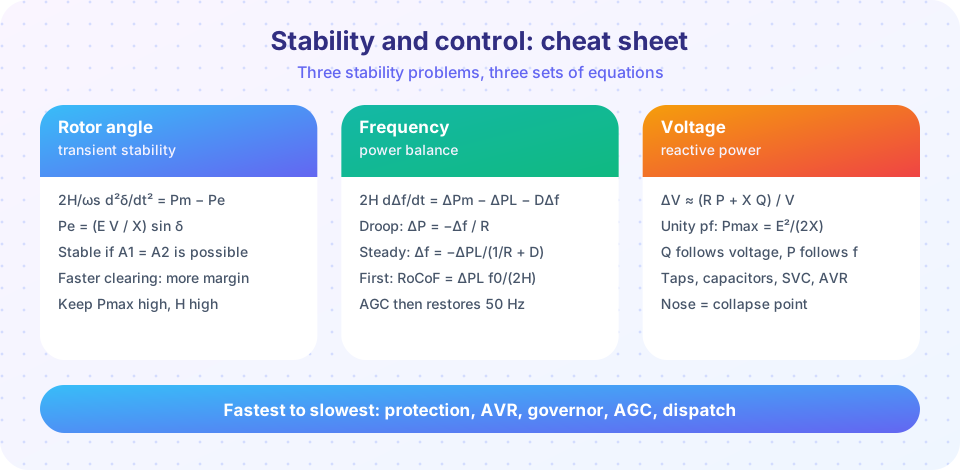
A grid that has just lost a line, a generator or a block of load has to answer three questions within seconds: do the machines stay in step, does the frequency settle, and does the voltage hold? Each question has its own equation, its own control and its own time scale. This review puts them side by side so you can see the pattern: every stability problem is an imbalance of some power, and every control restores that balance.
What you will learn
- Recall the key equations and controls for rotor angle, frequency and voltage stability.
- Use a small dashboard to see the three margins for a given system.
- Check which parts of the chapter need another look.
Recap table
| Problem | Imbalance of | Key equation | Typical control | Time scale |
|---|---|---|---|---|
| Rotor angle | Mechanical vs electrical power | (2H/ωs)·d²δ/dt² = Pm − Pe; Pe = Pmax·sin δ |
Fast clearing, AVR, power system stabilizer | 0 to 10 s |
| Frequency | Generation vs load | 2H·dΔω/dt = ΔPm − ΔPL − D·Δω; Δω = −ΔPL/(1/R + D) |
Inertia, governor droop, AGC, reserves | seconds to minutes |
| Voltage | Reactive supply vs demand | ΔV ≈ (R·P + X·Q)/V; Pmax = E²/(2X) at unity pf |
AVR, capacitors, SVC, STATCOM, tap changers, load shedding | seconds to minutes |
Other facts to keep in mind:
- Equal-area criterion: stable if the decelerating area can equal the accelerating area before
δmax = 180° − δ0. - Critical clearing time for a terminal fault:
tc = √(2(δc − δ0)·2H / (ωs·Pm)). RoCoF = ΔPL·f0/(2H); droop shares load by rating over droop; AGC drives the ACE to zero.- Tap changers shift voltage but make no reactive power; STATCOMs keep their current limit at low voltage.
- Inverter-based sources lower the system inertia and add converter-driven stability problems.
Common misconceptions
"Stability is one property." A system can pass a rotor angle test and still collapse in voltage, or hold voltage and lose frequency. Each form needs its own study.
"More generation fixes everything." Generation in the wrong place does not help voltage, and generation without inertia or governor response does not help frequency.
"Controls are interchangeable." Each control has a time scale; a slow control cannot rescue a fast problem.
Try it
The first example is a stability dashboard. Given a machine, a generation loss and a load, it computes three margins: the critical clearing time against a typical 0.1 s clearing time, the RoCoF against an illustrative limit of 0.5 Hz/s, and the loading margin of the line against its P-V nose. A margin above 1 means room to spare. It applies the equations of the chapter; the limits are teaching values, not standards.
Press Run (or Ctrl + Enter) to see the result here.
Program input · what you'd type while the program runs
Type the answers before you press Run, one per line. Each time the program reads a line (with input()), it gets the next line from this box.
The second example is a formula matcher: pick the equation that belongs to a concept. It is a self-test.
Check your understanding
Quick check · 10 questions
of 10 answered You scored / 10 · perfect!
-
1. A generator delivers Pm = 0.9 pu and Pmax = 1.8 pu. Its steady rotor angle is
delta0 = asin(0.9/1.8) = asin(0.5) = 30 degrees. -
2. Which action does NOT improve transient stability?
Slower clearing enlarges the accelerating area A1 and shrinks the margin. -
3. A 20 GW system with H = 5 s loses 1 GW (0.05 pu). The initial RoCoF at 50 Hz is
RoCoF = 0.05 x 50 / (2 x 5) = 0.25 Hz/s. -
4. Droop of 5 % with load damping 1 pu: what is the frequency response 1/R + D in pu?
1/0.05 + 1 = 20 + 1 = 21. -
5. Which device restores nominal frequency after a disturbance?
AGC's integral action removes the permanent offset left by droop. -
6. At unity power factor, a lossless line with E = 1.0 pu and X = 0.25 pu has a maximum deliverable power of
Pmax = E^2/(2X) = 1/0.5 = 2 pu. -
7. Why is reactive power best supplied locally?
Reactive power flowing through line reactance causes large voltage drops and losses. -
8. During the first moments after a generator trips, frequency falls mainly because
Before governors act, the deficit is supplied by the kinetic energy of rotating masses, so speed falls. -
9. Which is a typical emergency action against an imminent voltage collapse?
These actions limit load restoration and add reactive support. -
10. The nose of a P-V curve represents
Beyond the nose no steady operating point exists.
Summary
- Stability problems are power imbalances: mechanical against electrical (angle), generation against load (frequency), reactive supply against demand (voltage).
- Each has a defining equation, a stability limit and controls on matching time scales.
- Margins (critical clearing time, RoCoF/nadir, loading margin) turn the theory into design numbers.
- Chapter 7 asks how wind, solar and batteries change these margins.
Track your progress
Create a free account to tick off lessons and pick up where you left off on any device.
of Electric Power Systems lessons completed