


















Lesson 28 of 47 · Stability and Control
Frequency control
Understand how inertia, governor droop, AGC and reserves hold the grid frequency after a generator trips or the load jumps, with a full time-domain simulation.
Every alternator in a synchronous grid turns in lockstep. The frequency you measure at a wall socket is the rotational speed of the generators, expressed as electrical cycles per second. It is therefore a direct readout of one thing: whether the energy put into the grid matches the energy taken out. If load exceeds generation, the machines slow down and the frequency falls; if generation exceeds load, it rises. Nothing else changes frequency.
Because nobody can store large amounts of AC energy on the grid itself, operators hold frequency inside a narrow band (in Europe normal operation stays within about ±50 mHz of 50 Hz) with a hierarchy of controls that act at different speeds.
What you will learn
- Compute the initial rate of change of frequency from the imbalance and the inertia.
- Explain governor droop and calculate the steady-state frequency deviation.
- Describe primary, secondary and tertiary control and what each restores.
- Simulate a frequency event and see how inertia changes the nadir.
Key terms
RoCoF: rate of change of frequency, in Hz/s, right after an imbalance.
Droop (R): the permanent frequency change that moves a governor from no load to full load; typically 4 to 5 %.
Primary control: the automatic governor response, within seconds, that stops the frequency from falling.
AGC / secondary control: a central controller that returns frequency and tie-line flows to schedule.
Frequency nadir: the lowest frequency reached after a loss of generation.
Inertia: the first seconds
Write the swing equation for the whole system in per unit, with Δω the speed deviation (equal to Δf/f0):
2H · d(Δω)/dt = ΔPm − ΔPL − D·Δω
ΔPm is the change in mechanical power, ΔPL the change in load, H the system's inertia constant (about 3 to 6 s for large interconnections) and D the load damping: motor loads draw less power when frequency drops, typically D = 1 to 2 (a 1 % drop in frequency reduces the load by 1 to 2 %). At the instant of a disturbance ΔPm = 0 and Δω = 0, so the initial rate of change is
RoCoF = d(Δf)/dt = −ΔPL · f0 / (2H)
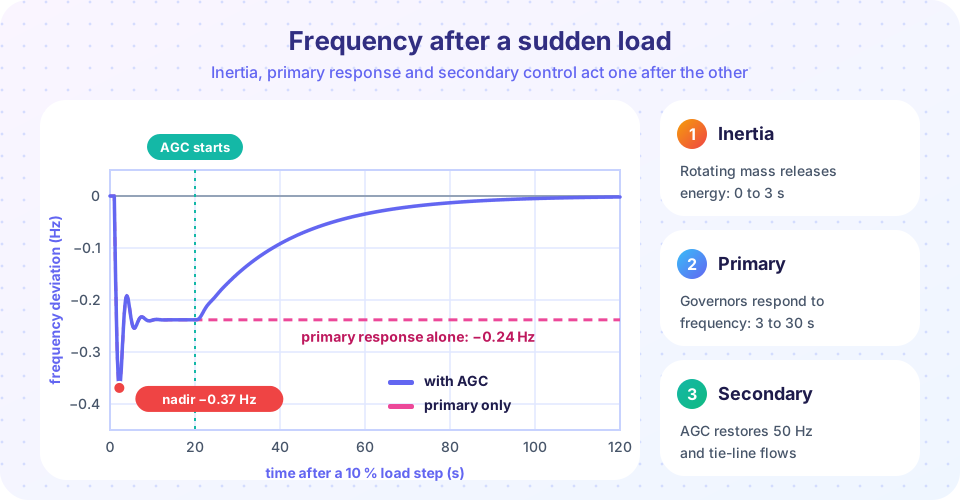
Suppose a 10 GW system with H = 5 s loses a 500 MW unit (ΔPL = 0.05 pu): RoCoF = −0.05 × 50 / 10 = −0.25 Hz/s. A 10 % imbalance (0.1 pu) gives −0.5 Hz/s, which is the starting slope of the curve in the figure. With less inertia, the same loss drives frequency down faster, leaving less time for the governors to react. That is why systems with many inverter-based sources, which have no rotating mass, study RoCoF so carefully.
Primary control: droop
A governor senses the speed and adjusts the valve or gate to change turbine power. If each governor responded in a way that restored 50 Hz by itself, the machines would fight each other over who should pick up the load. Instead governors use droop: output changes in proportion to frequency error,
ΔPgov = −Δω / R
with R typically 0.05 (5 %): a 5 % frequency drop would move the machine from zero to full output, so a 1 % frequency deviation changes its output by 20 % of rating. Because all governors share one frequency, each picks up a share of the load in proportion to its rating divided by its droop, without communication.
After a few seconds the system settles where generation, load and load damping balance:
Δω(steady) = −ΔPL / (1/R + D)
For the example (R = 0.05, D = 1, ΔPL = 0.1 pu) the denominator is 20 + 1 = 21 and Δω = −0.00476 pu, i.e. Δf = −0.238 Hz at 50 Hz. The quantity 1/R + D is the frequency response of the system. In megawatts per hertz, a 10 GW system with this response has 21 × 10,000 / 50 = 4,200 MW/Hz: it takes 4.2 GW of imbalance to move frequency by 1 Hz.
Primary control is fast but it cannot bring frequency back, because droop needs an error to produce its response. The governor and turbine also have delays: valves and steam volumes act with time constants of a fraction of a second to several seconds, which is why the real response overshoots a little (the nadir in the figure, −0.37 Hz, is lower than the final −0.24 Hz).
Governors are not instant. Thermal turbines can add power only as quickly as the boiler allows and hydro turbines have a "water hammer" effect that first reduces power when the gate opens. Operators therefore keep spinning reserve: capacity on synchronized machines, held below full output, ready to respond.
Secondary and tertiary control
After the primary response the frequency sits below nominal and each area's tie-line flows to neighbors differ from schedule. Automatic generation control (AGC), also called load-frequency control, measures the area control error
ACE = (tie-line flow − scheduled flow) + bias × (frequency error)
and adjusts the set-points of selected generators with an integral action until the ACE is zero. The result: the area that caused the imbalance picks up the missing power, tie-line flows return to schedule and frequency to 50 Hz. AGC typically acts every 2 to 10 seconds with a time scale of tens of seconds to minutes.
Tertiary control then rebuilds the reserves: operators re-dispatch cheaper units and start slower ones so that the system can face the next disturbance, on a scale of 10 minutes to hours. In Europe these three layers are called FCR, aFRR and mFRR (frequency containment, automatic and manual frequency restoration reserves); in North America, primary, secondary and tertiary.
If control is not enough, under-frequency load shedding disconnects blocks of customers in stages once frequency drops below set thresholds (in 50 Hz Europe the first stage is around 49 Hz). It is the last resort that stops a frequency collapse.
Common misconceptions
"Governors restore the frequency to 50 Hz." Droop control leaves a permanent offset. Restoring nominal frequency is the job of AGC.
"Inertia reduces the total frequency drop." Inertia slows the initial fall (lower RoCoF) and shallows the nadir by giving governors time, but the steady-state deviation depends on droop and damping, not on H.
"Frequency can be corrected locally." In a synchronous interconnection every generator shares the same frequency; the cure is always system-wide power balance.
Try it
The first example simulates the model above: swing equation, a first-order governor (Tg = 0.2 s), a first-order turbine (Tt = 0.5 s) and, from t = 20 s, an integral AGC. A 10 % load step happens at t = 1 s.
Press Run (or Ctrl + Enter) to see the result here.
Program input · what you'd type while the program runs
Type the answers before you press Run, one per line. Each time the program reads a line (with input()), it gets the next line from this box.
The second example is a frequency-event explorer. Change the inertia, the droop and the size of the lost generation, and read the initial RoCoF and the settled deviation. It integrates the same equations in the browser, without AGC.
The third example sweeps the inertia. For a fixed 10 % loss it reports the nadir and the initial RoCoF as H goes from 2 to 8 s, showing why low-inertia systems are harder to operate.
Press Run (or Ctrl + Enter) to see the result here.
Program input · what you'd type while the program runs
Type the answers before you press Run, one per line. Each time the program reads a line (with input()), it gets the next line from this box.
Check your understanding
Quick check · 5 questions
of 5 answered You scored / 5 · perfect!
-
1. A system with H = 4 s loses 8 % of its load-equivalent generation (0.08 pu). The initial RoCoF at 50 Hz is
RoCoF = 0.08 x 50 / (2 x 4) = 0.5 Hz/s. -
2. A governor with 4 % droop sees the frequency fall by 1 %. By how much does it change its output (as a fraction of rating)?
Change in power = 1 %/4 % = 25 % of rating. -
3. Which control restores the frequency to its nominal value?
Droop leaves a permanent offset; AGC's integral action removes it. -
4. Under-frequency load shedding is
It prevents frequency collapse by restoring balance through reduced load. -
5. What does the area control error (ACE) combine?
ACE = tie-line deviation + bias x frequency deviation; AGC drives it to zero.
Summary
- Frequency measures the balance between generation and load; a deficit makes it fall at
RoCoF = ΔPL·f0/(2H). - Primary control (governor droop) shares the imbalance and stops the fall, but leaves
Δω = −ΔPL/(1/R + D). - Secondary control (AGC, driven by ACE) restores nominal frequency and scheduled tie-line flows; tertiary control rebuilds reserves.
- Low inertia (as with inverter-based generation) means faster, deeper frequency swings.
- Under-frequency load shedding is the last line of defense.
Track your progress
Create a free account to tick off lessons and pick up where you left off on any device.
of Electric Power Systems lessons completed