


















Lesson 46 of 47 · Projects and Practice
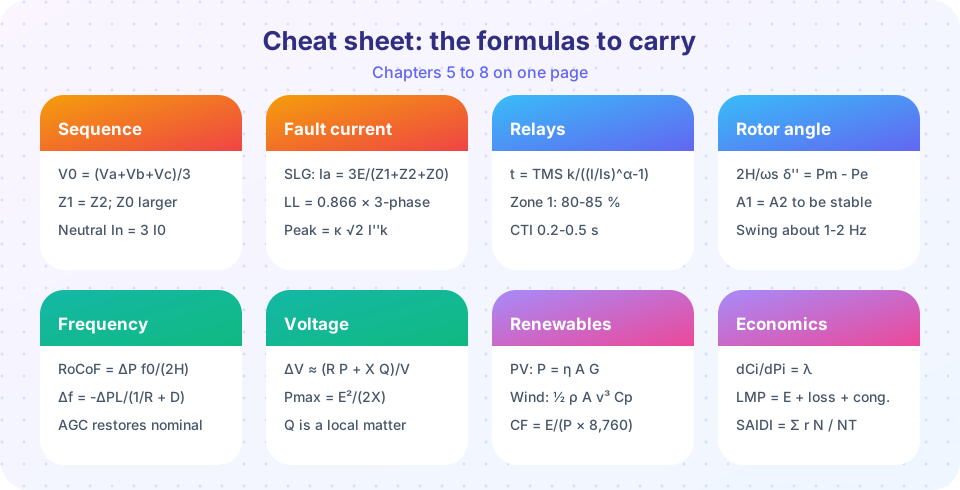
Cheat sheet: formulas for chapters 5 to 8
One page of the key formulas, constants and typical values for faults, protection, stability, frequency, voltage, renewables, storage, dispatch and reliability, with a runnable formula library.
When you work on a problem you rarely need a derivation; you need the right formula, with its symbols and units, and a feel for the numbers. This page collects the formulas of chapters 5 to 8 in one place, with the typical ranges that let you sanity-check a result. Bookmark it, print it, and when a formula looks unfamiliar follow the link back to the lesson where it is explained.
What you will learn
- Find the formula you need quickly, with its symbols and units.
- Use typical ranges to check a result.
- Run a small formula library to evaluate the formulas on your own numbers.
Key terms
pu: per unit, a quantity divided by its base.
κ: the peak factor 1.02 + 0.98·e^(−3R/X) for the first peak of a fault current.
ωs: synchronous angular speed, 2π·f.
CRF: capital recovery factor, r(1+r)^n/((1+r)^n − 1).
CF: capacity factor, annual energy over rated power times 8,760 h.
Chapter 5: faults and protection
| Item | Formula |
|---|---|
| Operator | a = 1∠120°, 1 + a + a² = 0 |
| Phase to sequence | V0 = (Va + Vb + Vc)/3, V1 = (Va + aVb + a²Vc)/3, V2 = (Va + a²Vb + aVc)/3 |
| Sequence to phase | Va = V0 + V1 + V2, Vb = V0 + a²V1 + aV2, Vc = V0 + aV1 + a²V2 |
| Three-phase fault | I = E/(Z1 + Zf) |
| SLG fault | Ia = 3E/(Z1 + Z2 + Z0 + 3Zf) |
| LL fault | Ib = √3·E/(Z1 + Z2 + Zf) |
| LLG fault | I1 = E/(Z1 + Z2‖(Z0 + 3Zf)) |
| Base current | Ibase = Sbase/(√3·Vbase) |
| Peak current | ip = κ·√2·I''k |
| Inverse-time relay | t = TMS·k/((I/Is)^α − 1); (0.14, 0.02), (13.5, 1), (80, 2) |
| Differential relay | Iop = abs(I1 + I2); trip if Iop > Imin + slope·Ires |
Chapter 6: stability and control
| Item | Formula |
|---|---|
| Swing equation | (2H/ωs)·d²δ/dt² = Pm − Pe, Pe = Pmax·sin δ |
| Steady angle | δ0 = asin(Pm/Pmax) |
| Critical angle (terminal fault) | cos δc = (Pm/Pmax)(δmax − δ0) + cos δmax, δmax = π − δ0 |
| Critical time (terminal fault) | tc = √(2(δc − δ0)·2H/(ωs·Pm)) |
| Swing frequency | ωn = √(ωs·Pmax·cos δ0/(2H)) |
| RoCoF | ΔP·f0/(2H) (pu power, Hz/s) |
| Steady frequency deviation | Δω = −ΔPL/(1/R + D) |
| Voltage drop | ΔV ≈ (R·P + X·Q)/V |
| Maximum power, unity pf | Pmax = E²/(2X); general: Pmax = (√(1 + tan²φ) − tan φ)/(2X) for E = 1 |
Chapter 7: renewables and storage
| Item | Formula |
|---|---|
| Diode model | I = Iph − I0(exp(V/a) − 1) |
| Fill factor, efficiency | FF = Pmp/(Voc·Isc), η = Pmp/(G·A) |
| PV energy | E = P × peak sun hours × 365 × PR |
| Wind power | P = ½·ρ·A·v³·Cp, Cp ≤ 16/27 |
| Weibull | f(v) = (k/c)(v/c)^(k−1)·exp(−(v/c)^k), mean c·Γ(1 + 1/k) |
| Capacity factor | CF = E/(P·8,760) |
| SCR | Ssc/Prated |
| Storage | duration = MWh/MW; arbitrage margin = η·ph − pl per MWh bought |
Chapter 8: smart grids and economics
| Item | Formula |
|---|---|
| Cost and incremental cost | C = a + bP + cP², IC = b + 2cP |
| Dispatch | dCi/dPi = λ, ΣPi = D; with losses PFi·ICi = λ, PFi = 1/(1 − ∂PL/∂Pi) |
| Congestion rent | (LMP_B − LMP_A) × flow |
| LCOE | (Capex·CRF + fixed O&M)/(8,760·CF) + variable cost |
| Reliability | SAIFI = ΣNi/NT, SAIDI = Σ(ri·Ni)/NT, CAIDI = SAIDI/SAIFI |
| Droop | f = f0 − mp·P; shares proportional to rating |
Constants and typical values
| Quantity | Value |
|---|---|
Synchronous speed ωs |
314.16 rad/s (50 Hz), 376.99 rad/s (60 Hz) |
| Air density at sea level | 1.225 kg/m³ |
| Betz limit | 16/27 = 0.593 |
| PV test conditions | 1,000 W/m², 25 °C |
H of large generators |
2 to 9 s |
| Governor droop | 4 to 5 % |
| Breaker clearing | 2 to 3 cycles; total fault clearing 2 to 6 cycles |
| Relay CTI | 0.2 to 0.5 s |
| Capacity factors | PV 15 to 30 %, onshore wind 25 to 45 % |
| Round-trip efficiency | Li-ion 85 to 90 %, pumped hydro 70 to 80 %, hydrogen 30 to 40 % |
| IBR fault current | 1.1 to 1.5 pu |
Common misconceptions
"A formula sheet replaces understanding." Each formula has assumptions (lossless line, balanced system, constant emf). When the assumption fails, the formula does too.
"Per unit means unitless, so bases do not matter." Per-unit values are only comparable when they share a base.
"Typical values are limits." They are ranges for ordinary cases; special systems fall outside them, but then you should be able to explain why.
Try it
The first example is a small formula library: Python functions for the main formulas of the chapters, with a demonstration of each. Copy it to your own notes and extend it.
Press Run (or Ctrl + Enter) to see the result here.
Program input · what you'd type while the program runs
Type the answers before you press Run, one per line. Each time the program reads a line (with input()), it gets the next line from this box.
The second example is a quick formula picker: choose a topic and see the formula with a numeric example.
Check your understanding
Quick check · 4 questions
of 4 answered You scored / 4 · perfect!
-
1. Which formula gives the maximum power of a lossless line at unity power factor?
Pmax = E^2/(2X), reached at V = 0.707 E. -
2. Which expression gives the RoCoF immediately after an imbalance?
RoCoF = dP f0/(2H). -
3. The capital recovery factor for r = 8 % and n = 20 years is about
0.08 x 4.661 / (4.661 - 1) = 0.102, where 1.08^20 = 4.661. -
4. Which relay curve is steepest?
The extremely inverse curve has alpha = 2, so its time falls fastest with current.
Summary
- The cheat sheet gathers the formulas of chapters 5 to 8 with typical values.
- Each formula has assumptions; check them before use and sanity-check with typical ranges.
- A small function library turns the formulas into reusable code.
Next: Further study
Track your progress
Create a free account to tick off lessons and pick up where you left off on any device.
of Electric Power Systems lessons completed