


















Lesson 7 of 48 · Sounds, Greetings and Basics
Vowels and Nasal Sounds in Portuguese
Learn the seven oral vowels, open versus closed é and ê, the nasal vowels with tilde or m/n, and how unstressed vowels change in Brazilian Portuguese.
Vowels carry most of the sound of Portuguese. English speakers often mispronounce them in two ways: they turn pure vowels into gliding diphthongs (saying "oh-w" for o), and they ignore the nasal vowels that make Portuguese sound like itself. Both habits are easy to fix once you know what is happening in the mouth.
This lesson teaches the seven oral vowels of Brazilian Portuguese, the difference between open and closed e and o, what happens to vowels when they are not stressed, and the nasal vowels. You will also hear how European Portuguese differs. Practice every example aloud; sounds belong to the mouth, not to the eyes.
What you will learn
- The seven oral vowels and how to spell them.
- How to tell open (é, ó) from closed (ê, ô) vowels.
- How unstressed final vowels change in Brazil.
- The nasal vowels: tilde, m, and n.
- A few oral and nasal diphthongs, such as ai, ei, ão, and ãe.
Key terms
Oral vowel: a vowel with air only through the mouth.
Nasal vowel: a vowel with air through mouth and nose, shown by a tilde or by m or n after the vowel.
Open / closed vowel: open means the mouth and tongue are lower (é, ó); closed means higher (ê, ô).
Diphthong: two vowel sounds in one syllable, as in pai (father).
Unstressed: not carrying the main emphasis of the word.
Seven stressed oral vowels
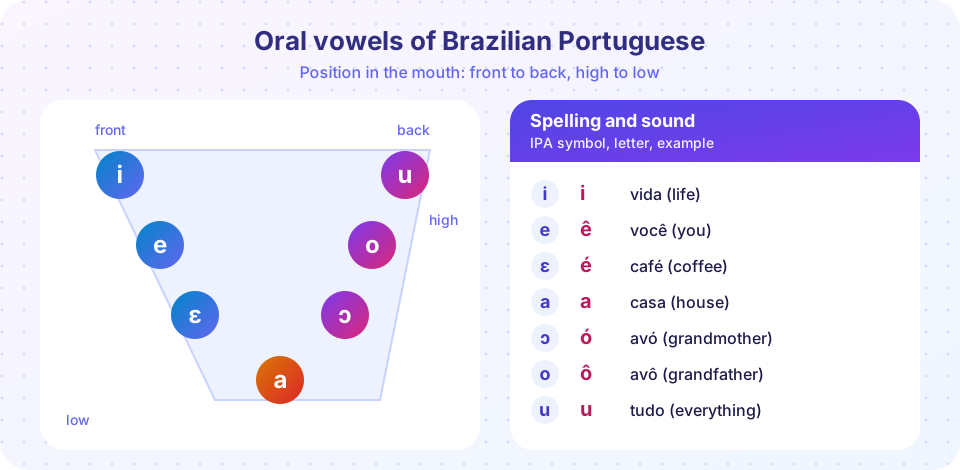
When a vowel is stressed, Brazilian Portuguese has seven distinct oral sounds. Five of them correspond to the letters you know. The other two come from splitting e and o into an open and a closed version.
| Letter | IPA | Respelling | Example |
|---|---|---|---|
| i | /i/ | "ee" | vida (life) |
| ê | /e/ | "ay" (without the glide) | você (you) |
| é | /ɛ/ | "eh" | café (coffee) |
| a | /a/ | "ah" | casa (house) |
| ó | /ɔ/ | "aw" (British law) | avó (grandmother) |
| ô | /o/ | "oh" (without the glide) | avô (grandfather) |
| u | /u/ | "oo" | tudo (everything) |
Keep every vowel steady. If you say você with an English "vo-SAY-ee", the sound glides and sounds foreign. Hold ê in one position, like a short, clean "ay".
Open or closed? Read the accent
The accent mark often tells you which sound to use. The acute accent (é, ó, á) means open and stressed. The circumflex (ê, ô, â) means closed and stressed. For example, avó has a mouth open wide for the last vowel, and avô is closed. Pairs like these are why the accents matter.
Words without a mark can also contain e or o with either sound, and the spelling does not show it. You learn them by listening, as an English speaker learns that "read" can sound two ways. Two helpful clues: in a stressed syllable before m or n, the vowel is closed (cama, ano), and the plurals of some words with o change quality: novo (new) has a closed o, but novos has an open one. Do not worry about that yet; just listen for it.
Unstressed vowels in Brazil
Unstressed vowels, especially at the end of a word, are weaker than stressed ones. In Brazil three changes occur again and again:
- A final unstressed -a sounds like a short "uh": casa is "KAH-zuh".
- A final unstressed -e sounds like "ee": leite (milk) is "LAY-chee" and noite (night) is "NOY-chee".
- A final unstressed -o sounds like "oo": livro (book) is "LEE-vroo" and amigo (friend) is "ah-MEE-goo".
Notice that e as a word on its own ("and") also sounds like "ee": pão e manteiga (bread and butter).
European Portuguese
In Portugal, unstressed vowels are reduced even more. Many unstressed e sounds are nearly silent, and the final -e often disappears, so leite sounds like "LAYT". Words can seem to be missing syllables: obrigado sounds close to "oh-bree-GAH-doo" in Brazil but a fast Portuguese speaker may squeeze it to something like "brigado". This is the main reason many learners find European speech harder to follow. You can handle it later; for now, learn the Brazilian sounds and be ready for the difference.
Nasal vowels
Nasal vowels are the sound that most often marks Portuguese. You make them by lowering the soft palate at the back of the mouth so air passes through the nose, while you say the vowel normally. A good trick is to start with the English word "sing" and notice how the vowel in it is already slightly nasal; Portuguese does the same thing, but you do not close the mouth to finish with a hard ng.
Nasal vowels are written in two ways:
- With a tilde: ã and õ, as in lã (wool), irmã (sister), limões (lemons).
- With m or n after the vowel, when it comes before another consonant or at the end of the word: bom (good), sim (yes), um (one), campo (field), tempo (time), onde (where), homem (man).
Here m or n is not a separate consonant. It is a signal that the vowel is nasal.
| Spelling | IPA | Respelling (approximate) | Example |
|---|---|---|---|
| ã, an, am | /ɐ̃/ | "uh" through the nose | maçã (apple), campo (field) |
| em, en | /ẽ/ | "eh" through the nose | tempo (time), bem (well) |
| im, in | /ĩ/ | "ee" through the nose | sim (yes), cinco (five) |
| om, on, õ | /õ/ | "oh" through the nose | bom (good), limões (lemons) |
| um, un | /ũ/ | "oo" through the nose | um (one), mundo (world) |
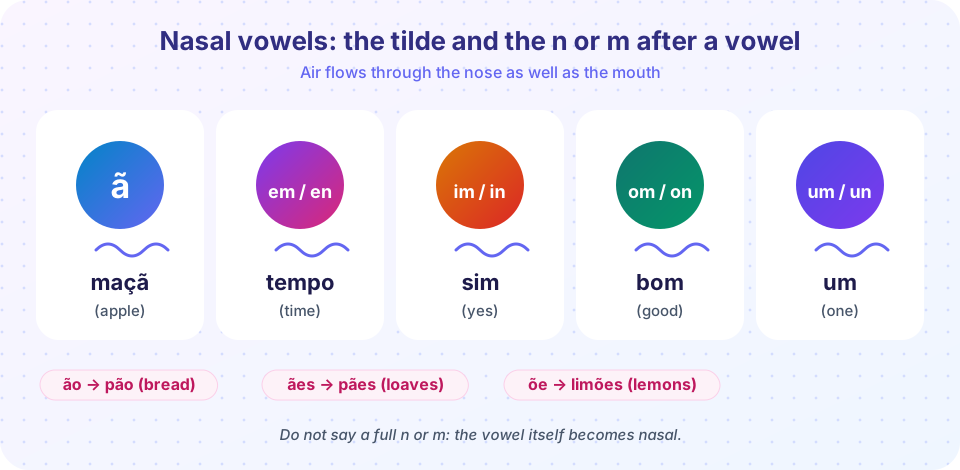
The respellings are approximations. In writing we cannot show nasality exactly, so listen to a native speaker for each word at least once.
Nasal diphthongs
Several common endings combine a nasal vowel with a glide:
- -ão (as in pão, não, coração) sounds roughly like "owng", with the vowel nasalized.
- -ãe (as in mãe, mother) is close to "my" through the nose.
- -õe (as in põe, "puts", and the plural ending -ões in limões) ends with a nasal "oy".
- A final -em (as in bem, também, homem) sounds like a nasal "ayng".
You will use não ("no" or "not") constantly, so practice it: keep your lips slightly rounded at the end, and do not pronounce a hard n or g.
Oral diphthongs
Oral diphthongs are the ones without nasality. The common ones are ai (pai, father), ei (rei, king), oi (oi, hi), au (mau, bad), eu (seu, your) and ui (fui, I went). They behave like their English equivalents: say each vowel quickly and glide to the next.
Two vowels together are not always a diphthong. In país (country) and saúde (health) the accent marks tell you that the two vowels are separate syllables: pa-ÍS, sa-Ú-de.
Minimal pairs to practice
A minimal pair is two words that differ in one sound. These pairs show why precision matters:
| Pair | Meaning |
|---|---|
| avó / avô | grandmother / grandfather |
| e / é | and / is |
| pais / país | parents / country |
| esta / está | this (feminine) / is (location or state) |
| pode / pôde | can / was able to (open ó versus closed ô) |
Common misconceptions
"Portuguese vowels are like English vowels." English vowels glide (go is really "goh-oo"). Portuguese vowels are pure and steady.
"The m or n in bom is pronounced." It is not a separate consonant. It only marks that the vowel is nasal. If you say "bomm" with a closed lip, you will sound foreign.
"Accent marks can be ignored." They change the sound and sometimes the word.
Try it
The first tool trains your ear for open, closed, and nasal vowels. Choose the type of the stressed vowel in each word.
The second tool is a spelling detector. It decides whether the spelling of a word signals a nasal vowel, using the rules from this lesson.
Press Run (or Ctrl + Enter) to see the console output here.
No output.
Check your understanding
Quick check · 5 questions
of 5 answered You scored / 5 · perfect!
-
1. Which word has a CLOSED stressed vowel?
The circumflex in você marks a closed e. The acute accents in café and avó mark open vowels. -
2. How is a final unstressed -e usually pronounced in Brazil?
Leite sounds like LAY-chee in Brazil. In Portugal the final -e is often nearly silent. -
3. What does the m in 'bom' show?
M or n after a vowel (before a consonant or at the end) marks a nasal vowel; it is not a separate consonant. -
4. Which pair means 'grandmother' and 'grandfather'?
Avó (open ó) is grandmother and avô (closed ô) is grandfather. -
5. Which word contains a nasal diphthong?
Pão contains ão, a nasal diphthong. Pai has an oral diphthong, and casa has none.
Summary
- Brazilian Portuguese has seven stressed oral vowels: /i e ɛ a ɔ o u/.
- The acute accent marks open vowels (é, ó) and the circumflex marks closed ones (ê, ô).
- Unstressed final -a, -e, -o sound like "uh", "ee", "oo" in Brazil, and are reduced further in Portugal.
- Nasal vowels are marked by a tilde or by m/n after the vowel; the m/n is not a separate consonant.
- Practice minimal pairs such as avó / avô and pais / país.
Track your progress
Create a free account to tick off lessons and pick up where you left off on any device.
of Portuguese for Beginners lessons completed