


















Lesson 5 of 48 · Getting Started
Chapter 1 Review: Getting Started
Review chapter 1 of Portuguese for Beginners with a one-picture summary, a recap table, a mini dialogue, two practice tools, and a ten-question quiz.
You have finished the first chapter. You now know where Portuguese is spoken, how Brazil and Portugal differ, how to turn English words into Portuguese ones, which false friends to avoid, and how to study in a way that lasts. That is a strong base, and you have not even started grammar yet.
This review brings the chapter together. Look at the picture, read the recap table, try the two practice tools, and then take the ten-question quiz without looking back. If a question stumps you, the explanation points you to the right lesson.
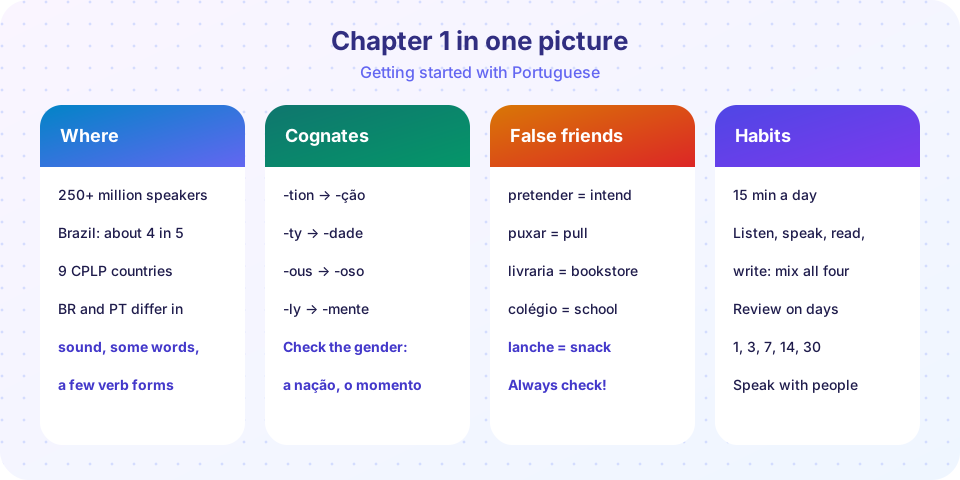
What you will review
- The size and geography of the Portuguese-speaking world.
- Brazilian and European differences.
- Cognate patterns and the main false friends.
- The study habits that make learning stick.
Chapter recap
| Lesson | Key ideas |
|---|---|
| Course map | The course teaches Brazilian Portuguese with European notes; nine chapters; every lesson has practice and a quiz; a course cannot replace speaking with people. |
| Portuguese around the world | An official language on four continents; Brazil has about four in five speakers; Latin → Galician-Portuguese → modern Portuguese; the CPLP; the ônibus/autocarro type of differences. |
| Cognates and false friends | -tion → -ção, -ty → -dade, -ous → -oso, -ment → -mento, -ly → -mente; false friends such as pretender, puxar, livraria, lanche, parentes. |
| Study plan and habits | Spaced review (1, 3, 7, 14, 30), retrieval practice, four skills, speak early, small can-do goals. |
A first dialogue
Here is a small conversation that uses only ideas from this chapter and the next. You do not need to understand every word yet; read it aloud, then look at the English.
| Portuguese | English |
|---|---|
| Ana: Oi! Você fala português? | Hi! Do you speak Portuguese? |
| Tom: Um pouco. Estou aprendendo. | A little. I am learning. |
| Ana: Muito bem! Qual é a sua palavra favorita? | Very good! What is your favorite word? |
| Tom: Eu gosto de "saudade". E você? | I like "saudade". And you? |
| Ana: Eu gosto de "obrigada". | I like "obrigada". |
Saudade is a famous Portuguese word for a tender longing for someone or something that is absent. It is hard to translate with one English word, which is one reason people love it. In the dialogue, Ana says obrigada because she is a woman; a man would say obrigado. You will see why in chapter 3. Portuguese people would say Estou a aprender instead of Estou aprendendo, as you learned in the second lesson.
Common misconceptions to check
"Spanish and Portuguese are interchangeable." They share roots but are different languages with different sounds, spelling, and many different words.
"Every look-alike word is safe." Check anything that you will use in an important sentence, especially words that feel too easy.
"I will start speaking when I am ready." You get ready by speaking. Begin in week two.
How to use this review
Reviews work best when you treat them as a test, not as another reading. First, cover the recap table with a sheet of paper and try to list from memory what each lesson taught. Then uncover the table and mark what you missed. The gaps are what you should revisit, and a gap found now is much cheaper to fix than a gap found in chapter 6.
A useful self-check for this chapter is a short list of can-do statements. Can you name at least five countries where Portuguese is official? Can you explain one difference between Brazilian and European Portuguese? Can you turn nation, city, and famous into Portuguese by rule? Can you name two false friends and say what they really mean? Can you describe your weekly study plan? If you can answer yes to each in your own words, you are ready for chapter 2. If not, reread the relevant lesson and try again tomorrow, which is also a small example of the spacing effect from lesson 4.
Try it
The first tool is a type-in test. Type the Portuguese word for each English one. The checker ignores accents, so nacao counts for nação, but try to type the accents anyway.
The second tool is a small "false friend alarm". Paste or edit the sentences and it warns you about risky words. It only knows the words from this chapter, so it is a study aid, not a translator.
Press Run (or Ctrl + Enter) to see the result here.
Program input · what you'd type while the program runs
Type the answers before you press Run, one per line. Each time the program reads a line (with input()), it gets the next line from this box.
Check your understanding
Quick check · 10 questions
of 10 answered You scored / 10 · perfect!
-
1. Roughly what share of Portuguese speakers live in Brazil?
Brazil has more than 200 million of the 250 million or more speakers, so about four in five. -
2. Which pair is correct, Brazil first and Portugal second?
Brazilians say ônibus and trem; Portuguese people say autocarro and comboio. -
3. What is the Portuguese ending that matches English -tion?
Nation becomes nação, information becomes informação. -
4. What does 'puxar' mean?
Puxar means to pull; empurrar means to push. -
5. What does the English word 'library' translate to?
Biblioteca is a library; livraria is a bookstore. -
6. Which description of 'costume' (Portuguese) is correct?
Costume means custom or habit. A party costume is fantasia. -
7. Which review schedule does this chapter suggest?
Spaced reviews at growing gaps keep memories strong. -
8. What does a missed study day mean for your plan?
A single gap hardly matters. Quitting does. -
9. Why should you start speaking in the second week?
Early speaking builds the habit and trains your mouth, even with only a few phrases. -
10. Which sentence about Portuguese varieties is accurate?
They are two standard varieties of one language, mutually understandable with some patience.
Summary
- Portuguese is spoken on four continents; Brazil has about four in five speakers.
- Brazilian and European Portuguese differ in sound, vocabulary, and some grammar.
- Cognate patterns give you free vocabulary; false friends need checking.
- Spaced review, retrieval, balanced skills, and early speaking drive progress.
Track your progress
Create a free account to tick off lessons and pick up where you left off on any device.
of Portuguese for Beginners lessons completed