


















Lesson 37 of 48 · Future, Pronouns and Subjunctive Basics
Chapter 7 Review: Future, Pronouns and Subjunctive
Review the Portuguese future, object pronouns and present subjunctive with a recap table, a one-page picture, a dialogue to translate and a ten-question quiz.
This chapter introduced the three tools that move your Portuguese from "textbook" to "real conversation": the future, object pronouns and the subjunctive. Each of them has a small core and a longer list of exceptions. In this review, focus on the cores: ir + infinitive, me/te before the verb, and the subjunctive recipe plus the main triggers.
Use the recap table to find gaps, translate the dialogue without looking at the English, and finish with the quiz. Wrong answers tell you which lesson to reread.
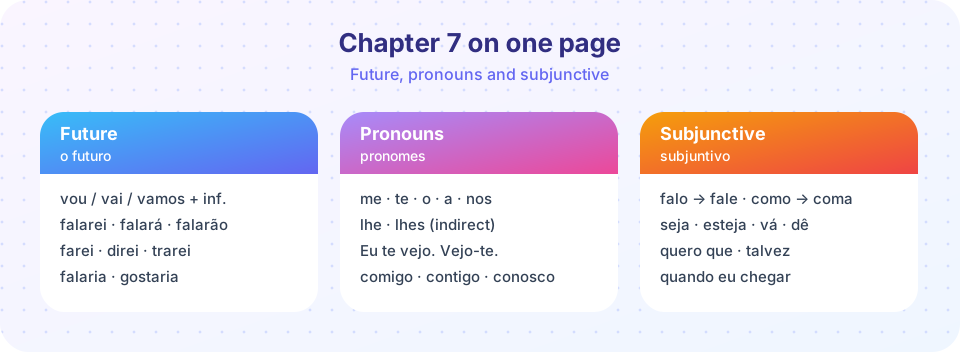
What you will learn
- Check that you can use the future, pronouns and subjunctive in short sentences.
- Practice them together in one dialogue.
- Know what to revisit.
Recap table
| Topic | The core | Example | Lesson |
|---|---|---|---|
| Everyday future | vou/vai/vamos/vão + infinitive | Vou viajar amanhã. | Talking about the future |
| Futuro simples | infinitive + -ei, -ás, -á, -emos, -ão | falarei, farei, direi | same |
| Conditional | stem + -ia, -ias, -ia, -íamos, -iam | gostaria, poderia | same |
| Future time words | amanhã, semana que vem, daqui a pouco | Daqui a dois dias | same |
| Direct pronouns | me, te, o, a, nos, os, as | Eu te vejo. | Object pronouns |
| Indirect pronouns | me, te, lhe, nos, lhes | Ela me deu um livro. | same |
| Position | Brazil: before; Portugal: after with hyphen | Vou te ligar. / Vejo-te. | same |
| With prepositions | comigo, contigo, conosco; para eu fazer | Vem comigo! | same |
| Subjunctive recipe | eu form, drop -o, opposite vowel | fale, coma, faça | Subjunctive basics |
| Irregular subjunctive | seja, esteja, vá, dê, saiba, queira | Espero que seja bom. | same |
| Triggers | querer que, talvez, é importante que | Talvez ele venha. | same |
| Future subjunctive | quando/se + eu chegar, tiver | Se eu tiver tempo, eu vou. | same |
A dialogue to translate
Cover the English column and say each line aloud in English, then in Portuguese.
| Portuguese | English |
|---|---|
| Vou viajar para Lisboa em dezembro. | I am going to travel to Lisbon in December. |
| Que legal! Espero que você goste. | How nice! I hope you like it. |
| Você vem comigo? Eu te pago a passagem. | Will you come with me? I will pay your ticket. |
| Talvez eu vá, mas preciso falar com o meu chefe. | Maybe I will go, but I need to talk to my boss. |
| Quando você souber, me avise. | When you know, let me know. |
| Claro! Assim que ele me responder, eu te ligo. | Of course! As soon as he answers me, I will call you. |
How to use this review
This chapter has three separate skills, so review them separately before you mix them. Spend a few minutes on each: ten sentences with "vou" plus a time word, ten with me/te before the verb, and five wishes with "espero que". Then take the dialogue and the quiz. If the subjunctive still feels heavy, remember the recipe (eu form, drop -o, flip the vowel) and the short list of triggers; fluency comes with use.
Common misconceptions
"I need the futuro simples to talk about the future." No. "Vou + infinitive" is enough for everyday talk.
"Te only goes with tu." In Brazil te also goes with você.
"Subjunctive means uncertain, so I can use it for everything uncertain." Use it after the triggers. "Acho que" takes the indicative.
"After 'quando' I use the present." For future events use the future subjunctive: "Quando eu chegar".
Try it
First, a gap-fill that mixes all three topics.
The Python TryIt combines future forms, the subjunctive recipe and pronoun placement in one reference script. Read the output as a mini cheat sheet and change the verbs.
Press Run (or Ctrl + Enter) to see the result here.
Program input · what you'd type while the program runs
Type the answers before you press Run, one per line. Each time the program reads a line (with input()), it gets the next line from this box.
Check your understanding
Quick check · 10 questions
of 10 answered You scored / 10 · perfect!
-
1. How do you say 'I am going to call you' in Brazilian Portuguese?
ir + pronoun before the infinitive: Vou te ligar. -
2. What is the futuro simples of 'dizer' for 'eu'?
Dizer loses -ze-: direi. -
3. What is the subjunctive of 'comer' for 'você'?
From como: drop -o, add -a. -er verbs take -a. -
4. Which is correct?
After 'espero que' use the subjunctive: venha. -
5. What does 'comigo' mean?
com + eu = comigo. -
6. Which pronoun is indirect in the third person?
'Lhe/lhes' are the indirect forms. -
7. Which sentence is correct for 'When I arrive, I will call you'?
Future events after 'quando' use the future subjunctive: chegar. -
8. How do you say 'for me to do' correctly?
The subject of an infinitive is eu: para eu fazer. -
9. Which verb has the subjunctive 'vá'?
Ir has the irregular subjunctive vá, vás, vá, vamos, vão. -
10. Which sentence uses the indicative correctly?
'Acho que' expresses an opinion as fact (indicative); 'duvido que' needs the subjunctive.
Summary
- Future: vou + infinitive; falarei, farei, direi, trarei; gostaria, poderia for politeness.
- Pronouns: me, te, o, a, lhe; before the verb in Brazil; comigo, contigo, conosco; para eu fazer.
- Subjunctive: eu form, drop -o, flip the vowel; irregulars seja, esteja, vá, dê, saiba, queira.
- Triggers: quero que, espero que, talvez, é importante que, duvido que; future subjunctive after quando and se.
Track your progress
Create a free account to tick off lessons and pick up where you left off on any device.
of Portuguese for Beginners lessons completed