


















Lesson 18 of 48 · Present Tense Verbs
Ser and Estar: The Two Verbs for To Be
Learn the present tense of ser and estar, when to use each verb, how meaning changes with adjectives, and how to say hungry, tired and cold in Portuguese.
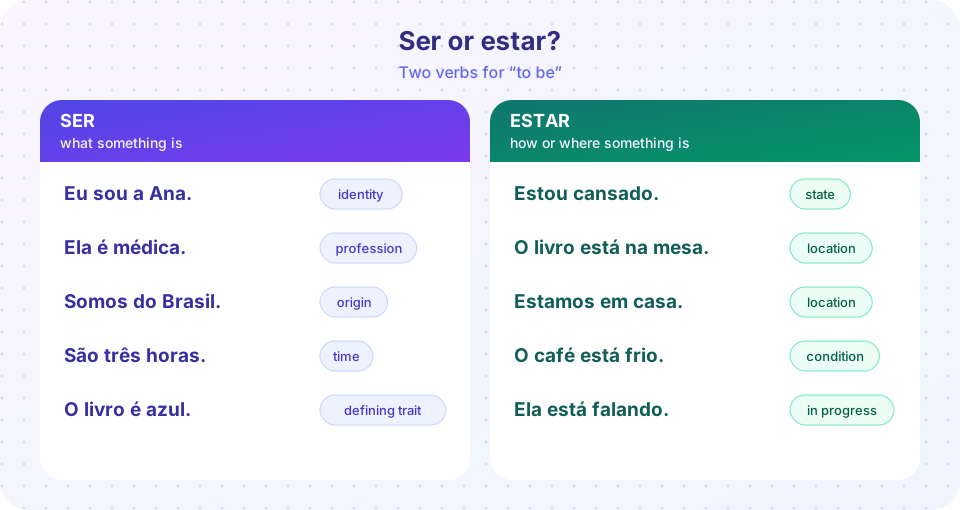
English has one verb "to be". Portuguese has two: ser and estar. At first this seems like double the work, but the two verbs divide the job logically. Very roughly, ser says what something is (identity, origin, profession, time, and defining traits), and estar says how or where something is (location, condition, and state).
These are the two most frequent verbs in the language. You will say sou and estou in your first minute of conversation, so it is worth learning them well. This lesson gives you the forms, the rules of use with many examples, the pairs where the choice changes the meaning, and a few common expressions that use estar com.
What you will learn
- The present tense of ser and estar.
- The main uses of each verb.
- How ser and estar change the meaning of some adjectives.
- Expressions such as estou com fome and the progressive estou falando.
- How to make negatives and questions.
Key terms
Ser: the verb of identity and lasting characteristics.
Estar: the verb of location and temporary states.
Progressive: the form that says an action is in progress: estou falando (I am speaking).
Gerund (gerúndio): the verb form ending in -ando, -endo, -indo, used in the progressive in Brazil.
The forms
| Pronoun | ser (to be) | estar (to be) |
|---|---|---|
| eu | sou | estou |
| tu | és | estás |
| você / ele / ela / a gente | é | está |
| nós | somos | estamos |
| vocês / eles / elas | são | estão |
Pronunciation (Brazil): sou "so", é "eh", somos "SOH-moos", são "sowng"; estou "ehs-TOH", está "ehs-TAH", estamos "ehs-TAH-moos", estão "ehs-TOWNG". In casual Brazilian speech, estar often loses its first syllable: tô (estou), tá (está), tamo (estamos), tão (estão). You will hear Tá bom! ("OK!") all the time. In writing and formal speech, use the full forms.
When to use ser
1. Identity and definition
- Eu sou a Ana. (I am Ana.)
- Isto é um livro. (This is a book.)
2. Nationality and origin (with de)
- Sou brasileiro. (I am Brazilian.)
- Somos de São Paulo. (We are from São Paulo.)
3. Profession and role (no article)
- Ela é médica. (She is a doctor.)
- Eles são estudantes. (They are students.)
4. Time, dates, and days
- São duas horas. (It is two o'clock.)
- Hoje é segunda-feira. (Today is Monday.)
5. Defining characteristics: appearance, personality, size, color
- A casa é grande. (The house is big.)
- Meu irmão é simpático. (My brother is nice.)
- O céu é azul. (The sky is blue.)
6. Material and possession (with de)
- A mesa é de madeira. (The table is made of wood.)
- O livro é da Ana. (The book is Ana's.)
7. Where an event takes place
- A festa é na minha casa. (The party is at my house.)
8. Impersonal opinions: É importante estudar. (It is important to study.)
When to use estar
1. Location of people and things
- Eu estou em casa. (I am at home.)
- O livro está na mesa. (The book is on the table.)
- Onde está o banheiro? (Where is the bathroom?)
2. Temporary states and conditions
- Estou cansado. (I am tired.)
- O café está frio. (The coffee is cold.)
- Ela está doente. (She is sick.)
3. Feelings and moods
- Estamos felizes. (We are happy.)
- Ele está triste. (He is sad.)
4. Actions in progress (progressive)
- Brazil: Estou estudando. (I am studying.) Eles estão comendo. (They are eating.)
- Portugal: Estou a estudar. Eles estão a comer.
The Brazilian progressive uses estar plus the gerund. Make the gerund by replacing the infinitive ending: -ar → -ando (falar → falando), -er → -endo (comer → comendo), -ir → -indo (partir → partindo).
Expressions with estar com
To say that someone feels hungry, thirsty, cold, hot, or sleepy, Portuguese uses estar com plus a noun, literally "to be with hunger":
| Portuguese | English |
|---|---|
| Estou com fome. | I am hungry. |
| Estou com sede. | I am thirsty. |
| Estou com frio. / com calor. | I am cold. / hot. |
| Estou com sono. | I am sleepy. |
| Estou com pressa. | I am in a hurry. |
| Estou com medo. | I am afraid. |
In Portugal, people also say Tenho fome or Tenho sede, using the verb ter (you will meet it in the next lessons). Both forms are understood everywhere.
The same adjective, two verbs
With adjectives, the choice of verb changes the meaning: ser says a lasting trait, and estar says a current state.
| With ser | With estar |
|---|---|
| Ela é bonita. She is pretty (a pretty person). | Ela está bonita. She looks pretty today. |
| Ele é feliz. He is a happy person. | Ele está feliz. He is happy right now. |
| Ela é nervosa. She is a nervous type. | Ela está nervosa. She is nervous now. |
| A banana é verde. The banana is a green variety. | A banana está verde. The banana is unripe. |
| Ele é chato. He is boring or annoying (by nature). | Ele está chato. He is being annoying today. |
A useful test is to ask whether the quality is part of what the thing is, or a state that can change.
Exceptions to the simple rule
The rule "ser = permanent, estar = temporary" is a good start, but it has limits. People use ser for events (O jogo é às oito horas) even though they are temporary, and estar for places even when a thing always stays there (O Brasil está na América do Sul). So think of identity and definition versus state and location, instead of only "permanent versus temporary".
Negatives and questions
To make a negative, put não before the verb: Eu não sou brasileiro. (I am not Brazilian.) Ela não está em casa. (She is not at home.) To ask a yes-or-no question, keep the same word order and raise your voice at the end: Você é brasileiro? (Are you Brazilian?) Ela está em casa? (Is she at home?) Question words come first: Onde você está? (Where are you?) Como você está? (How are you?) De onde você é? (Where are you from?) Quem é ele? (Who is he?)
A dialogue
| Portuguese | English |
|---|---|
| A: Você é brasileiro? | Are you Brazilian? |
| B: Sou, sou de Recife. E você? | Yes, I am from Recife. And you? |
| A: Sou americana, mas estou morando no Brasil. | I am American, but I am living in Brazil. |
| B: Como você está? | How are you? |
| A: Estou bem, só um pouco cansada. | I am fine, just a little tired. |
| B: Estou com fome. Vamos comer? | I am hungry. Shall we eat? |
Choosing quickly
When you are speaking, you do not have time to review every rule. Use two quick questions. If the question is "What is it?" or "Who is it?" (a name, a job, a country, a day, a size, a color, a general quality), choose ser. If the question is "Where is it?" or "How is it right now?" (a place, a mood, a condition, an action in progress), choose estar.
Test the questions on a few sentences. Meu pai é médico answers "What is he?", so ser. Meu pai está no hospital answers "Where is he?", so estar. A sopa é quente is a general fact, the usual state of soup, but A sopa está quente says it is hot at this moment, which is what you say before you eat. Ele é doente would suggest a chronic condition, while Ele está doente says he is sick now, which is the usual meaning.
Mistakes with these two verbs are among the most common ones for English speakers, and native speakers forgive them easily. If you pick the wrong one and are corrected, repeat the sentence with the right verb once, and move on.
Common misconceptions
"Ser means permanent and estar means temporary." It helps, but events use ser and locations use estar.
"Estar is for feelings only." It also covers location (O livro está na mesa) and progressive actions (Estou estudando).
"I can use ser or estar for hunger." Use estar com (or ter in Portugal): Estou com fome, not Sou fome.
"I am cold = Sou frio." Sou frio means "I am a cold person (emotionally cold)". For temperature, say Estou com frio.
"Estou a falar is wrong." It is the normal European form; in Brazil the standard form is Estou falando.
Try it
The first tool is a game. Choose ser or estar for each sentence.
The second tool prints the present tense of ser and estar and builds the Brazilian progressive. It applies the rules in this lesson.
Press Run (or Ctrl + Enter) to see the result here.
Program input · what you'd type while the program runs
Type the answers before you press Run, one per line. Each time the program reads a line (with input()), it gets the next line from this box.
Check your understanding
Quick check · 6 questions
of 6 answered You scored / 6 · perfect!
-
1. Which verb do you use for a person's profession?
Professions use ser: Ela é médica. -
2. How do you say 'The book is on the table'?
Location of things uses estar: O livro está na mesa. -
3. What does 'Ela está bonita' suggest?
Estar with an adjective gives a current impression; ser gives a lasting trait. -
4. How do you say 'I am hungry'?
Hunger uses estar com: Estou com fome. -
5. Which form goes with 'nós' for ser?
Nós somos (ser); nós estamos is the form of estar. -
6. How do you say 'I am studying' in Brazil?
Brazil uses estar + gerund: estou estudando. Estou a estudar is European.
Summary
- Ser: sou, é, somos, são (and tu és). Estar: estou, está, estamos, estão (and tu estás).
- Use ser for identity, origin, profession, time, defining traits, material, possession, and events.
- Use estar for location, states, feelings, and progressive actions.
- Some adjectives change meaning: é bonita (pretty) versus está bonita (looks pretty today).
- Hunger, thirst, cold, and heat use estar com; make negatives with não before the verb.
Next: Regular present verbs
Track your progress
Create a free account to tick off lessons and pick up where you left off on any device.
of Portuguese for Beginners lessons completed