


















Lesson 30 of 48 · Past Tenses
The Pretérito Imperfeito: Habits and Descriptions
Learn the Portuguese imperfect: the endings -ava and -ia, the irregular verbs ser, ter, vir and pôr, and how to describe habits, childhood and ongoing actions.
When you describe how things used to be, you need the pretérito imperfeito. "When I was a child, I lived in Recife. We played in the street every afternoon. It was always hot." Each of those sentences paints a picture rather than reporting a single event, and in Portuguese the verbs are all in the imperfeito.
This is the friendliest past tense to learn. The endings are almost completely regular: only four verbs are irregular. The challenge is not the forms but the idea: you must decide whether you are describing a scene or reporting an event. This lesson teaches the forms and the main uses; the next one practices the choice between the two pasts.
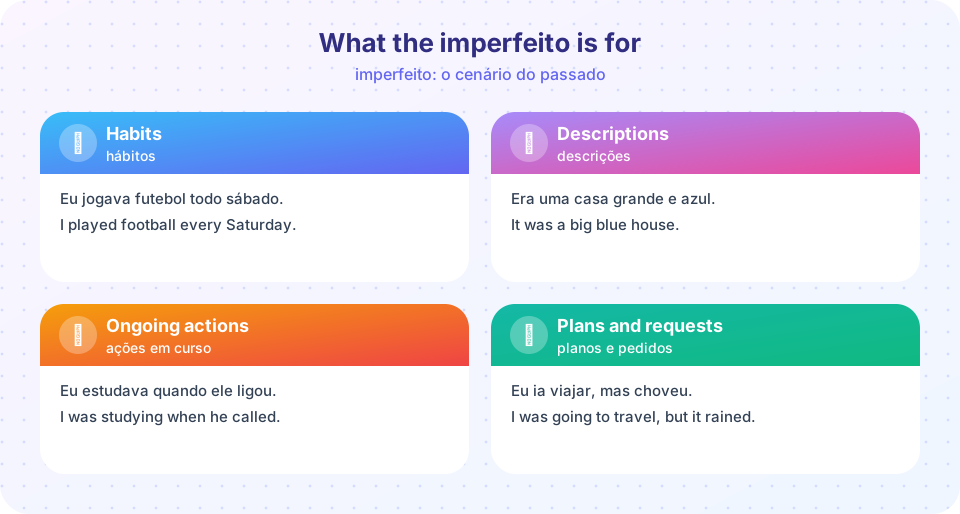
What you will learn
- The imperfeito endings for -ar and -er/-ir verbs.
- The irregular verbs: ser, ter, vir and pôr, plus the regular ir and ver.
- The uses: habits, descriptions, ongoing actions, ages and time, and polite requests.
- The past progressive: "estava falando" in Brazil, "estava a falar" in Portugal.
Key terms
Imperfeito: the past tense for habits and scenes. "Imperfeito" means not completed: it does not say how the situation ended.
Gerúndio (gerund): the -ndo form (falando, comendo, partindo), used in Brazil for actions in progress.
Antigamente: in the old days. Naquela época: at that time.
Hábito (habit): something you did repeatedly in the past.
The forms
Add these endings to the stem of the verb (the infinitive without -ar, -er or -ir):
| Person | -ar (falar) | -er (comer) | -ir (partir) |
|---|---|---|---|
| eu | falava | comia | partia |
| tu | falavas | comias | partias |
| você / ele / ela | falava | comia | partia |
| nós | falávamos | comíamos | partíamos |
| vocês / eles / elas | falavam | comiam | partiam |
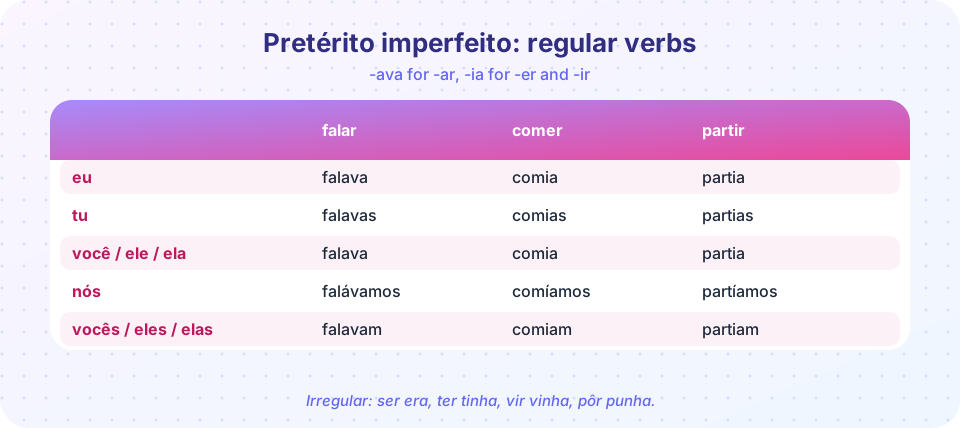
Two details deserve attention:
- The eu and você/ele forms are identical (falava, comia). The subject pronoun, or the context, tells you who is meant. In the past you will hear "eu" more often to avoid confusion.
- The nós form has a written accent on the stressed syllable: falávamos, comíamos, partíamos. Without it, the stress would be wrong.
The irregular verbs
Only four verbs are irregular in the imperfeito:
| Infinitive | eu | você/ele/ela | nós | vocês/eles |
|---|---|---|---|---|
| ser | era | era | éramos | eram |
| ter | tinha | tinha | tínhamos | tinham |
| vir | vinha | vinha | vínhamos | vinham |
| pôr | punha | punha | púnhamos | punham |
The verbs ir and ver are regular: ia, ias, ia, íamos, iam and via, vias, via, víamos, viam. That makes the imperfeito much easier than the perfeito, where nearly every common verb is irregular.
What the imperfeito expresses
1. Habits and repeated actions (used to)
- Todo sábado eu jogava futebol. (Every Saturday I played football.)
- Minha avó cozinhava aos domingos. (My grandmother cooked on Sundays.)
- A gente ia à praia todo verão. (We used to go to the beach every summer.)
English often uses "used to" or "would". Portuguese needs no extra word. Time markers include sempre (always), todo dia (every day), às vezes (sometimes), normalmente, antigamente and quando eu era criança.
2. Descriptions: people, places, weather, age and time
- Era uma casa grande e azul. (It was a big blue house.)
- Eu tinha dez anos. (I was ten years old. Literally: I had ten years.)
- Chovia muito. (It rained a lot. / It was raining a lot.)
- Fazia frio. (It was cold.)
- Eram oito horas. (It was eight o'clock.) And Era meio-dia. (It was noon.)
- Havia muita gente. (There were many people.) In Brazilian speech Tinha muita gente is more common.
The scene-setting uses ser, ter, estar and weather verbs most often: era, tinha, estava, chovia, fazia.
3. Actions in progress
- Eu estudava quando ele ligou. (I was studying when he called.)
- Ela dormia e eu lia. (She was sleeping and I was reading.)
For emphasis, Brazilian Portuguese uses estar in the imperfeito + gerund: Eu estava estudando, Ela estava dormindo. Portugal uses estar + a + infinitive: Eu estava a estudar, Ela estava a dormir. Both mean "was studying".
4. Feelings, states and polite requests
- Eu estava cansada e queria dormir. (I was tired and wanted to sleep.)
- Eu queria perguntar uma coisa. (I wanted to ask something: a polite opening.)
Polite uses of queria, podia and tinha soften a request: "Eu queria um café" (I would like a coffee). This is the queria from the restaurant lesson.
5. Plans that changed
- Eu ia viajar, mas choveu. (I was going to travel, but it rained.)
- Nós íamos sair quando o telefone tocou. (We were about to leave when the phone rang.)
The imperfeito of ir plus an infinitive means "was going to".
6. Stories: "Era uma vez"
Fairy tales start with Era uma vez... (Once upon a time...), a perfect example of the imperfeito setting the scene.
Questions, negatives and "would"
Questions and negatives need no new forms. Put não before the verb, or raise your voice: "Você morava aqui?" (Did you live here?), "Eu não gostava de acordar cedo." (I did not like getting up early.), "O que vocês faziam nas férias?" (What did you do on vacation?) Object pronouns follow the usual rule: "Ele me ligava todo dia" (He called me every day).
The imperfeito also translates English "would" when it means a habit in the past: "Every summer we would visit my grandmother" is "Todo verão a gente visitava a minha avó". Do not use the conditional (visitaria) for habits. The conditional is for hypotheticals and polite requests.
Stress and pronunciation
The stress in these forms is easy to hear if you say them in groups. In falava the stress falls on the second syllable (fa-LA-va), unlike the perfeito fa-LOU. In comia it falls on the mi (co-MI-a). In the nós form the stress shifts to the syllable before the ending, and the written accent marks it: fa-LÁ-va-mos, co-MÍ-a-mos. Say these aloud: falava, falavas, falávamos, falavam; comia, comias, comíamos, comiam.
A childhood dialogue
| Portuguese | English |
|---|---|
| Onde você morava quando era criança? | Where did you live when you were a child? |
| Eu morava em Recife, perto da praia. | I lived in Recife, near the beach. |
| O que vocês faziam nas férias? | What did you do on vacation? |
| A gente ia para a casa da minha avó. Ela cozinhava o dia inteiro e tinha um cachorro chamado Bidu. | We went to my grandmother's house. She cooked all day and had a dog called Bidu. |
| Que bom! Você tinha muitos primos? | How nice! Did you have many cousins? |
| Tinha, sim. Éramos doze! | Yes, I did. There were twelve of us! |
Common misconceptions
"Imperfeito" means the action was never finished. Not exactly. It describes a situation without saying when it ended. "Eu morava em Recife" tells you where you lived, not that you moved.
"I played" is always the imperfeito. "Eu joguei" (a single match) is the perfeito; "Eu jogava" (regularly) is the imperfeito. See the next lesson.
"Tinha" always means "had". In Brazilian speech "tinha" also means "there was/were": "Tinha muita gente na festa."
"Falava" can only be "I spoke". It also means "he/she spoke", "I used to speak" and "I was speaking".
Try it
First, a Python conjugator for the imperfeito. Predict the output for each verb before you run it. The progressive "estava + gerund" is included for comparison.
Press Run (or Ctrl + Enter) to see the result here.
Program input · what you'd type while the program runs
Type the answers before you press Run, one per line. Each time the program reads a line (with input()), it gets the next line from this box.
Next, a gap-fill about a childhood scene. Choose the imperfeito form.
Finally, flashcards with typical past-scene sentences.
Check your understanding
Quick check · 6 questions
of 6 answered You scored / 6 · perfect!
-
1. What is the imperfeito nós form of 'falar'?
-ar verbs use -ávamos in the nós form, with an accent on the á: falávamos. -
2. Which sentence describes a habit?
'Todo sábado' signals repetition, so the imperfeito 'jogava' is right. -
3. Which is the imperfeito of 'ser' for 'eu'?
'Era' is the imperfeito; 'fui' is the perfeito; 'seria' is the conditional. -
4. How do you say 'I was ten years old'?
Portuguese uses 'ter' for age: Eu tinha dez anos. -
5. Which sentence means 'I was going to travel, but it rained'?
'Ia' + infinitive (the imperfeito of ir) means 'was going to'. -
6. What is the Brazilian way to say 'I was studying' with emphasis?
Brazil uses estar + gerund. 'Estava a estudar' is the European form.
Summary
- Endings: -ar → -ava, -avas, -ava, -ávamos, -avam; -er/-ir → -ia, -ias, -ia, -íamos, -iam.
- Irregular: ser (era), ter (tinha), vir (vinha), pôr (punha). Ir (ia) and ver (via) are regular.
- Use the imperfeito for habits, descriptions, ages, time, weather, ongoing actions and "was going to".
- Brazil: estava + gerund; Portugal: estava + a + infinitive.
- "Queria" and "podia" are polite requests.
Next: Perfeito or imperfeito?
Track your progress
Create a free account to tick off lessons and pick up where you left off on any device.
of Portuguese for Beginners lessons completed