


















Lesson 44 of 48 · Projects and Practice
Project 2: Build Your Own Travel Phrasebook
Build a personal Portuguese travel phrasebook with 40 phrases for transport, hotels, food, health and emergencies, plus a searchable app and a flashcard export.
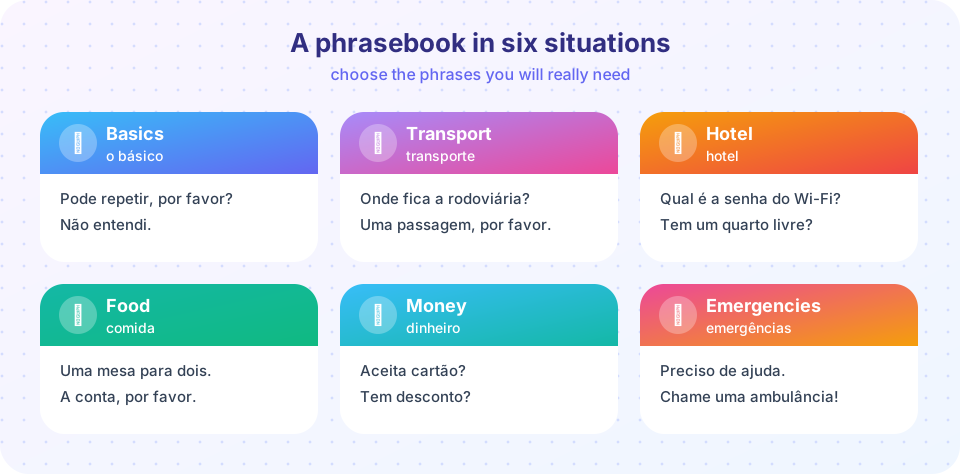
A good phrasebook is not a long list of sentences; it is a short list that you have chosen, understood and practiced. In this project you will build your own travel phrasebook for Brazil (with notes for Portugal): about 40 phrases in six categories, each one adapted to your trip. You will then use a searchable app to review it and a Python script to export your phrases as flashcards for any spaced-repetition program.
The pattern you will use most is simple: a request frame plus a noun. "Preciso de..." (I need...), "Onde fica...?" (Where is...?), "Tem...?" (Do you have...?), "Posso...?" (Can I...?), "Quanto custa...?" (How much does... cost?). If you master these five frames, one noun at a time, you can say hundreds of sentences.
What you will learn
- How to organize a phrasebook by situation and by sentence frame.
- Forty useful phrases for travel in Brazil, with notes for Portugal.
- How to adapt the phrases to your own needs (diet, health, plans).
- How to export your phrases as flashcards.
Key terms
Frase útil (useful phrase): a complete sentence you can use as it is.
Estrutura (frame): a sentence pattern with a slot for a noun, like "Preciso de ___".
Cartão de memória (flashcard): a card with the question on one side and the answer on the other.
Repetição espaçada (spaced repetition): reviewing items at growing intervals.
Five frames that carry the whole trip
| Frame | Use | Examples |
|---|---|---|
| Preciso de + noun | I need... | Preciso de ajuda. / Preciso de um médico. |
| Onde fica / Onde tem ...? | Where is...? | Onde fica o banheiro? / Onde tem uma farmácia? |
| Tem ...? | Do you have...? | Tem Wi-Fi? / Tem mesa para dois? |
| Posso + infinitive? | Can I...? | Posso pagar com cartão? / Posso sentar aqui? |
| Quanto custa / Quanto é ...? | How much...? | Quanto custa a passagem? |
In Brazil "Tem...?" is the natural way to ask "Is there...?" or "Do you have...?". Portugal says "Há...?" and "Tem...?" both.
The 40-phrase phrasebook
Arriving and basics
| Portuguese | English |
|---|---|
| Bom dia. / Boa tarde. / Boa noite. | Good morning. / Good afternoon. / Good evening. |
| Com licença. | Excuse me. |
| Eu não falo bem português. | I do not speak Portuguese well. |
| Você fala inglês? | Do you speak English? |
| Pode repetir, por favor? | Can you repeat, please? |
| Não entendi. | I did not understand. |
| Como se diz isso em português? | How do you say this in Portuguese? |
Transport
| Portuguese | English |
|---|---|
| Onde fica a rodoviária / o aeroporto? | Where is the bus station / the airport? |
| Uma passagem para o Rio, por favor. | One ticket to Rio, please. |
| De ida e volta. | Round trip. |
| Esse ônibus vai para o centro? | Does this bus go downtown? |
| Pode me avisar quando chegar? | Can you tell me when we arrive? |
| Quanto custa até o hotel? | How much to the hotel? |
| Estou perdido / perdida. | I am lost. |
Hotel
| Portuguese | English |
|---|---|
| Tenho uma reserva em nome de... | I have a reservation under the name... |
| Tem um quarto disponível? | Is there a room available? |
| Qual é a senha do Wi-Fi? | What is the Wi-Fi password? |
| A que horas é o café da manhã? | What time is breakfast? |
| O ar-condicionado não funciona. | The air conditioning does not work. |
| Pode chamar um táxi? | Can you call a taxi? |
Food
| Portuguese | English |
|---|---|
| Uma mesa para dois, por favor. | A table for two, please. |
| O que você recomenda? | What do you recommend? |
| Sou vegetariano / vegetariana. | I am vegetarian. |
| Sou alérgico / alérgica a amendoim. | I am allergic to peanuts. |
| Sem pimenta, por favor. | Without hot pepper, please. |
| A conta, por favor. | The bill, please. |
Money and shopping
| Portuguese | English |
|---|---|
| Quanto custa? | How much does it cost? |
| Aceita cartão? / Aceita Pix? | Do you accept cards? / Pix? |
| Onde posso trocar dinheiro? | Where can I exchange money? |
| Tem desconto? | Is there a discount? |
| Pode embrulhar? | Can you wrap it? |
Health and emergencies
| Portuguese | English |
|---|---|
| Preciso de ajuda. | I need help. |
| Chame uma ambulância! | Call an ambulance! |
| Onde fica o hospital / a farmácia? | Where is the hospital / the pharmacy? |
| Estou com dor de cabeça / de barriga. | I have a headache / a stomachache. |
| Perdi o meu passaporte. | I lost my passport. |
| Roubaram a minha mochila. | They stole my backpack. |
Note the imperative in "Chame uma ambulância!" (subjunctive form of chamar) and the perfeito in "Perdi" and "Roubaram". These are survival sentences, so learn them as chunks.
Emergency numbers. In Brazil the main numbers are 190 (police), 192 (ambulance, SAMU) and 193 (fire brigade). In Portugal and across the EU the number is 112. Check the numbers again before your trip, as they can change.
How to adapt the phrasebook
- Cross out phrases you will not need. A phrasebook with 40 relevant phrases beats one with 200.
- Add your own: your diet, your health needs, your hotel, your hobby ("Onde posso alugar uma bicicleta?").
- Add the answers you may hear: "Siga em frente", "São quinze reais", "Não temos mais". Knowing the likely answer is half the conversation.
- Choose the variety: use "ônibus" in Brazil but "autocarro" in Portugal; "banheiro" versus "casa de banho".
A role-play to rehearse
Practice with a partner, or play both roles yourself. This is a hotel check-in.
| Portuguese | English |
|---|---|
| Boa tarde. Tenho uma reserva em nome de Daniel Souza. | Good afternoon. I have a reservation under Daniel Souza. |
| Boa tarde! Um momento, por favor. Sim, aqui está: quatro noites, quarto duplo. Pode me mostrar o passaporte? | Good afternoon! One moment, please. Yes, here it is: four nights, a double room. Can you show me your passport? |
| Claro, aqui está. A que horas é o café da manhã? | Of course, here it is. What time is breakfast? |
| De seis e meia às dez. A senha do Wi-Fi está no cartão. | From 6:30 to 10. The Wi-Fi password is on the card. |
| Obrigado. Pode chamar um táxi para amanhã às oito da manhã? | Thank you. Can you call a taxi for tomorrow at eight in the morning? |
| Pode deixar. Boa estadia! | Leave it to me. Enjoy your stay! |
First read it aloud with the English covered. Then change the details: another name, another time, another request (a late check-out, an extra towel, a quieter room). Changing one detail at a time is how the frames become flexible.
If you are traveling to Portugal
Swap the vocabulary: autocarro for ônibus, casa de banho for banheiro, pequeno-almoço for café da manhã, telemóvel for celular, ementa for cardápio. The polite "please" in shops and restaurants is often se faz favor: "A conta, se faz favor." Cash machines are often called multibanco: "Onde há um multibanco?" The emergency number is 112. Pronoun position changes too: "Pode ajudar-me?" instead of "Pode me ajudar?".
Common misconceptions
"I need hundreds of phrases." You need the frames and the nouns you will really use.
"I only need to say things." Practice the answers too, especially numbers, directions and times.
"A phrasebook makes me sound like a robot." Sentences you have practiced and personalized sound natural; use "por favor" and smile.
"Emergency phrases are not for beginners." They are the most important ones. Learn them first.
Try it
The first TryIt is a searchable phrasebook app. Filter by category, search any word and add your own phrases (they are kept only while the page is open). Edit the book list to add your trip's phrases.
The second TryIt exports your phrases as tab-separated flashcards: one line per card, front and back separated by a tab. Most flashcard programs can import this format. Copy the printed lines into a text file named phrasebook.txt.
Press Run (or Ctrl + Enter) to see the result here.
Program input · what you'd type while the program runs
Type the answers before you press Run, one per line. Each time the program reads a line (with input()), it gets the next line from this box.
Finally, a flashcard deck of survival phrases to say aloud.
Check your understanding
Quick check · 4 questions
of 4 answered You scored / 4 · perfect!
-
1. Which frame means 'I need...'?
'Preciso de' + noun means 'I need'. -
2. What are the main emergency numbers in Brazil?
Brazil uses 190, 192 and 193; Portugal and the EU use 112. Check before you travel. -
3. What does 'Pode me avisar quando chegar?' ask?
'Avisar' = to let someone know; 'quando chegar' uses the future subjunctive. -
4. Which is best for a good phrasebook?
Relevant, practiced phrases are more useful than a long unused list.
Summary
- Build a short phrasebook of about 40 phrases in six situations: basics, transport, hotel, food, money, health and emergencies.
- Five frames carry a lot of meaning: Preciso de, Onde fica, Tem, Posso, Quanto custa.
- Personalize it, add the answers you may hear, and choose the variety (Brazil or Portugal).
- Export it as tab-separated flashcards for spaced repetition.
Next: Mixed practice drills
Track your progress
Create a free account to tick off lessons and pick up where you left off on any device.
of Portuguese for Beginners lessons completed