


















Lesson 17 of 48 · Present Tense Verbs
Chapter 4 Overview: Present Tense Verbs
Preview chapter 4 of Portuguese for Beginners: subject pronouns, the infinitive, regular -ar -er -ir verbs, ser and estar, and the first irregular verbs.
Verbs are the engine of every sentence. They tell you who does what, and when. In this chapter you will learn the present tense, which you use to say what is true now and what happens regularly: Eu falo português ("I speak Portuguese"), Ela trabalha em São Paulo ("She works in São Paulo"), Nós somos amigos ("We are friends").
Portuguese verbs look intimidating because they change their ending for each person. English changes very little ("I speak, you speak, she speaks"), while Portuguese has up to six different forms. The good news is that the endings are regular and predictable. Learn the three verb families and the dozen verbs that break the rules, and you will be able to say most of what you need.
What you will learn
- What the infinitive is and how verbs are grouped as -ar, -er, and -ir.
- The subject pronouns, including você and a gente.
- How to conjugate regular verbs in the present.
- The two verbs "to be": ser and estar.
- Common irregular verbs such as ter, ir, fazer, poder, and querer.
Key terms
Verb (verbo): a word for an action or state: falar (to speak), ser (to be).
Infinitive (infinitivo): the dictionary form, ending in -ar, -er, or -ir: falar, comer, partir.
Conjugation (conjugação): changing the verb to match the person and tense.
Stem and ending: the stem is what remains after you remove -ar/-er/-ir; the ending shows the person: fal + o = falo.
Subject pronoun: a word for the doer: eu, você, nós.
The big picture
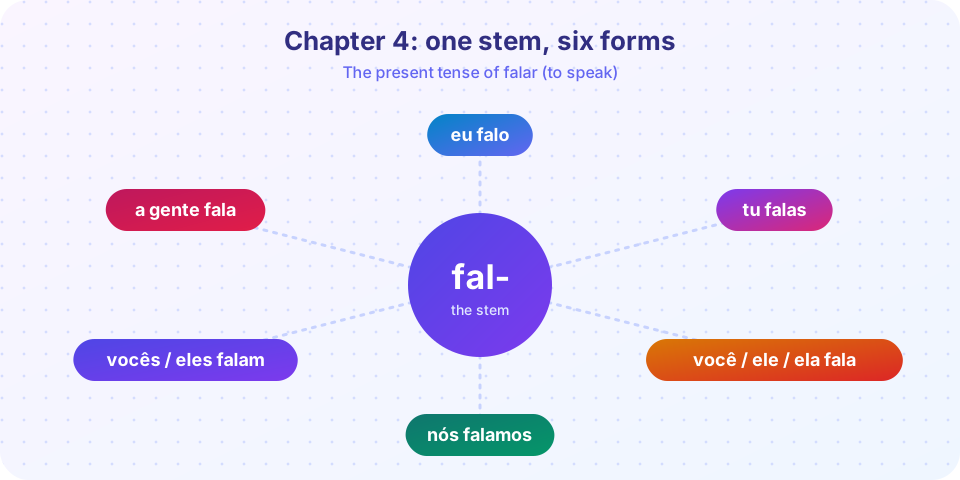
One infinitive, many forms. The infinitive is the name of the verb. When you look up falar in a dictionary or say "I want to speak" (Quero falar), you use the infinitive. To say who is speaking, you remove -ar, keep the stem fal-, and add an ending: falo, falas, fala, falamos, falam.
Three families. Verbs ending in -ar (falar, trabalhar, estudar) are by far the most common. Verbs in -er (comer, beber, vender) and -ir (partir, abrir, decidir) use slightly different endings. Once you know one verb in each group, you can conjugate hundreds.
You can drop the pronoun. The ending already tells you who is acting, so Portuguese often leaves out eu, nós, and so on: Falo português means "(I) speak Portuguese". You use the pronoun for emphasis or clarity: Eu falo, mas ela não fala.
Some verbs are irregular. The most useful verbs, such as ser, estar, ter, ir, fazer, break the pattern. They are used so often that you will learn them by repetition.
Who is acting?
Three families
The big verbs
The subject pronouns
| Pronoun | Meaning | Notes |
|---|---|---|
| eu | I | |
| tu | you (informal singular) | Standard in Portugal; used in parts of Brazil |
| você | you (singular) | The usual "you" in most of Brazil |
| ele / ela | he / she | |
| nós | we | |
| a gente | we (informal) | Common in Brazilian speech; the verb is in the ele/ela form |
| vocês | you (plural) | Used in Brazil for "you all"; also in Portugal in some situations |
| eles / elas | they | Eles is used for mixed groups |
Você and vocês take the same verb endings as ele/ela and eles/elas. This is why, in practice, many Brazilians use only four verb forms in conversation: eu, você/ele/ela/a gente, nós (often replaced by a gente), and vocês/eles/elas. Speakers of tu add a fifth form. The old form vós exists in literature and prayers but is not used in daily speech.
The lessons in this chapter
| Lesson | What it covers |
|---|---|
| Ser and estar | Two verbs for "to be", their forms, and when to use each. |
| Regular present verbs | -ar, -er, -ir endings, negation, questions, and everyday verbs. |
| Irregular present verbs | ter, ir, fazer, poder, querer, dizer, ver, vir, saber, dar, ler, pôr and ir + infinitive. |
| Chapter 4 review | A one-picture summary and a ten-question quiz. |
A first dialogue
| Portuguese | English |
|---|---|
| A: Você fala inglês? | Do you speak English? |
| B: Falo, e também falo um pouco de espanhol. | I do, and I also speak a little Spanish. |
| A: Eu estudo português. | I study Portuguese. |
| B: Que legal! Onde você mora? | How cool! Where do you live? |
| A: Moro em Boston. E você? | I live in Boston. And you? |
| B: Moro no Rio. | I live in Rio. |
Look at the endings: falo (I speak), estudo (I study), moro (I live). All end in -o, the eu form of regular verbs. Você fala uses -a, the third-person ending.
Common misconceptions
"I must always say the pronoun." You usually do not: Moro em Boston is more natural than Eu moro em Boston.
"Você takes the tu form." It takes the third-person form: você fala, not você falas.
"There is one verb for 'to be'." There are two, ser and estar, with different uses.
"Portuguese present means only 'right now'." It also covers habits (Eu estudo todos os dias) and near plans (Amanhã eu viajo).
Try it
The first tool trains you to link verb forms to pronouns. Each form tells you who is acting.
The second tool splits an infinitive into stem and ending and builds the present tense of an -ar verb. It previews the next lessons.
Press Run (or Ctrl + Enter) to see the result here.
Program input · what you'd type while the program runs
Type the answers before you press Run, one per line. Each time the program reads a line (with input()), it gets the next line from this box.
Check your understanding
Quick check · 5 questions
of 5 answered You scored / 5 · perfect!
-
1. What is the infinitive of 'falo'?
Falar is the infinitive; falo is the eu form. -
2. Which pronoun goes with 'falamos'?
The ending -amos signals nós. -
3. Why can Portuguese often drop 'eu'?
Falo can only mean I speak, so eu is optional. -
4. Which verb form goes with 'você'?
Você uses the same form as ele/ela: você fala. -
5. What does 'a gente' mean?
A gente means we in everyday Brazilian Portuguese: a gente fala.
Summary
- Verbs have an infinitive (-ar, -er, -ir) and change their endings for each person.
- Regular verbs follow predictable patterns; the stem stays and the ending changes.
- Pronouns can be dropped: Moro em Boston.
- Você/ele/ela/a gente share a form; so do vocês/eles/elas.
- Ser, estar, and a dozen irregular verbs must be learned individually.
Next: Ser and estar
Track your progress
Create a free account to tick off lessons and pick up where you left off on any device.
of Portuguese for Beginners lessons completed