


















Lesson 42 of 48 · Conversation and Culture
Chapter 8 Review: Conversation and Culture
Review informal Brazilian speech, the differences between Brazilian and European Portuguese, and etiquette with a recap table, a picture and a quiz.
In this chapter you moved from the grammar book to the real world: spoken contractions and slang, the two major varieties of Portuguese, and the customs that surround the language. This review brings it together. The recap table lists the key points, the picture shows the chapter at a glance, and the quiz mixes all three topics.
Culture and informal speech are best learned by exposure, so treat this review as a map for further listening: choose three phrases, one from each lesson, and look for them in a song, a show or a conversation this week.
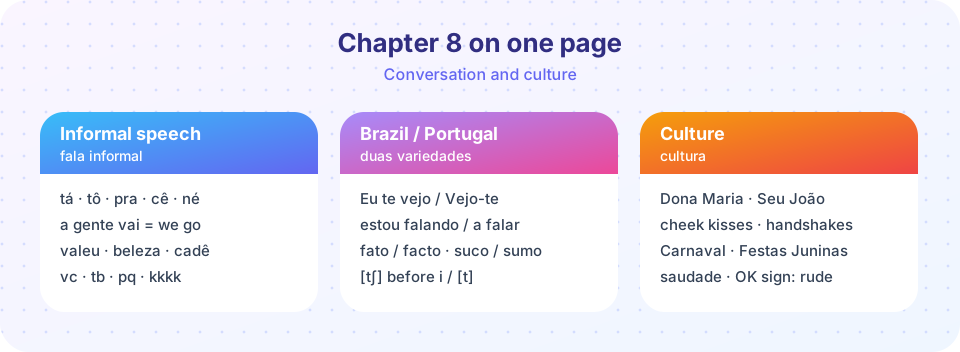
What you will learn
- Check your understanding of spoken forms, varieties and customs.
- Practice a mixed conversation using casual phrases and polite manners.
- Decide what to listen for next.
Recap table
| Topic | The key points | Example | Lesson |
|---|---|---|---|
| Spoken contractions | tá, tô, pra, pro, cê, né, bora | Tô com fome. | Informal Brazilian speech |
| A gente | means "we", third-person singular verb | A gente vai. | same |
| Slang | valeu, beleza, legal, cadê, de boa | Valeu! Beleza? | same |
| Chat | vc, tb, pq, blz, kkkk | vc vem? kkkk | same |
| Pronunciation | BR [tʃ] before i, final l as w; PT reduced vowels | tia [ˈtʃi.ɐ] / [ˈti.ɐ] | Brazil and Portugal |
| Spelling | fato/facto, recepção/receção, Antônio/António | fato / facto | same |
| Grammar | estou falando / estou a falar; Eu te vejo / Vejo-te | Pode me ajudar? / Pode ajudar-me? | same |
| Vocabulary | ônibus / autocarro; suco / sumo | trem / comboio | same |
| Greetings | cheek kisses, handshakes, first names, Dona/Seu | Dona Maria | Culture and etiquette |
| Meals | ask "Posso levar alguma coisa?"; service charge around 10 percent | Bom apetite! | same |
| Festivals | Carnaval, Festas juninas, 7 de Setembro, 25 de Abril | Réveillon | same |
| Culture words | saudade, cafuné, jeitinho brasileiro | Que saudade! | same |
A mixed dialogue
Read it aloud; mark the parts that are casual, the parts that are Brazilian and the parts that are polite.
| Portuguese | English |
|---|---|
| E aí, Dona Marta! Tudo bem com a senhora? | Hello, Dona Marta! How are you? |
| Tudo bem, querido. Cê já almoçou? | All good, dear. Have you had lunch yet? |
| Já, sim, obrigado. Vim só dar um oi. | Yes, thank you. I only came to say hi. |
| Que bom! A gente vai fazer um churrasco no sábado. Vem! | Great! We are having a barbecue on Saturday. Come! |
| Posso levar alguma coisa? | Can I bring something? |
| Leva um refrigerante. Que saudade de você! | Bring a soda. I have missed you so much! |
How to use this review
Chapter 8 is learned best by listening, so combine the review with real audio. Choose a short clip, a song or a video message in Portuguese and note every casual form (tá, pra, né, a gente), every word that is clearly Brazilian or European, and every cultural reference. Then read the recap table again and see which items you found. The quiz is a check, but the listening is the practice.
Common misconceptions
"I should speak as casually as possible." Match the situation: casual with friends, polite with strangers and elders.
"One variety is right and the other wrong." Both are standard; choose according to your goals.
"Gestures are universal." The "OK" sign is rude in Brazil.
"Culture words can be translated one-to-one." Saudade and cafuné have no single English word.
Try it
First, a mixed gap-fill about informal speech and manners.
The Python TryIt is a mini "culture quiz" that picks facts from a small dictionary. Run it, answer silently, and compare with the printed answers.
Press Run (or Ctrl + Enter) to see the result here.
Program input · what you'd type while the program runs
Type the answers before you press Run, one per line. Each time the program reads a line (with input()), it gets the next line from this box.
Check your understanding
Quick check · 10 questions
of 10 answered You scored / 10 · perfect!
-
1. What does 'a gente' mean in everyday Brazilian speech?
'A gente' means 'we' and takes a third-person singular verb. -
2. Which is the European Portuguese way to say 'I am speaking'?
Portugal uses estar + a + infinitive; Brazil uses the gerund. -
3. Which spelling is typical of Portugal?
'Facto' with the c is standard in Portugal; Brazil writes 'fato' for fact. -
4. What is 'Cê tá bem?' in standard Portuguese?
Cê = você (spoken), tá = está. -
5. Which gesture should you avoid in Brazil?
The OK circle is vulgar in Brazil. -
6. What is the capital of Brazil?
Brasília has been the capital since 1960. -
7. What does 'Eu te vejo' show?
Brazil places the pronoun before the verb. -
8. What is 'saudade'?
Saudade is nostalgic longing. -
9. When is it polite to ask 'Posso levar alguma coisa?'
It is a polite offer to contribute to a meal or party. -
10. How is 'tia' typically pronounced in most of Brazil?
T before i usually becomes [tʃ] in Brazil.
Summary
- Spoken Brazilian Portuguese: tá, tô, pra, né, a gente, valeu, beleza; chat abbreviations vc, tb, kkkk.
- Brazil and Portugal differ in pronunciation, spelling, pronoun position, progressive form and vocabulary.
- Culture: greetings, titles (Dona, Seu), manners at meals, the OK gesture, holidays and untranslatable words.
- Use casual forms where they fit; stay polite with strangers and elders.
Track your progress
Create a free account to tick off lessons and pick up where you left off on any device.
of Portuguese for Beginners lessons completed