


















Lesson 40 of 48 · Conversation and Culture
Brazilian vs European Portuguese: Key Differences
Compare Brazilian and European Portuguese: pronunciation, spelling after the 1990 agreement, grammar, pronouns, and a vocabulary table of everyday words.
Portuguese is one language with two main standard varieties, Brazilian and European, plus the African and Asian varieties that sit closer to the European norm in most respects. People from Brazil and Portugal understand each other, in the way that Americans and British people do, but the differences are more than a few vocabulary words: the pronunciation is noticeably different, the spelling has small but frequent differences, and a few grammar habits differ.
This course teaches Brazilian Portuguese as its base because most speakers and most media are Brazilian. If your goal is Portugal, Angola or Mozambique, you will not need to start over. You need to learn the differences in this lesson, which are fewer than they first appear.
What you will learn
- The main pronunciation differences, with IPA.
- Spelling differences and the 1990 Orthographic Agreement.
- Grammar differences: pronouns, progressive, pronoun position, possessives.
- A table of common vocabulary pairs and a few risky false friends.
- How to choose which variety to learn.
Key terms
Acordo Ortográfico de 1990 (AO90): the agreement to unify spelling across the Portuguese-speaking countries. In force in Brazil and Portugal since 2009, after transition periods.
Variedade (variety): a regional or national version of the language.
Consoante muda (silent consonant): letters like the c in "facto" that are not pronounced.
IPA: the International Phonetic Alphabet, in square brackets, for sounds.
Pronunciation
The writing is almost the same, but the sound is not. Here are the main differences. The IPA values are approximate and vary by region.
| Feature | Brazil | Portugal | Example |
|---|---|---|---|
| t and d before i (and final unstressed e) | usually [tʃ] and [dʒ] | [t] and [d] | tia: BR [ˈtʃi.ɐ], PT [ˈti.ɐ]; dia: BR [ˈdʒi.ɐ], PT [ˈdi.ɐ] |
| Unstressed vowels | clearly pronounced | reduced or dropped | pequeno: BR [peˈke.nu], PT [pɨˈke.nu] (sounds like "pkeno") |
| Final -e | [i] | nearly silent [ɨ] | leite: BR [ˈlej.tʃi], PT [ˈlɐj.tɨ] |
| Syllable-final s | [s] (São Paulo) or [ʃ] (Rio) | [ʃ] | os livros: PT [uʃ ˈli.vɾuʃ] |
| Final l | like a w: [w] | dark l: [ɫ] | Brasil: BR [bɾaˈziw], PT [bɾɐˈziɫ] |
| Initial r / rr | [h] or [x] in many areas | uvular [ʁ] or trilled [r] | rato: BR [ˈha.tu], PT [ˈʁa.tu] |
| Stressed e/o before m or n | closed vowel (ê, ô) | open vowel (é, ó) | Antônio / António |
For the beginner this means two things: Brazilian speech is easier to follow because the syllables are clear and pronounced, and European speech sounds "faster" because unstressed vowels shrink. Learners who study with Brazilian audio often find European Portuguese hard at first, but it becomes familiar quickly. Many Portuguese people understand Brazilian speech easily because of Brazilian music and television.
Spelling: AO90 and what still differs
Before 2009, the two countries had several spelling differences. The Orthographic Agreement of 1990 removed some, but not all. Both now write "ação", "ótimo", "direção". Some differences remain:
| Brazil | Portugal | Meaning | Reason |
|---|---|---|---|
| fato | facto | fact | Portugal keeps the c in some words where it is pronounced there |
| recepção | receção | reception | consonant pronounced or not |
| contato | contacto | contact | same |
| Antônio | António | Anthony | e/o before m or n: circumflex (BR) versus acute (PT) |
| fenômeno | fenómeno | phenomenon | same |
| bebê | bebé | baby | same |
| equipe | equipa | team | different final vowel |
These are small details, and a good spell-checker for each variety handles them.
Grammar differences
| Topic | Brazil | Portugal |
|---|---|---|
| Tu / você | você is the everyday "you" in most regions; tu in parts of the south and northeast (often with a 3rd-person verb) | tu for friends and family, você or "o senhor/a senhora" for formal or distant |
| Progressive | estou falando (gerund) | estou a falar (a + infinitive) |
| Pronoun position | Eu te vejo. Me liga! | Vejo-te. Liga-me! |
| Possessives | meu livro (article often dropped) | o meu livro (article almost always) |
| "We" | a gente is very common | nós; a gente exists but is less used |
Another difference is intonation. Brazilians use a lot of "né?" and "tá?", and Portuguese speakers say "pois" (yes), "está bem" (OK), and "então" in many positions. Both countries use "obrigado/obrigada" and "bom dia".
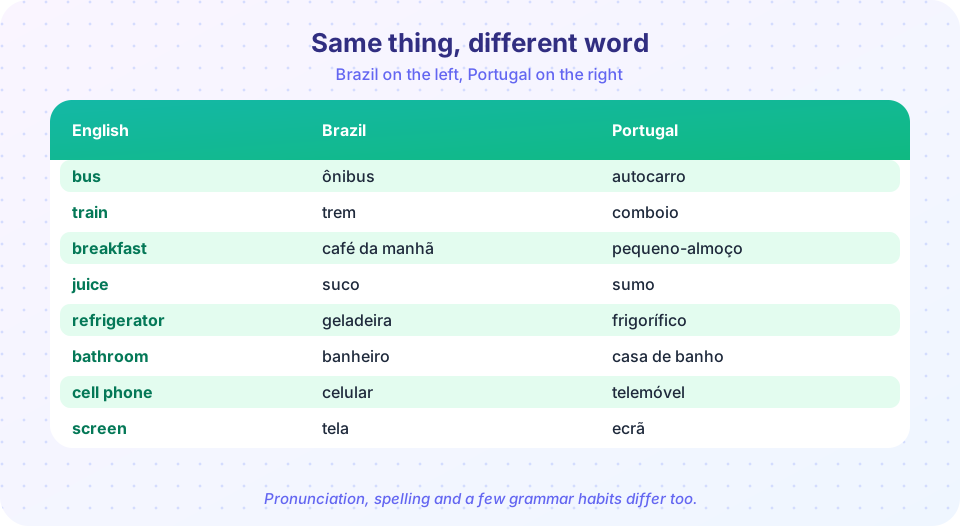
Vocabulary: different words for the same thing
| English | Brazil | Portugal |
|---|---|---|
| bus | ônibus | autocarro |
| train | trem | comboio |
| breakfast | café da manhã | pequeno-almoço |
| juice | suco | sumo |
| refrigerator | geladeira | frigorífico |
| bathroom | banheiro | casa de banho |
| cell phone | celular | telemóvel |
| screen | tela | ecrã |
| ice cream | sorvete | gelado |
| ticket (event) | ingresso | bilhete |
| team | time / equipe | equipa |
| user | usuário | utilizador |
| cup | xícara | chávena |
| lawn | grama | relva |
| suit | terno | fato |
| driver's license | carteira de motorista | carta de condução |
| queue / line | fila | bicha |
False friends and risky words
Some words have a different or even offensive meaning in the other variety, so be careful:
- rapariga: "girl" in Portugal, but in much of Brazil (especially the Northeast) it can be insulting. Use "menina", "garota" or "moça" in Brazil.
- puto: "kid, boy" (informal) in Portugal, but a rude word in Brazil.
- bicha: "queue" in Portugal; offensive in Brazil when used about people.
- camisola: "sweater, jersey" in Portugal; a nightgown in Brazil.
- fato: "suit" in Portugal; "fact" in Brazil (and "terno" is the suit).
The words that matter most are the ones above. If you are not sure, use a neutral word.
How the varieties get along
Speakers of the two varieties communicate without major problems, especially in writing. Newspapers, films and books are readable in either variety. Differences tend to show in speech: the speed, the reduced vowels, and the slang. In Africa, Angolan and Mozambican Portuguese are closer to the European norm in grammar, but with their own pronunciation, vocabulary from local languages and everyday habits. In Cape Verde, most people also speak Kabuverdianu (Cape Verdean Creole). Timor-Leste, Macau and Goa have small Portuguese-speaking communities.
Which one should I learn?
| If you want to... | Learn... | Notes |
|---|---|---|
| travel in Brazil, work with Brazilian companies, use Brazilian media | Brazilian | Most learning materials are Brazilian. |
| move to Portugal, study in Lisbon, work in the EU | European | Use European audio from the start. |
| work in Angola or Mozambique | European norm with local features | Add local vocabulary. |
| keep options open | Brazilian base + this lesson | Switch pronouns and vocabulary when needed. |
Whichever you choose, be consistent within a conversation, and do not worry about mixing: locals will help you.
A dialogue in both varieties
| Brazil | Portugal | English |
|---|---|---|
| Você está gostando da cidade? | Estás a gostar da cidade? | Are you enjoying the city? |
| Estou, sim. Peguei o ônibus até o centro. | Estou, sim. Apanhei o autocarro até ao centro. | Yes, I took the bus to the center. |
| Quer tomar um suco? | Queres beber um sumo? | Do you want to have a juice? |
| Vamos, é por minha conta. | Vamos, é por minha conta. | Let's go, it is on me. |
| Me liga amanhã! | Liga-me amanhã! | Call me tomorrow! |
Common misconceptions
"They are two different languages." They are one language with two standards that are mutually intelligible, with some effort in speech.
"European Portuguese is more correct." Both are correct standards. Neither is "pure".
"Brazilians do not use tu." Many do, especially in the south and parts of the northeast.
"The 1990 spelling agreement made them identical." It reduced differences, but spelling still differs in words like facto/fato.
Try it
The first TryIt is a small lookup tool. Type a word from either variety and see its counterpart.
The second TryIt is a Python "variety detector". It counts markers such as vocabulary, the progressive form and pronoun position. It is a toy that works on short sentences, not a real language identifier.
Press Run (or Ctrl + Enter) to see the result here.
Program input · what you'd type while the program runs
Type the answers before you press Run, one per line. Each time the program reads a line (with input()), it gets the next line from this box.
Last, a match activity: pair each Brazilian word with its European counterpart.
Check your understanding
Quick check · 6 questions
of 6 answered You scored / 6 · perfect!
-
1. Which sentence is typical of Brazilian Portuguese?
Brazil uses estar + gerund; Portugal uses estar + a + infinitive. -
2. What is the European Portuguese word for 'bus'?
'Autocarro' is the bus in Portugal; 'comboio' is the train. -
3. How is 'tia' typically pronounced in most of Brazil?
In most Brazilian dialects t before i becomes [tʃ]. -
4. What does 'camisola' mean in Brazil?
In Portugal it is a sweater or jersey; in Brazil it is a nightgown. -
5. What did the 1990 Orthographic Agreement do?
It removed some differences (like silent consonants in many words) but not all (fato/facto). -
6. Which pair shows the pronoun position difference?
Brazil: before the verb (Eu te vejo). Portugal: after it with a hyphen (Vejo-te).
Summary
- One language, two main standards: Brazilian and European. They are mutually intelligible.
- Pronunciation: Brazilian clear syllables, [tʃ] and [dʒ] before i, final l as [w]; European reduced vowels, [ʃ] for final s.
- Spelling still differs in words like fato/facto, recepção/receção and Antônio/António.
- Grammar: você versus tu, estou falando versus estou a falar, Eu te vejo versus Vejo-te, "o meu livro" versus "meu livro".
- Many everyday words differ; some false friends (rapariga, puto, bicha, camisola) can offend.
- Learn the one you need and learn the differences; switching is easy.
Next: Culture and etiquette
Track your progress
Create a free account to tick off lessons and pick up where you left off on any device.
of Portuguese for Beginners lessons completed