


















Lesson 20 of 48 · Present Tense Verbs
Irregular Present Verbs: ter, ir, fazer, poder, querer and More
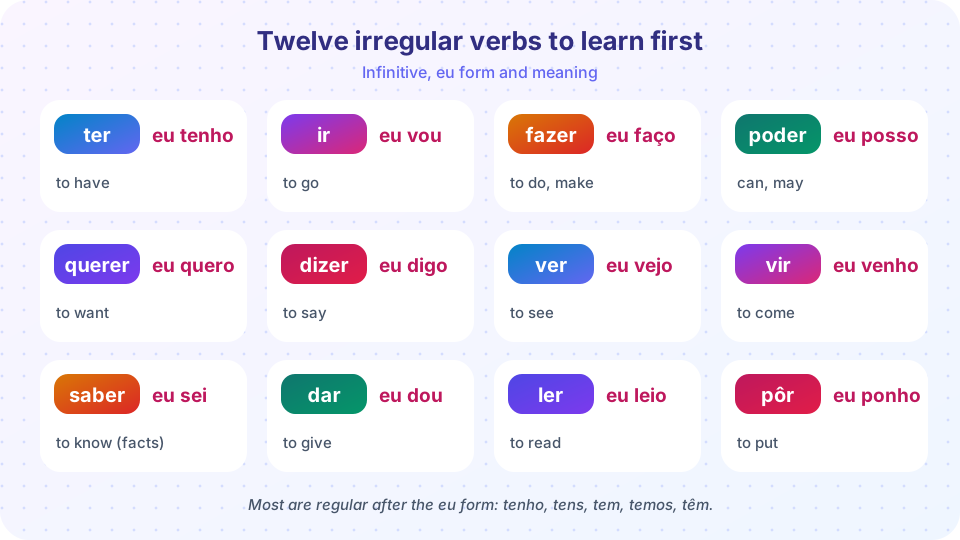
Learn the present tense of the most important irregular Portuguese verbs, ter, ir, fazer, poder, querer, dizer, ver, vir, saber, dar, ler and pôr, and the ir + infinitive future.
Irregular verbs are the busiest verbs in the language: ter (to have), ir (to go), fazer (to do, make), poder (can), querer (to want). They are irregular because they are so old and so frequent that they kept their own odd forms. The good news is that you will meet them in almost every sentence, so they stick quickly.
Many irregular verbs are only irregular in the eu form (tenho, faço, posso, quero), and the other forms are close to the regular pattern. This lesson gives you the twelve most useful ones, a group of verbs that change a vowel in the stem, and the easiest way to talk about the future: ir plus an infinitive.
What you will learn
- The present tense of twelve key irregular verbs.
- Stem-changing verbs: dormir, pedir, preferir, ouvir, sair.
- Using ter que, poder, and querer with infinitives.
- The near future with ir + infinitive.
- Tem and há for "there is".
Key terms
Irregular verb: a verb whose forms do not follow the regular endings.
Modal-like verb: a verb such as poder or querer that is followed by an infinitive: Posso ajudar?
Near future: the future expressed with ir + infinitive: Vou estudar.
Stem-changing verb: a verb that changes a vowel in the stem, as in dormir → durmo.
The twelve key verbs
| Pronoun | ter (have) | ir (go) | fazer (do, make) | poder (can) |
|---|---|---|---|---|
| eu | tenho | vou | faço | posso |
| tu | tens | vais | fazes | podes |
| você / ele / ela | tem | vai | faz | pode |
| nós | temos | vamos | fazemos | podemos |
| vocês / eles / elas | têm | vão | fazem | podem |
| Pronoun | querer (want) | dizer (say) | ver (see) | vir (come) |
|---|---|---|---|---|
| eu | quero | digo | vejo | venho |
| tu | queres | dizes | vês | vens |
| você / ele / ela | quer | diz | vê | vem |
| nós | queremos | dizemos | vemos | vimos |
| vocês / eles / elas | querem | dizem | veem | vêm |
| Pronoun | saber (know) | dar (give) | ler (read) | pôr (put) |
|---|---|---|---|---|
| eu | sei | dou | leio | ponho |
| tu | sabes | dás | lês | pões |
| você / ele / ela | sabe | dá | lê | põe |
| nós | sabemos | damos | lemos | pomos |
| vocês / eles / elas | sabem | dão | leem | põem |
Written accents matter: tem (he has) versus têm (they have), and vem (he comes) versus vêm (they come), where the circumflex marks the plural. These pairs sound almost the same. Since the 2009 spelling reform, veem and leem have no accent. Vimos means "we come" and also "we saw" (the past of ver); context tells you which.
Key uses
ter (have)
- Possession: Tenho um carro. (I have a car.)
- Age: Tenho vinte e cinco anos. (I am 25 years old, literally "I have 25 years".)
- Obligation: Tenho que estudar (or Tenho de estudar, common in Portugal). (I have to study.)
- "There is, there are" in Brazil: Tem um banco aqui perto? (Is there a bank nearby?) Tem muitas pessoas. (There are many people.) In writing and in Portugal, há is used: Há um banco aqui perto?
ir (go)
- To a place: Vou ao mercado. (I am going to the market.) Ela vai para o Rio. (She is going to Rio.)
- Let's: Vamos! (Let's go!) Vamos comer? (Shall we eat?)
- Near future: see below.
fazer (do, make)
- O que você faz? (What do you do for a living?) Faço compras. (I do shopping.)
- Weather: Faz frio. (It is cold.) Faz calor. (It is hot.) Faz sol. (It is sunny.)
- Time ago: Moro aqui faz dois anos. (I have lived here for two years.)
poder (can, may)
- Ability or possibility: Posso ajudar? (Can I help?)
- Permission and requests: Posso entrar? (May I come in?) Pode repetir? (Can you repeat?)
querer (want)
- Quero um café. (I want a coffee.) Quero estudar. (I want to study.) Você quer vir? (Do you want to come?)
dizer (say, tell): O que você diz? (What do you say?) Digo que sim. (I say yes.)
ver (see): Vejo você amanhã. (I will see you tomorrow.) Você vê aquele prédio? (Do you see that building?)
vir (come): Venho do trabalho. (I come from work.) Eles vêm de ônibus. (They come by bus.)
saber (know a fact, know how): Sei falar português. (I know how to speak Portuguese.) Não sei. (I do not know.) Saber is for facts and skills; use conhecer for people and places: Conheço o Rio. (I know Rio, I have been there.)
dar (give): Dou um presente. (I give a gift.) In casual Brazilian speech, dá also means "it is possible": Dá para ver? (Can you see it?) Não dá. (It is not possible.)
ler (read): Leio todos os dias. (I read every day.)
pôr (put): Ponho o livro na mesa. (I put the book on the table.)
Stem-changing verbs
Some -ir verbs change a vowel in the eu form only (and sometimes in other forms of the singular and eles):
| Pronoun | dormir (sleep) | pedir (ask for) | preferir (prefer) | ouvir (hear) | sair (leave, go out) |
|---|---|---|---|---|---|
| eu | durmo | peço | prefiro | ouço | saio |
| tu | dormes | pedes | preferes | ouves | sais |
| você / ele / ela | dorme | pede | prefere | ouve | sai |
| nós | dormimos | pedimos | preferimos | ouvimos | saímos |
| vocês / eles / elas | dormem | pedem | preferem | ouvem | saem |
The eu form is where the surprise sits: Durmo bem. Peço um café. Prefiro chá. Ouço música. Saio às oito. The rest is regular.
The near future with ir
The easiest way to talk about the future is ir (in the present) + infinitive:
- Vou estudar amanhã. (I am going to study tomorrow.)
- Ela vai viajar em julho. (She is going to travel in July.)
- Vamos comer pizza hoje. (We are going to eat pizza today.)
- Você vai ver o filme? (Are you going to watch the film?)
- Não vou sair. (I am not going out.)
The first verb (ir) changes; the second verb stays in the infinitive. Brazilians use this form far more than the formal future tense, which chapter 7 covers.
Using infinitives after conjugated verbs
With poder, querer, saber, dever (should), precisar de, and ter que, the second verb stays in the infinitive: Posso ajudar. Quero comer. Sei dançar. Preciso de dormir. In Brazil people often drop the de in speech (Preciso dormir), but precisar de is the standard form before a noun (Preciso de ajuda).
A dialogue
| Portuguese | English |
|---|---|
| A: O que você vai fazer hoje? | What are you going to do today? |
| B: Vou ao mercado. Tenho que comprar frutas. | I am going to the market. I have to buy fruit. |
| A: Posso ir com você? | Can I go with you? |
| B: Claro! Você quer sair agora? | Of course! Do you want to leave now? |
| A: Quero, mas primeiro tenho que fazer um café. | I do, but first I have to make a coffee. |
| B: Está bem. Vejo você daqui a pouco. | OK. See you in a little while. |
Memory strategies for irregular verbs
Twelve verbs with five forms each is sixty forms, but you do not need to learn them as sixty separate facts. Look for patterns. The eu forms fall into three groups. Some end in -go sounds: digo, faço, posso, quero, ponho, venho, tenho (the nh in tenho and venho is the same sound you saw in banho). Some are very short and end in a vowel: vou, dou, sei, sou, estou. Others only add a small change: vejo, leio. Say each group aloud in a row until the sounds feel natural.
Practice with tiny sentences instead of tables: Eu tenho, eu vou, eu faço, eu posso, eu quero. Then add a noun or an infinitive: Tenho um livro. Vou ao mercado. Faço um café. Posso ajudar. Quero dormir. Review them with the spaced schedule from chapter 1.
Two contrasts deserve extra attention. Poder and saber both translate "can", but Posso nadar aqui? asks whether you may or are able to swim here, while Sei nadar says you know how to swim. And ter que (or ter de) expresses obligation, like "have to", while dever is closer to "should".
Common misconceptions
"All verbs are irregular in the same way." Each has its own pattern; the eu form is the usual surprise.
"Tem and têm are the same." Tem is singular and têm is plural; the accent shows the number.
"Saber and conhecer are interchangeable." Saber is for facts and skills, and conhecer is for people, places, and being familiar with something.
"After ir, the second verb must be conjugated." It stays in the infinitive: Vou comer, not Vou como.
"Fazer frio means to make cold." It is the weather expression for "it is cold".
Try it
The first tool is a quick drill on the eu forms. Pick the right one.
The second tool lists the irregular forms and builds near-future sentences with ir + infinitive. The table is typed in by hand from this lesson, so it only knows these verbs.
Press Run (or Ctrl + Enter) to see the result here.
Program input · what you'd type while the program runs
Type the answers before you press Run, one per line. Each time the program reads a line (with input()), it gets the next line from this box.
Check your understanding
Quick check · 6 questions
of 6 answered You scored / 6 · perfect!
-
1. What is the 'eu' form of 'fazer'?
Fazer is irregular in the eu form: faço. -
2. How do you say 'I am going to study tomorrow'?
Use ir + infinitive: Vou estudar amanhã. -
3. What is the difference between 'tem' and 'têm'?
The circumflex on têm marks the plural: ele tem, eles têm. -
4. Which verb do you use for 'I know Rio' (I have been there)?
Conhecer is for people and places: Conheço o Rio. Saber is for facts and skills. -
5. What does 'Faz frio' mean?
Faz plus a weather noun describes the weather: faz frio, faz calor, faz sol. -
6. How do you say 'Is there a bank nearby?' in everyday Brazilian Portuguese?
In Brazil people usually say tem for there is; há is more formal or European.
Summary
- Irregular verbs: ter (tenho), ir (vou), fazer (faço), poder (posso), querer (quero), dizer (digo), ver (vejo), vir (venho), saber (sei), dar (dou), ler (leio), pôr (ponho).
- Tem/têm and vem/vêm show singular and plural with the accent.
- Dormir, pedir, preferir, ouvir, sair change in the eu form: durmo, peço, prefiro, ouço, saio.
- Near future: ir + infinitive: Vou estudar.
- Saber is for facts and skills, conhecer for people and places; Brazilians say tem for "there is".
Next: Chapter 4 review
Track your progress
Create a free account to tick off lessons and pick up where you left off on any device.
of Portuguese for Beginners lessons completed