


















Lesson 21 of 48 · Present Tense Verbs
Chapter 4 Review: Present Tense Verbs
Review ser, estar, regular -ar -er -ir verbs and key irregular verbs in the Portuguese present tense, with a summary picture, a dialogue, two tools and a ten-question quiz.
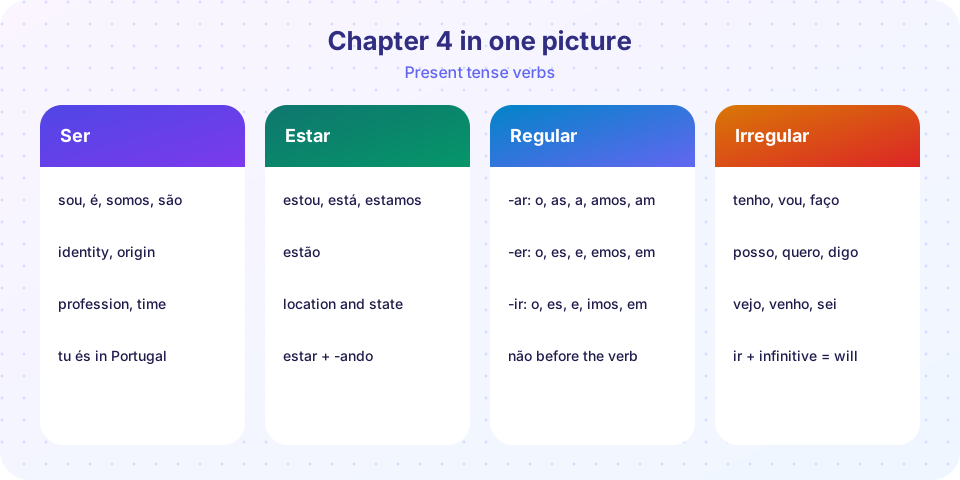
You have reached the end of the first half of the course. In chapter 4 you learned the engine of the language: how verbs change for each person, the two verbs for "to be", the regular endings of the three verb families, and the irregular verbs that you will use every day. With these tools you can describe yourself, say what you do and like, talk about plans, and ask simple questions.
This review brings the chapter together. Read the one-page picture, check the recap table, try the two tools, read the dialogue aloud, and then take the quiz. After that, you will be ready for chapter 5, where you will use all of this to ask questions, shop, eat, and travel.
What you will review
- Ser and estar: forms and uses.
- Regular present endings for -ar, -er, and -ir.
- Irregular verbs: ter, ir, fazer, poder, querer and more.
- Negatives, questions, and the near future with ir.
Chapter recap
| Lesson | Key ideas |
|---|---|
| Ser and estar | sou, é, somos, são; estou, está, estamos, estão; ser for identity, origin, profession, time, traits; estar for location, state, progressive; estar com fome. |
| Regular present verbs | -ar: o, as, a, amos, am; -er: o, es, e, emos, em; -ir: o, es, e, imos, em; não before the verb; questions with o que, onde, quando; gostar de. |
| Irregular present verbs | tenho, vou, faço, posso, quero, digo, vejo, venho, sei, dou, leio, ponho; durmo, peço, prefiro, ouço, saio; Vou estudar; tem for "there is". |
A conversation at a language exchange
Read it aloud: first slowly, then at a natural speed.
| Portuguese | English |
|---|---|
| Marta: Oi! Você é o Tom? | Hi! Are you Tom? |
| Tom: Sou eu! Prazer. Você é a Marta? | That's me! Nice to meet you. Are you Marta? |
| Marta: Sou. Eu sou de Salvador, mas moro em São Paulo. E você? | I am. I am from Salvador, but I live in São Paulo. And you? |
| Tom: Sou dos Estados Unidos. Estou aprendendo português. | I am from the United States. I am learning Portuguese. |
| Marta: Que legal! Você fala bem. O que você faz? | How cool! You speak well. What do you do? |
| Tom: Sou professor. Trabalho numa escola. E você? | I am a teacher. I work at a school. And you? |
| Marta: Sou engenheira. Eu gosto muito de viajar. | I am an engineer. I like traveling a lot. |
| Tom: Eu também! Vou viajar para o Brasil em julho. | Me too! I am going to travel to Brazil in July. |
| Marta: Que bom! Você quer ver Salvador? | Great! Do you want to see Salvador? |
| Tom: Quero, sim! Tem muito para ver, não tem? | Yes, I do! There is a lot to see, isn't there? |
Count the verbs you now understand: ser (sou, é), morar (moro), estar (estou), falar (fala), fazer (faz), trabalhar (trabalho), gostar (gosto), ir (vou), querer (quer, quero), and ter (tem). That is ten verbs in one conversation.
Decision guide
When you build a sentence, ask these questions:
- Who is acting? Choose the pronoun (or drop it): eu, você, nós, vocês.
- Is it "to be"? Use ser for what something is, estar for where or how it is.
- Which family? -ar, -er, or -ir gives the endings.
- Is it irregular? Check ter, ir, fazer, poder, querer, dizer, ver, vir, saber, dar, ler, pôr.
- Is it the future? Use ir plus the infinitive.
- Is it a negative or a question? Put não before the verb or use a question word first.
Common misconceptions to check
"Ser and estar are interchangeable." They are not: Ela é cansada means she is a tired person by nature, while Ela está cansada means she is tired now.
"Você takes an -s ending." It does not: você fala, not você falas.
"Tenho fome." It is understood everywhere, but in Brazil people usually say Estou com fome.
"After vou I conjugate the second verb." Vou comer, not Vou como.
How to use this review
The best way to test verbs is to speak them. Pick five verbs, such as morar, trabalhar, comer, ter, and ir, and say a full sentence for each person: Eu moro em..., você mora..., nós moramos... Doing this aloud for a few minutes a day for a week produces more fluency than reading the tables.
Use this can-do list. Can you say the present tense of ser and estar without looking? Can you choose between them for location, profession, and mood? Can you conjugate a new regular verb in all persons, and spot the eu spelling changes in conhecer and dirigir? Can you use tenho, vou, faço, posso, and quero in simple sentences? Can you ask Onde você mora? and answer it? Can you say what you are going to do tomorrow with ir + infinitive?
If the answer is yes, you have finished the first half of Portuguese for Beginners. The second half builds on every one of these skills.
Try it
The first tool is a translation game. Pick the correct Portuguese sentence for each English one.
The second tool writes a short self-introduction from your details. Change the values at the top and read the result aloud. It only fills a template with the grammar of this course, so check the endings you change.
Press Run (or Ctrl + Enter) to see the result here.
Program input · what you'd type while the program runs
Type the answers before you press Run, one per line. Each time the program reads a line (with input()), it gets the next line from this box.
Check your understanding
Quick check · 10 questions
of 10 answered You scored / 10 · perfect!
-
1. Which sentence means 'She is tired (right now)'?
A temporary state uses estar. -
2. What is the 'nós' form of 'falar'?
-ar verbs use -amos for nós: falamos. -
3. What is the 'eu' form of 'ter'?
Ter is irregular: eu tenho. -
4. Which sentence means 'We are going to travel'?
Ir + infinitive: Vamos viajar. -
5. How do you say 'He works in a bank' (Brazil)?
Ele takes the -a ending: trabalha. Num = em + um. -
6. Which is the correct negative?
Não comes before the verb. -
7. Which verb do you use for 'I am hungry'?
Hunger uses estar com (or ter fome in Portugal). -
8. What does 'Tem um banco aqui?' mean?
In Brazil, tem is often used for there is. -
9. Which form do você and ele share for 'comer'?
Você uses the ele/ela form: come. -
10. How do you say 'I know Brazil' (have been there)?
Conhecer is for places and people: Conheço o Brasil.
Summary
- Ser (sou, é, somos, são) for identity, origin, profession, time, and traits; estar (estou, está, estamos, estão) for location, state, and the progressive.
- Regular endings: -ar o, as, a, amos, am; -er/-ir o, es, e, emos/imos, em.
- Irregular verbs: learn the eu forms tenho, vou, faço, posso, quero, digo, vejo, venho, sei, dou, leio, ponho.
- Use não before the verb, question words first, and ir + infinitive for the near future.
- Chapters 1-4 have given you the base: sounds, greetings, nouns, adjectives, and the present tense.
Track your progress
Create a free account to tick off lessons and pick up where you left off on any device.
of Portuguese for Beginners lessons completed