


















Lesson 34 of 48 · Future, Pronouns and Subjunctive Basics
Talking About the Future in Portuguese
Learn to talk about plans and predictions in Portuguese: ir + infinitive, the future simple (falarei), the conditional (falaria), and key future time words.
Plans, promises, predictions: "I am going to call you", "It will rain tomorrow", "I would like to travel". Portuguese has several ways to talk about what has not happened yet, and, as in English, the everyday one is the easiest. In this lesson you will learn the three forms you need: ir + infinitive for conversation, the futuro simples for formal and written Portuguese, and the conditional for polite requests and hypotheticals.
The most useful sentence of the lesson is "Vou + infinitive". With just that, you can already speak about the future in almost any situation. The other forms you will recognize when you read, and you will use them to sound more polished.
What you will learn
- Form the near future with "ir + infinitive".
- Form the futuro simples, including the irregular verbs farei, direi and trarei.
- Use the conditional for polite requests: "gostaria", "poderia".
- Use future time words: amanhã, semana que vem, daqui a pouco.
Key terms
Futuro perifrástico (periphrastic future): "ir + infinitive", the everyday future.
Futuro do presente (simple future): falarei, falarás, falará, falaremos, falarão.
Futuro do pretérito (conditional): falaria, falarias, falaria, falaríamos, falariam.
Infinitivo: the dictionary form (falar, comer, partir).
1. "Ir + infinitive": the everyday future
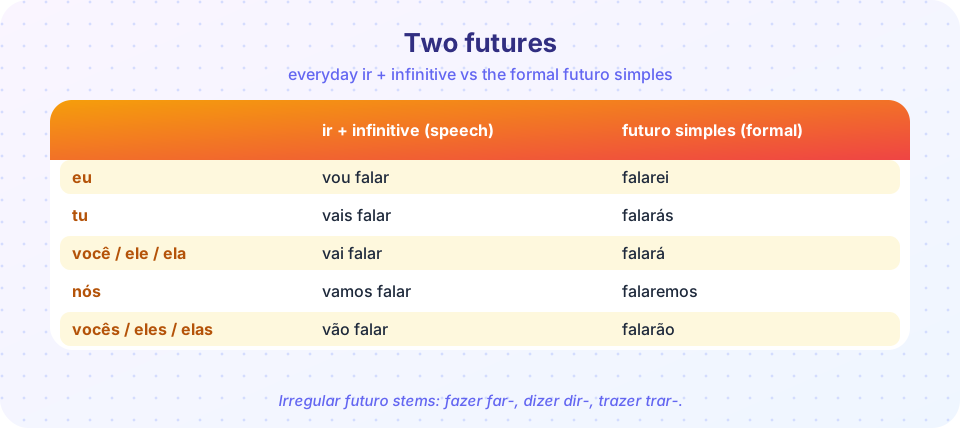
Conjugate ir (to go) in the present and add the infinitive of the main verb. It is exactly like "I am going to..." in English.
| Person | ir | Example |
|---|---|---|
| eu | vou | Eu vou viajar amanhã. (I am going to travel tomorrow.) |
| tu | vais | Tu vais gostar. (You will like it.) |
| você / ele / ela | vai | Ela vai chegar tarde. (She is going to arrive late.) |
| nós | vamos | Nós vamos jantar fora. (We are going to eat out.) |
| vocês / eles / elas | vão | Eles vão ficar em casa. (They are going to stay home.) |
For the negative, put não before ir: "Não vou trabalhar sábado" (I am not going to work on Saturday). For questions, keep the word order and raise your voice: "Você vai sair hoje?" (Are you going out today?)
Vamos also means "let's": "Vamos comer!" (Let's eat!). It is a very common way to propose something.
Weather and predictions use the same form: "Vai chover amanhã" (It is going to rain tomorrow), "Vai fazer calor" (It will be hot).
The present for scheduled events
Portuguese, like English, uses the plain present for scheduled or almost certain future events when a time word is given: "Amanhã eu viajo" (Tomorrow I leave), "O filme começa às oito" (The movie starts at eight), "Sábado tem festa" (There is a party on Saturday).
2. The futuro simples
The futuro simples is built from the infinitive plus these endings:
| Person | Endings | falar | comer | partir |
|---|---|---|---|---|
| eu | -ei | falarei | comerei | partirei |
| tu | -ás | falarás | comerás | partirás |
| você / ele / ela | -á | falará | comerá | partirá |
| nós | -emos | falaremos | comeremos | partiremos |
| vocês / eles / elas | -ão | falarão | comerão | partirão |
Notice that the stress is on the ending, and that the written accents mark it (-á, -ás, -ão) except in -emos and -ei. All verbs use the same endings for -ar, -er and -ir.
Only three common verbs are irregular. They lose the "-ze-" in the infinitive:
| Infinitive | Future stem | Forms (eu) |
|---|---|---|
| fazer | far- | farei, farás, fará, faremos, farão |
| dizer | dir- | direi, dirás, dirá, diremos, dirão |
| trazer | trar- | trarei, trarás, trará, traremos, trarão |
Other common verbs are regular here: serei, terei, irei, verei, virei, estarei, poderei. The verb pôr gives porei.
In speech, Brazilians use the futuro simples rarely, mostly for promises, formal announcements, horoscopes, news and literature: "A reunião será amanhã" (The meeting will be tomorrow), "Prometo que farei o possível" (I promise that I will do my best). It also expresses guesses: "Que horas serão?" (I wonder what time it is), "Ele estará em casa" (He must be at home). In everyday speech people prefer "deve ser" (it must be).
3. The conditional: "would"
The futuro do pretérito (conditional) uses the same stems as the future plus the imperfeito endings -ia, -ias, -ia, -íamos, -iam:
- eu falaria (I would speak), ele comeria, nós partiríamos
- irregular like the future: faria, diria, traria
- ser → seria, ter → teria, ir → iria, poder → poderia, gostar → gostaria
It has two main uses:
- Polite requests. "Eu gostaria de um café" (I would like a coffee), "Você poderia me ajudar?" (Could you help me?), "Seria possível pagar com cartão?" (Would it be possible to pay by card?).
- Hypotheticals. "Se eu tivesse tempo, eu viajaria mais" (If I had time I would travel more). The "if" part uses another subjunctive tense, which you can learn later.
In casual Brazilian speech you will often hear the imperfeito instead: "Eu queria um café" rather than "Eu gostaria". Both are polite.
Future time words
| Portuguese | English |
|---|---|
| amanhã | tomorrow |
| depois de amanhã | the day after tomorrow |
| hoje à noite | tonight |
| semana que vem / na próxima semana | next week |
| mês que vem / ano que vem | next month / next year |
| em breve | soon |
| daqui a pouco | in a little while |
| daqui a dois dias | in two days (from now) |
| mais tarde | later |
| algum dia | someday |
Daqui a is the key phrase for "in (a period of time)": "Daqui a uma semana eu viajo" (In a week I leave).
Talking about plans
Beyond the future tense, these verbs help you express intentions:
- Quero + infinitive: Quero aprender português. (I want to learn Portuguese.)
- Pretendo + infinitive: Pretendo viajar em dezembro. (I intend to travel in December.)
- Estou pensando em + infinitive: Estou pensando em mudar de emprego. (I am thinking of changing jobs.)
- Vou ter que + infinitive: Vou ter que trabalhar sábado. (I will have to work on Saturday.)
A planning dialogue
| Portuguese | English |
|---|---|
| O que você vai fazer no fim de semana? | What are you going to do on the weekend? |
| No sábado vou ao mercado e depois vou cozinhar para os meus pais. | On Saturday I am going to the market and then I will cook for my parents. |
| E no domingo? | And on Sunday? |
| Ainda não sei. Talvez eu vá à praia. | I do not know yet. Maybe I will go to the beach. |
| Se você for, me avise! | If you go, let me know! |
(The last two sentences use the subjunctive, which is the topic of a later lesson.)
Putting it together: three mini-scenarios
- Making an appointment. "Amanhã às dez eu vou ao dentista, mas vou estar livre à tarde." (Tomorrow at ten I am going to the dentist, but I will be free in the afternoon.) Notice that "vou estar" works like "I will be".
- Making a promise or an offer. Brazilians often promise with the plain present: "Eu te ligo!" (I will call you!), "Pode deixar, eu faço." (Leave it to me, I will do it.) The formal version is "Prometo que farei o possível."
- Predicting. "Acho que vai chover." (I think it is going to rain.) "Vai dar tudo certo." (Everything will work out.)
Two handy expressions: Já vou! (I am coming right now!) and estar prestes a + infinitive for "to be about to": "Estou prestes a sair" (I am about to leave).
Common misconceptions
"The futuro simples is the normal way to speak about the future." In spoken Brazilian Portuguese it is "ir + infinitive". The futuro simples is mostly written or formal.
"Fazer becomes fazerei." It becomes farei: the -ze- drops out. Same for dizer (direi) and trazer (trarei).
"Vai" always means go." Before an infinitive it is only a future marker: "Ela vai chegar" means "She will arrive".
"Gostaria is the only polite form." In daily Brazilian speech "queria" is just as polite.
Try it
First, a Python conjugator for the future and the conditional, with the three irregular verbs. Run it and check each form against the tables.
Press Run (or Ctrl + Enter) to see the result here.
Program input · what you'd type while the program runs
Type the answers before you press Run, one per line. Each time the program reads a line (with input()), it gets the next line from this box.
Next, a gap-fill: choose the right form for each future sentence.
Last, flashcards with future time phrases.
Check your understanding
Quick check · 5 questions
of 5 answered You scored / 5 · perfect!
-
1. How do you say 'We are going to eat out' in everyday Portuguese?
'Vamos' (ir) + infinitive is the everyday future. -
2. What is the futuro simples of 'fazer' for 'eu'?
Fazer, dizer and trazer lose -ze-: farei, direi, trarei. -
3. What does 'daqui a dois dias' mean?
'Daqui a' means 'from now': daqui a dois dias = in two days. -
4. Which sentence is the most polite request?
'Gostaria de' (conditional) is polite; 'queria' is also fine. -
5. What does 'Que horas serão?' express?
The future can express conjecture: 'Que horas serão?' means 'I wonder what time it is'.
Summary
- Everyday future: vou/vais/vai/vamos/vão + infinitive; the present also works for scheduled events.
- Futuro simples: infinitive + -ei, -ás, -á, -emos, -ão; irregular farei, direi, trarei.
- Conditional: stem + -ia, -ias, -ia, -íamos, -iam; gostaria, poderia, seria for polite requests.
- Time words: amanhã, semana que vem, em breve, daqui a pouco, daqui a dois dias.
- The futuro simples can express a guess ("Que horas serão?").
Next: Object pronouns
Track your progress
Create a free account to tick off lessons and pick up where you left off on any device.
of Portuguese for Beginners lessons completed