


















Lesson 29 of 48 · Past Tenses
The Pretérito Perfeito: Simple Past in Portuguese
Learn the Portuguese simple past: regular -ar, -er, -ir endings, spelling changes like paguei, and irregular verbs fui, tive, fiz, disse with practice.
The pretérito perfeito is the tense you use to say what happened: "I called", "she arrived", "we ate". It is the closest match to the English simple past, and it is the tense of stories, news and everyday reports. In this lesson you will learn how to form it for regular verbs, which spelling changes to expect, and the dozen irregular verbs that Portuguese speakers use constantly.
The word "perfeito" here means completed: the action has a beginning and an end, and it is over. Once you master this tense you can already answer "O que você fez ontem?" (What did you do yesterday?) with a string of past events.
What you will learn
- The perfeito endings of regular -ar, -er and -ir verbs.
- The spelling changes in the "eu" form of verbs in -car, -gar and -çar.
- The key irregular verbs, including ser/ir, ter, estar, fazer, dizer and poder.
- How to link events in a story, and answer with "já" or "ainda não".
Key terms
Radical (stem): the verb without -ar, -er or -ir: fal- in falar.
Terminação (ending): what you add to the stem to show the person and the tense.
Pretérito perfeito: the simple past, for finished events.
Verbo irregular: a verb that does not follow the regular pattern, often with a new stem in the past.
Regular verbs
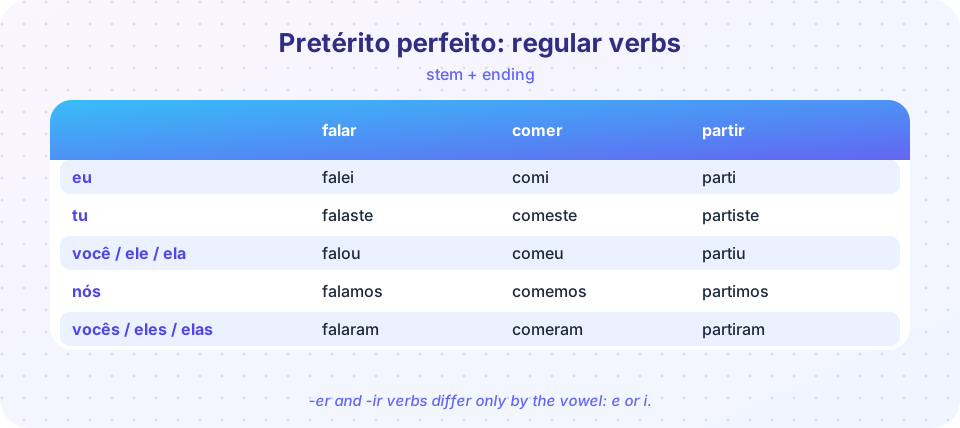
Remove the -ar, -er or -ir and add these endings:
| Person | -ar (falar) | -er (comer) | -ir (partir) |
|---|---|---|---|
| eu | falei | comi | parti |
| tu | falaste | comeste | partiste |
| você / ele / ela | falou | comeu | partiu |
| nós | falamos | comemos | partimos |
| vocês / eles / elas | falaram | comeram | partiram |
Notes on the table:
- The -er and -ir verbs differ only in the vowel (e versus i): comeste / partiste, comeu / partiu, comemos / partimos, comeram / partiram. Only the eu form (-i) is the same.
- The stress is on the last syllable in the eu and você forms: faLEI, faLOU, coMEU. Written accents are not needed.
- Nós falamos is the same word as the present tense. Context tells you which: "Ontem nós falamos" is past, "Nós falamos todo dia" is present. In Portugal the past is often written falámos, with an acute accent, to mark the difference.
- In Brazil many speakers use tu rarely (see the chapter on culture); você and vocês use the third-person forms.
Examples:
- Ontem eu falei com a minha avó. (Yesterday I spoke with my grandmother.)
- Ela comeu tudo. (She ate everything.)
- Nós partimos cedo. (We left early.)
- Eles chegaram tarde. (They arrived late.)
Spelling changes in the eu form
To keep the sound the same, verbs ending in -car, -gar and -çar change spelling in the eu form only:
| Infinitive | Rule | Eu form |
|---|---|---|
| tocar (to play, touch) | c → qu | toquei |
| ficar (to stay) | c → qu | fiquei |
| pagar (to pay) | g → gu | paguei |
| chegar (to arrive) | g → gu | cheguei |
| começar (to begin) | ç → c | comecei |
| almoçar (to have lunch) | ç → c | almocei |
Without the change, "chegei" would be pronounced with a soft "j"; "cheguei" keeps the hard "g" of "chegar".
A few -er/-ir verbs whose stem ends in a vowel take accents: ler (li, leu, lemos, leram), sair (saí, saiu, saímos, saíram), ouvir (regular: ouvi, ouviu).
The irregular verbs you need
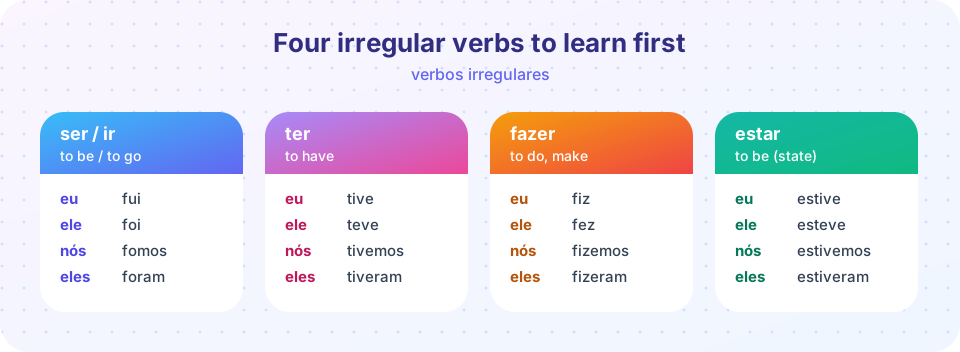
Irregular perfeito verbs mostly have a new stem in all persons, with endings such as -e, -emos, -eram. You will meet them every day, so learn them first.
| Infinitive | eu | você/ele/ela | nós | vocês/eles |
|---|---|---|---|---|
| ser / ir | fui | foi | fomos | foram |
| ter | tive | teve | tivemos | tiveram |
| estar | estive | esteve | estivemos | estiveram |
| fazer | fiz | fez | fizemos | fizeram |
| dizer | disse | disse | dissemos | disseram |
| poder | pude | pôde | pudemos | puderam |
| querer | quis | quis | quisemos | quiseram |
| saber | soube | soube | soubemos | souberam |
| vir | vim | veio | viemos | vieram |
| ver | vi | viu | vimos | viram |
| dar | dei | deu | demos | deram |
| trazer | trouxe | trouxe | trouxemos | trouxeram |
The tu forms are foste, tiveste, estiveste, fizeste, disseste, pudeste, quiseste, soubeste, vieste, viste, deste, trouxeste.
Ser and ir are identical
In the perfeito, ser (to be) and ir (to go) have exactly the same forms. Context decides: "Ontem eu fui ao cinema" (I went to the cinema) versus "A festa foi ótima" (The party was great). You will never be confused for long, because ir is followed by a destination (ao, à, para) and ser by a description.
Using the perfeito in a story
A string of perfeito verbs tells events in order, like a list of things that happened:
Ontem eu acordei às seis, tomei café, peguei o ônibus e cheguei ao trabalho às oito. (Yesterday I woke up at six, had coffee, took the bus and arrived at work at eight.)
Common helpers: primeiro (first), depois (afterwards), então (then), por fim (finally), de repente (suddenly). To say ago use há: "Cheguei há dois dias" (I arrived two days ago). In Brazil you also hear "dois dias atrás".
To make a negative, put não before the verb: "Eu não fui." To ask, keep the order and raise your voice: "Você viu o jogo?" Two handy answers: Já (already) and Ainda não (not yet): "Você já almoçou? — Já." / "Ainda não."
Europe versus Brazil
In Portugal the tu forms (comeste, partiste) are common in daily speech; Brazil uses você. The Portuguese past of nós is often written with an accent (falámos). In both countries the pretérito perfeito composto ("tenho falado") does not mean "I have spoken". It means a repeated action up to now: "Tenho falado muito com ele" (I have been talking to him a lot lately).
Pronunciation and accents
In the regular eu and você/ele forms the stress is on the last syllable: fa-LEI, fa-LOU, co-MI, co-MEU, par-TI, par-TIU. Because the stress is already final, no accent mark is needed. Compare the present tense FA-lo (stress on the first syllable) with the past fa-LEI. In Brazil the ending -ou sounds like English "ow" and -ei like "ay".
A few forms do carry accents: pôde (past of poder, versus present pode), saí and saímos (sair), and, in Portugal, falámos for the nós past.
Negatives, questions and time expressions
To deny, put não before the verb: "Eu não fui à festa." A question keeps the statement order: "Você já comeu?", "O que ele disse?" Useful time words with the perfeito are ontem, anteontem, na semana passada, no mês passado, em 2019, há três dias, de manhã and à noite. You can also say três dias atrás (three days ago) and, informally, faz três dias que cheguei (it has been three days since I arrived).
How to learn the irregular verbs
Do not memorize the whole table at once. Learn the verbs in small families:
- -iv- and -iz- stems: tive, estive, fiz, quis, pude.
- -ouxe / -oube: trouxe, soube.
- short forms: vi, dei, li, fui, vim.
For each verb, write one sentence about your last weekend and say it aloud ("No sábado eu fui à praia e fiz um bolo."). Spaced repetition does the rest.
Common misconceptions
"Falamos" is only present tense. It is also the past ("falamos ontem"). Use time words to tell them apart.
"Fui" has two verbs, so I must know which one. The forms are identical; the sentence shows which verb you mean.
"I have eaten" is "tenho comido". Not in Portuguese. Say "comi" (I ate) or "já comi" (I already ate).
"Chegei" is the eu form of chegar. It is "cheguei": the g needs the u to stay hard.
Try it
The Python TryIt below is a conjugator that applies the regular pattern, the spelling changes and a dictionary of irregular verbs. Add new verbs to the list and check whether you can predict the output first.
Press Run (or Ctrl + Enter) to see the result here.
Program input · what you'd type while the program runs
Type the answers before you press Run, one per line. Each time the program reads a line (with input()), it gets the next line from this box.
Next, a gap-fill in which you choose the right perfeito form. Remember the spelling of "cheguei" and "paguei".
Last, match the infinitive to the "eu" form of the perfeito.
Check your understanding
Quick check · 6 questions
of 6 answered You scored / 6 · perfect!
-
1. What is the eu form of 'comer' in the pretérito perfeito?
-er verbs take -i in the eu form: comi. 'Comia' is the imperfeito. -
2. Which form of 'chegar' is correct for 'I arrived'?
Verbs in -gar add u before -ei to keep the hard g: cheguei. -
3. 'Ontem eu fui ao mercado.' Which verb is 'fui' here?
Ser and ir share the perfeito forms, and here the destination 'ao mercado' shows it is 'ir'. -
4. What does 'Nós falamos ontem' mean?
'Falamos' is both present and past. 'Ontem' (yesterday) makes it past. -
5. What is the perfeito of 'fazer' for 'ele'?
'Fazer' is irregular: eu fiz, ele fez, nós fizemos, eles fizeram. -
6. How do you answer 'Você já almoçou?' if you have not eaten yet?
'Ainda não' means 'not yet'. 'Já' means 'already'.
Summary
- Regular perfeito endings: -ar: -ei, -aste, -ou, -amos, -aram; -er: -i, -este, -eu, -emos, -eram; -ir: -i, -iste, -iu, -imos, -iram.
- Spelling in the eu form: -car → -quei, -gar → -guei, -çar → -cei.
- Learn the irregulars as whole forms: fui, tive, estive, fiz, disse, pude, quis, soube, vim, vi, dei, trouxe.
- Ser and ir are identical in the perfeito; "nós falamos" is present or past.
- Use "já" and "ainda não" to answer "Have you...?" questions; "tenho falado" is not "I have spoken".
Next: The pretérito imperfeito
Track your progress
Create a free account to tick off lessons and pick up where you left off on any device.
of Portuguese for Beginners lessons completed