


















Lesson 35 of 48 · Future, Pronouns and Subjunctive Basics
Object Pronouns in Portuguese: me, te, o, a, lhe
Learn Portuguese direct and indirect object pronouns, where they go in Brazil and Portugal, forms like comigo and conosco, and the -lo/-la rule.
Pronouns let you avoid repeating nouns. In English you say "I saw her" and "He gave me a book" without thinking about it. Portuguese has the same idea, but its object pronouns are short, unstressed words that attach to the verb, and their position changes between Brazil and Portugal. Once you understand the pattern, you can say sentences like "Eu te amo", "Ela me deu um livro" and "Pode me ajudar?", which fill everyday speech.
This lesson covers direct and indirect object pronouns, the pronouns used after prepositions (para mim, comigo), the position rules, and the special -lo/-la forms. You will also see how Brazilian speech differs from the textbook.
What you will learn
- The direct object pronouns (me, te, o, a, nos, os, as) and the indirect ones (me, te, lhe, nos, lhes).
- Where to place the pronoun in Brazilian and European Portuguese.
- How to use comigo, contigo, conosco and "para mim".
- How reflexive pronouns (me chamo, se levanta) use the same words.
Key terms
Objeto direto (direct object): what or whom the verb acts on. "Eu vejo o Pedro."
Objeto indireto (indirect object): to or for whom. "Eu dei o livro ao Pedro."
Próclise: the pronoun before the verb (Eu te vejo). Ênclise: after the verb with a hyphen (Vejo-te).
Pronome reflexivo: me, te, se, nos, se, used when the subject acts on itself.
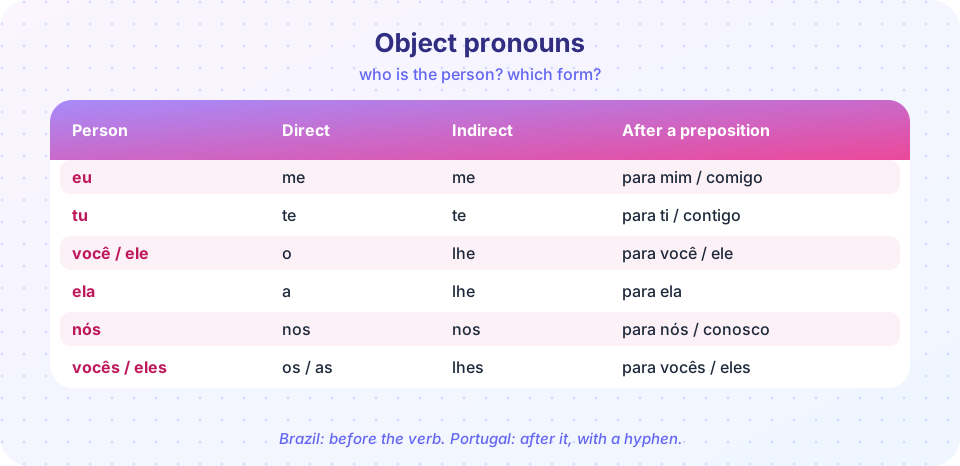
The pronouns
| Person | Direct (whom?) | Indirect (to whom?) | After a preposition |
|---|---|---|---|
| eu | me | me | mim / comigo |
| tu | te | te | ti / contigo |
| você, ele | o | lhe | você, ele |
| ela | a | lhe | ela |
| nós | nos | nos | nós / conosco |
| vocês, eles | os / as | lhes | vocês, eles |
Direct object: answers "whom or what?".
- Ele me viu. (He saw me.)
- Eu te amo. (I love you.)
- Eu o conheço. (I know him.)
- Nós as vimos. (We saw them, feminine.)
Indirect object: answers "to or for whom?".
- Ela me deu um livro. (She gave me a book.)
- Eu te disse a verdade. (I told you the truth.)
- Ele lhe enviou uma carta. (He sent him/her/you a letter.)
Notice that me, te, nos work for both direct and indirect objects. Only the third person differs: o/a/os/as (direct) versus lhe/lhes (indirect).
What people really say in Brazil
In everyday Brazilian speech:
- o, a, os, as are replaced by the subject pronoun after the verb: "Eu vi ele" and "Eu conheço ela" (formal grammar: "Eu o vi", "Eu a conheço"). With things, people often simply drop the pronoun: "Você viu o filme? — Vi."
- lhe/lhes is replaced by "para você", "pra ele": "Eu dei o livro pra ele".
- te is combined with você: "Eu te amo, você é demais". Textbooks pair te with tu, but in most of Brazil people say você and use te. It is completely normal.
The forms o/a/lhe remain correct and appear in writing, formal speech and in Portugal.
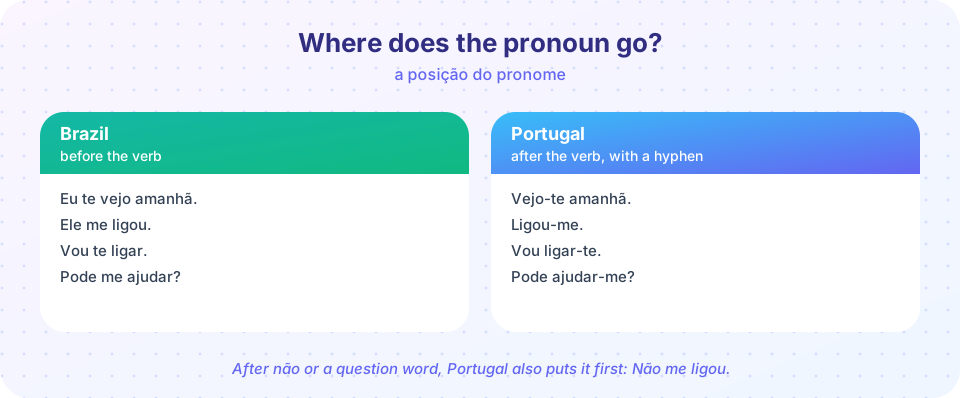
Position: where does the pronoun go?
Brazil (everyday speech): the pronoun goes before the verb.
- Eu te vejo amanhã. (I will see you tomorrow.)
- Ele me ligou. (He called me.)
- Você me ajuda? (Will you help me?)
With an auxiliary + infinitive (including the future and "pode"), the pronoun usually goes before the infinitive:
- Vou te ligar. (I will call you.)
- Pode me ajudar? (Can you help me?)
- Quero te ver. (I want to see you.)
In very formal Brazilian writing you may see the pronoun after the verb with a hyphen ("Pode ajudar-me?"), but it sounds stiff in speech. A sentence also does not begin with an unstressed pronoun in formal grammar ("Me dá" is spoken, "Dê-me" is written), but you will hear "Me dá isso" constantly.
Portugal: the normal position is after the verb in affirmative sentences, linked with a hyphen:
- Vejo-te amanhã. / Ligou-me. / Pode ajudar-me?
But the pronoun goes before the verb after negatives and certain words (não, nunca, já, também, question words, que): "Não me ligou", "Quem te disse?", "Eu já o vi".
| Meaning | Brazil | Portugal |
|---|---|---|
| I see you tomorrow. | Eu te vejo amanhã. | Vejo-te amanhã. |
| He called me. | Ele me ligou. | Ele ligou-me. |
| Can you help me? | Pode me ajudar? | Pode ajudar-me? |
| Do not call me. | Não me liga. | Não me ligues. |
The -lo, -la, -los, -las forms
When a formal sentence puts o/a/os/as after a verb that ends in -r, -s or -z, the final letter drops and an l is added: -lo, -la, -los, -las. Infinitives are the main case, and accents may appear:
| Verb ending | Rule | Example |
|---|---|---|
| -ar | á-lo | falar + o → falá-lo |
| -er | ê-lo | comer + a → comê-la |
| -ir | i-lo | partir + o → parti-lo |
| -ôr | ô-lo | pôr + o → pô-lo |
Examples: "Vou comê-lo" (I will eat it), "Quero vê-las" (I want to see them), "Preciso fazê-lo" (I need to do it). After endings in -m, -ão, -õe the pronouns become -no, -na, -nos, -nas: "viram-no", "dão-na", "põe-nos". In normal Brazilian speech you would just say "Vou comer ele" or drop the pronoun.
After prepositions
After a preposition, English "me/him/us" becomes mim, ti, ele, ela, nós, but with com four forms fuse:
| With | Form |
|---|---|
| com + eu | comigo (with me) |
| com + tu | contigo (with you) |
| com + você / ele / ela | com você / com ele / com ela |
| com + nós | conosco (Brazil), connosco (Portugal) |
| com + vocês | com vocês |
Examples: "Vem comigo!" (Come with me!), "Eu vou contigo." (I will go with you.) "Isto é para mim." (This is for me.)
An important rule: the subject of an infinitive is eu, not mim: "para eu fazer isso" (for me to do that), "Entre mim e você" (between you and me, after a preposition). Many Brazilians say "para mim fazer", which is considered wrong.
Reflexive pronouns: the same small words
When the subject and the object are the same person, you use me, te, se, nos, se:
- Eu me chamo Paulo. (I am called Paulo.)
- Como você se chama? (What is your name?)
- Ela se levanta cedo. (She gets up early.)
- Nós nos vemos amanhã. (We will see each other tomorrow.)
Position follows the same rule: before the verb in Brazil, after it in Portugal ("Chamo-me Paulo").
A dialogue with pronouns
| Portuguese | English |
|---|---|
| Oi, Ana! Eu te liguei ontem. | Hi, Ana! I called you yesterday. |
| Desculpa, não vi. Você me deixou algum recado? | Sorry, I did not see it. Did you leave me a message? |
| Deixei, sim. Queria te convidar para o meu aniversário. | I did. I wanted to invite you to my birthday. |
| Que legal! Vou com você. | How nice! I will go with you. |
| Perfeito. Eu te mando o endereço. | Perfect. I will send you the address. |
Common misconceptions
"Te is only for tu." In Brazil, te is used with você all the time. Do not worry about the mix.
"Lhe means him, so I must use it in speech." In everyday Brazilian speech "pra ele", "pra você" replace it.
"Para mim fazer" is correct. The correct form is "para eu fazer".
"The pronoun always follows the verb." That is European Portuguese. In Brazil it normally comes first.
Try it
First, a gap-fill about the pronouns. Choose between me, te, o, lhe, comigo and so on.
The second TryIt applies the replacement rule: it swaps a noun for a pronoun and shows the formal and the everyday forms. Try new sentences.
Press Run (or Ctrl + Enter) to see the result here.
Program input · what you'd type while the program runs
Type the answers before you press Run, one per line. Each time the program reads a line (with input()), it gets the next line from this box.
Finally, match the prepositional forms.
Check your understanding
Quick check · 6 questions
of 6 answered You scored / 6 · perfect!
-
1. Which sentence is natural in everyday Brazilian Portuguese?
Brazilian speech places the pronoun before the verb. 'Vejo-te' is the European order. -
2. How do you say 'with me'?
Com + eu fuse into 'comigo'; similarly com + tu is 'contigo'. -
3. Which is correct?
The subject of an infinitive is eu, not mim: 'para eu fazer'. -
4. What is 'comer + a' in a formal sentence?
The final -r drops and the pronoun becomes -la, with a circumflex: comê-la. -
5. Which pronoun is indirect (to whom?) in the third person?
'Lhe/lhes' is the indirect object; 'o/a/os/as' are direct. -
6. How does a Brazilian most often say 'I saw him'?
'Eu vi ele' is the everyday form; 'Eu o vi' is formal and 'Vi-o' is European.
Summary
- Direct: me, te, o, a, nos, os, as. Indirect: me, te, lhe, nos, lhes.
- Brazil: pronoun before the verb or the infinitive (Eu te vejo, Vou te ligar). Portugal: after the verb with a hyphen (Vejo-te), but before after não and question words.
- Everyday Brazil: "vi ele", "pra ele", and te with você.
- After prepositions: para mim, para ti, comigo, contigo, conosco; "para eu fazer".
- Infinitive + o/a → -lo/-la (comê-la, falá-lo); reflexives use me, te, se, nos.
Next: Subjunctive basics
Track your progress
Create a free account to tick off lessons and pick up where you left off on any device.
of Portuguese for Beginners lessons completed