


















Lesson 24 of 48 · Daily Life and Questions
Asking Questions in Portuguese
Learn the Portuguese question words (quem, onde, quando, como, qual, quanto), yes/no questions, short answers, and the four tricky forms of porque.
Questions are the engine of conversation. When you are new to a language you ask more than you tell: where is the station, what is this, how much is it, who is that? In Portuguese the good news is that yes/no questions need no special grammar at all, and the question words are a short list that you can learn in one sitting.
In this lesson you will learn how a statement becomes a question, the eight question words you will use daily, how to put prepositions in front of them ("de onde", "com quem"), how to answer in the natural Brazilian way by repeating the verb, and why Portuguese has four different words spelled "porque".
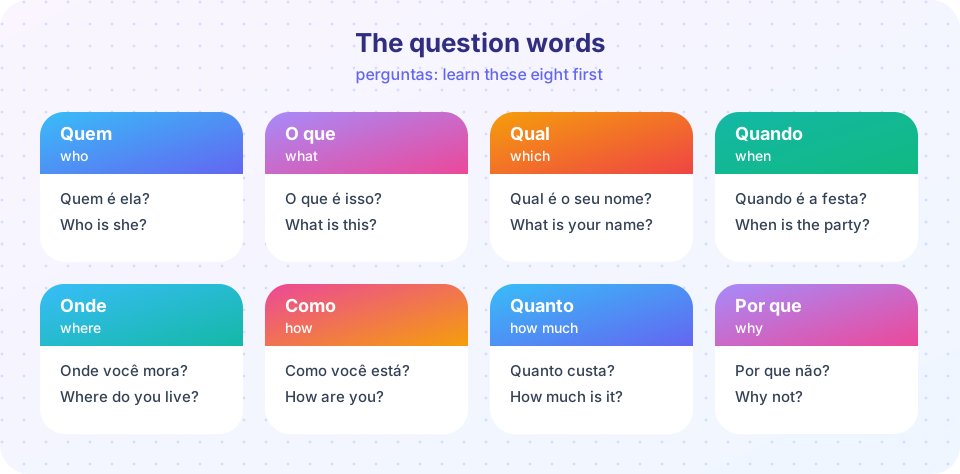
What you will learn
- Turn any statement into a yes/no question with intonation alone.
- Use quem, o que, qual, quando, onde, como, quanto and por que correctly.
- Add prepositions: de onde, para onde, com quem, a que horas.
- Answer questions with "sim", "não" or just the verb, and use negative words properly.
- Ask for help in a conversation: "Como se diz...?", "Pode repetir?"
Key terms
Pergunta (question) and resposta (answer).
Entonação (intonation): the rise and fall of your voice. In Portuguese a rising voice at the end marks a yes/no question.
Pronome interrogativo (interrogative word): quem, qual, quanto and so on.
Dupla negação (double negative): in Portuguese "não" plus another negative word is correct, as in "Não vejo ninguém".
Yes/no questions: the voice does the work
In English you rearrange the sentence: "You speak English" becomes "Do you speak English?". In Portuguese you keep the word order and raise your voice at the end. In writing the only change is the question mark. (Portuguese uses a single question mark at the end, not the upside-down one used by Spanish.)
| Statement | Question |
|---|---|
| Você fala inglês. (You speak English.) | Você fala inglês? (Do you speak English?) |
| Ele mora aqui. (He lives here.) | Ele mora aqui? (Does he live here?) |
| A loja está aberta. (The shop is open.) | A loja está aberta? (Is the shop open?) |
You can also add a tag at the end, like "right?" in English. In Brazil the most common is né? (short for "não é?"): "Está calor, né?" (It is hot, isn't it?). In more careful speech people say não é? or certo?. Add por favor and a softer verb ("poderia", "pode") to make requests more polite: "Você poderia me ajudar?" (Could you help me?).
Another useful frame is É...? to check something: "É longe?" (Is it far?), "É aqui?" (Is it here?), "É isso?" (Is that it?).
The question words
Quem means who. It does not change: "Quem é ela?" (Who is she?), "Quem chegou?" (Who arrived?).
O que (or just que) means what. At the end of a sentence it carries an accent: "Você disse o quê?" (You said what?). "O que você quer?" (What do you want?)
Qual (plural quais) means which or what when you choose from a set: "Qual é o seu nome?" (What is your name?), "Quais são os seus planos?" (What are your plans?). Use o que é to ask what a thing is ("O que é isso?") and qual é to ask for a specific detail ("Qual é o seu telefone?").
Quando means when: "Quando é a festa?" (When is the party?).
Onde means where: "Onde você mora?" (Where do you live?). Use onde fica for the location of buildings and places: "Onde fica a estação?"
Como means how: "Como você está?" (How are you?), "Como você chega lá?" (How do you get there?). It is also how you ask someone to repeat: "Como?" (Pardon?).
Quanto means how much, and it agrees with the noun in gender and number: quanto (m. sing.), quanta (f. sing.), quantos (m. pl.), quantas (f. pl.). "Quanto custa?" (How much does it cost?), "Quantas horas?" (How many hours?), "Quantos irmãos você tem?" (How many siblings do you have?).
Por que means why: "Por que você aprende português?" (Why are you learning Portuguese?).
Adding prepositions
When the question word relates to a preposition, put the preposition in front of it. English may leave it at the end ("Where are you from?"), but Portuguese never does.
| Portuguese | English |
|---|---|
| De onde você é? | Where are you from? |
| Para onde você vai? | Where are you going? |
| Com quem você mora? | Who do you live with? |
| A que horas começa o filme? | At what time does the film start? |
| Em que cidade você nasceu? | In which city were you born? |
| Há quanto tempo você estuda? | For how long have you been studying? |
| Desde quando você mora aqui? | Since when have you lived here? |
Notice "Há quanto tempo você estuda?": Portuguese uses the present tense with "há" (there is) for something that began in the past and continues.
The four "porques"
Portuguese uses the same letters for four different things. The accent and spacing tell them apart.
| Form | Use | Example |
|---|---|---|
| por que | why, at the start of a question | Por que você está triste? |
| por quê | why, at the end of a question | Você está triste por quê? |
| porque | because, in an answer | Porque perdi o ônibus. |
| porquê | the reason (a noun, with an article) | Não sei o porquê. |
For a beginner the rule of thumb is: ask with por que, answer with porque. "Por que você está atrasado? — Porque o trânsito estava terrível." (Why are you late? — Because the traffic was terrible.) Portugal handles this differently: there the question usually starts with a single word, "Porque é que chegaste tarde?", so do not be surprised by the variation.
Answering questions
The simplest answers are sim (yes) and não (no). In everyday Brazilian Portuguese, though, people often answer by repeating the verb, which sounds natural and a little more friendly than a bare "sim":
| Question | Natural answer |
|---|---|
| Você tem irmãos? | Tenho. / Tenho dois. |
| Você gosta de café? | Gosto. / Gosto muito. |
| Você fala espanhol? | Falo um pouco. |
| Você mora aqui? | Não, não moro. |
For negative answers, Portuguese adds não before the verb and then uses a negative word, and this double negative is correct: "Não vejo ninguém" (I do not see anyone), "Não tenho nada" (I have nothing), "Não vou lá nunca" (I never go there). The negative words are nada (nothing), ninguém (nobody), nunca (never), nenhum/nenhuma (none) and também não (neither).
Some good answers to keep in your pocket: "Não sei" (I do not know), "Talvez" (maybe), "Acho que sim" (I think so), "Acho que não" (I think not), "Com certeza" (certainly), "Depende" (it depends).
Questions that keep a conversation going
When you do not understand something, these questions save you:
- Como? or Pode repetir, por favor? (Pardon? Can you repeat?)
- Mais devagar, por favor. (Slower, please.)
- Não entendi. (I did not understand.)
- Como se diz "thank you" em português? (How do you say it?)
- O que significa "saudade"? (What does "saudade" mean?)
- Como se escreve? (How is it spelled?)
- Como assim? (What do you mean?)
- Você fala inglês? (Do you speak English?)
A short dialogue at a language school ties it together.
| Portuguese | English |
|---|---|
| Oi! Qual é o seu nome? | Hi! What is your name? |
| Meu nome é Daniel. E o seu? | My name is Daniel. And yours? |
| Sou a Marta. De onde você é? | I am Marta. Where are you from? |
| Sou de Toronto. E você? | I am from Toronto. And you? |
| Eu sou de Salvador. Há quanto tempo você estuda português? | I am from Salvador. For how long have you been studying Portuguese? |
| Há três meses. Por que você pergunta? | For three months. Why do you ask? |
| Porque você fala muito bem! | Because you speak very well! |
Europe versus Brazil
In Portugal speakers often add é que after the question word to give it emphasis: "Onde é que moras?" (Where do you live?), "Como é que te chamas?" (What are you called?). This is also heard in Brazil but far less often. Portugal also uses tu much more, so "Onde moras?" instead of "Onde você mora?". And in Portugal "Está a gostar?" (Are you liking it?) replaces the Brazilian "Você está gostando?".
Common misconceptions
"Portuguese needs the verb before the subject in questions." No. "Você fala inglês?" keeps the same order as the statement. Only your voice changes.
"Qual" and "o que" are interchangeable. Not usually. "O que é isto?" asks for a definition; "Qual é o seu endereço?" asks for one specific piece of information.
"Porque, por que, por quê and porquê are all the same." They are not: ask with "por que", answer with "porque".
"Two negatives make a positive." Not in Portuguese: "Não vejo ninguém" is the correct way to say "I see nobody".
Try it
The first TryIt is a gap-fill quiz on the question words. Type the missing word, check, and notice the hint about accents.
The second TryIt is a Python helper that guesses what kind of answer a question wants. It is a toy, but it shows how the first word predicts the answer.
Press Run (or Ctrl + Enter) to see the result here.
Program input · what you'd type while the program runs
Type the answers before you press Run, one per line. Each time the program reads a line (with input()), it gets the next line from this box.
Last, a deck of classroom questions to say aloud.
Check your understanding
Quick check · 5 questions
of 5 answered You scored / 5 · perfect!
-
1. How do you turn 'Ele mora aqui' (He lives here) into a question?
Portuguese yes/no questions normally keep the statement order. Intonation, and the question mark in writing, signal the question. -
2. Which is the correct way to ask where someone is from?
The preposition goes in front of the question word: de onde. -
3. Which word means 'because' in an answer?
'Porque' (one word, no accent) introduces the reason. 'Por que' opens a question, and 'porquê' is a noun. -
4. What is correct for 'I see nobody'?
Portuguese needs 'não' before the verb with negative words like ninguém: the double negative is correct. -
5. How would a Brazilian most naturally answer 'Você gosta de café?' in the affirmative?
Repeating the verb ('Gosto.') is the everyday answer. 'Sim, gosto' also works.
Summary
- Yes/no questions keep the statement order; your voice rises at the end. Add "né?" for a casual tag.
- The core question words: quem, o que, qual, quando, onde, como, quanto (agrees in gender and number), por que.
- Prepositions go before the question word: de onde, com quem, a que horas, há quanto tempo.
- Ask with "por que", answer with "porque"; "por quê" ends a question and "porquê" is a noun.
- Answer with sim/não or repeat the verb; negative words like nada and ninguém need "não" before the verb.
- Keep rescue questions ready: "Pode repetir?", "Como se diz...?", "Não entendi."
Next: Food and shopping
Track your progress
Create a free account to tick off lessons and pick up where you left off on any device.
of Portuguese for Beginners lessons completed