


















Lesson 36 of 48 · Future, Pronouns and Subjunctive Basics
Subjunctive Basics in Portuguese: Wishes and Doubts
Learn the Portuguese present subjunctive: the simple formation recipe, irregular forms like seja and vá, the main triggers, commands and quando eu chegar.
The subjunctive has a bad reputation among learners, but in Portuguese its core is surprisingly simple. A verb in the indicative states a fact: "Ele vem" (He is coming). A verb in the subjunctive talks about something that is not simply a fact: a wish, a doubt, an emotion or an event that has not happened yet. "Espero que ele venha" (I hope he comes), "Talvez ele venha" (Maybe he will come), "Quando ele vier..." (When he comes...).
English has traces of the subjunctive ("I wish he were here", "It is important that she be on time"), but Portuguese uses it every day. In this lesson you will learn a one-step recipe for the present subjunctive, the short list of triggers that call for it, how it makes polite commands, and a first taste of the "future subjunctive" used after quando and se.
What you will learn
- The three-step recipe for the present subjunctive.
- The irregular verbs: seja, esteja, vá, dê, saiba, queira.
- The common triggers: querer que, esperar que, talvez, é importante que, para que.
- How commands use the subjunctive ("Fale mais devagar", "Não faça isso").
- A preview of "quando eu chegar" and "se eu tiver".
Key terms
Indicativo (indicative): the mood of facts. Subjuntivo (subjunctive): the mood of wishes, doubts and non-facts.
Gatilho (trigger): the word or phrase that calls for the subjunctive (quero que, talvez, duvido que).
Oração subordinada (subordinate clause): the second part after "que": "Quero que você venha".
Imperativo (imperative): the command form. For formal commands it equals the subjunctive.
The recipe
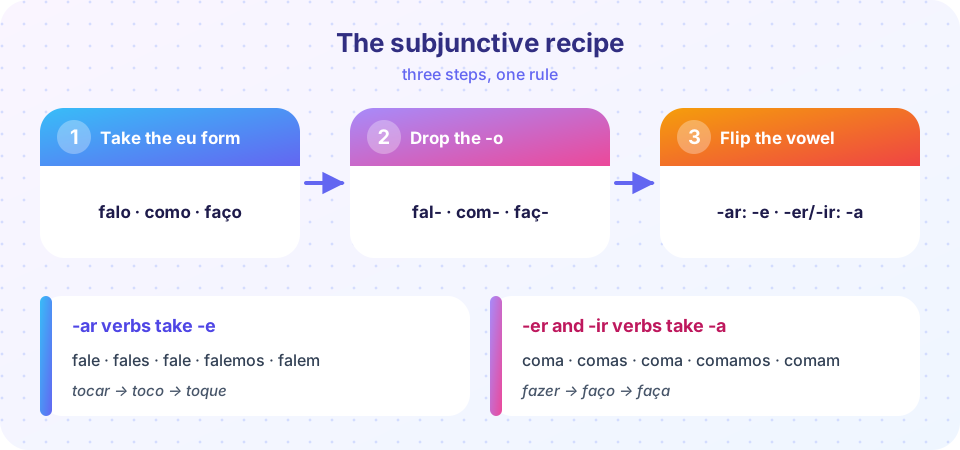
- Take the eu form of the present tense: falo, como, parto, faço, tenho.
- Drop the final -o: fal-, com-, part-, faç-, tenh-.
- Add the "opposite" vowel: -ar verbs take -e, -er and -ir verbs take -a.
| Person | falar (-e) | comer (-a) | partir (-a) |
|---|---|---|---|
| eu | fale | coma | parta |
| tu | fales | comas | partas |
| você / ele / ela | fale | coma | parta |
| nós | falemos | comamos | partamos |
| vocês / eles / elas | falem | comam | partam |
Because the recipe starts from the eu form, it automatically picks up irregularities in that form:
| Infinitive | eu (present) | Subjunctive (você) |
|---|---|---|
| fazer | faço | faça |
| dizer | digo | diga |
| ter | tenho | tenha |
| vir | venho | venha |
| ver | vejo | veja |
| sair | saio | saia |
| ouvir | ouço | ouça |
| pedir | peço | peça |
| conhecer | conheço | conheça |
| poder | posso | possa |
Spelling changes keep the sound: tocar → toque, chegar → chegue, começar → comece.
The six verbs that do not follow the recipe
| Infinitive | você | nós | vocês/eles |
|---|---|---|---|
| ser | seja | sejamos | sejam |
| estar | esteja | estejamos | estejam |
| ir | vá | vamos | vão |
| dar | dê | demos | deem |
| saber | saiba | saibamos | saibam |
| querer | queira | queiramos | queiram |
(The verb haver gives haja.) The tu forms are sejas, estejas, vás, dês, saibas, queiras.
When to use it: the triggers
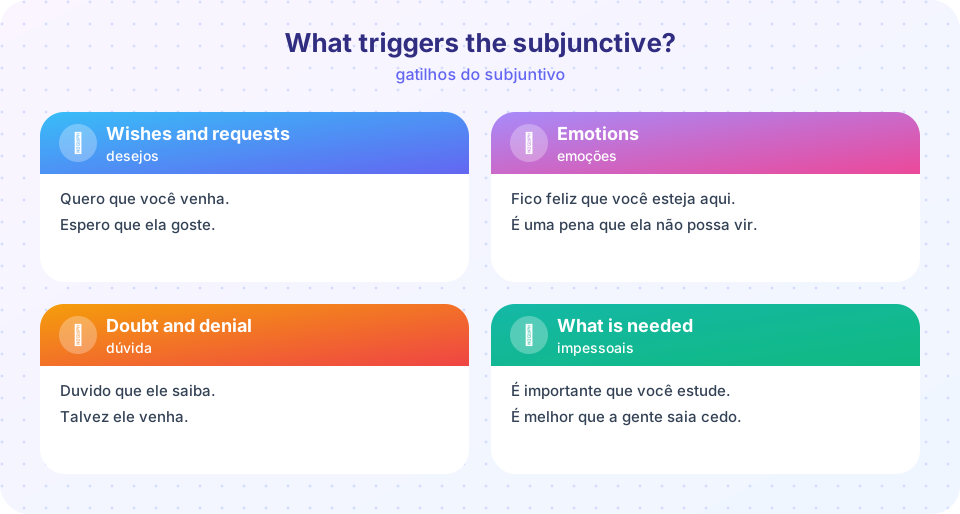
The subjunctive almost always appears in a clause introduced by que, after a main clause that expresses something other than a plain fact. The two clauses usually have different subjects.
| Trigger type | Examples |
|---|---|
| Wishes and requests | Quero que você venha. Espero que ela goste. Peço que vocês esperem. Tomara que chova. |
| Emotions | Fico feliz que você esteja aqui. Tenho medo que ele se perca. É uma pena que ela não possa vir. |
| Doubt and denial | Duvido que ele saiba. Não acho que seja caro. Talvez ele venha. |
| Opinions about what is needed | É importante que você estude. É melhor que a gente saia cedo. É preciso que eles entendam. |
| Certain conjunctions | Para que você entenda... Embora faça frio... Caso você precise... Antes que ele chegue... Sem que ninguém perceba... |
Same subject: use the infinitive
If the subject does not change, use the infinitive instead of "que + subjunctive":
- Quero viajar. (I want to travel.)
- Quero que você viaje. (I want you to travel.)
- Espero chegar cedo. (I hope to arrive early.)
Indicative versus subjunctive
The same main verb can take either mood depending on certainty:
| Indicative (fact, certainty) | Subjunctive (doubt, denial) |
|---|---|
| Acho que ele vem. (I think he is coming.) | Não acho que ele venha. (I do not think he is coming.) |
| Tenho certeza que ela sabe. (I am sure she knows.) | Duvido que ela saiba. (I doubt she knows.) |
| É verdade que eles moram aqui. | Talvez eles morem aqui. (Maybe they live here.) |
Commands: the subjunctive in disguise
The formal (você) command is the subjunctive; the negative command also uses it for every person:
- Fale mais devagar, por favor. (Speak more slowly, please.)
- Venha cá! (Come here!)
- Não faça isso. (Do not do that.)
- Vire à direita. (Turn right. This is the "vire" from the directions lesson.)
- Vamos comer! (Let's eat. "Vamos" is the same as the indicative.)
Everyday Brazilian speech often uses the indicative você form for informal commands ("Fala mais devagar", "Vem cá") and the subjunctive for the negative ("Não fala assim" is also heard).
A taste of the future subjunctive
Portuguese uses a different tense, the futuro do subjuntivo, after quando, se, assim que and enquanto to talk about the future:
- Quando eu chegar, eu te ligo. (When I arrive, I will call you.)
- Se você puder, venha. (If you can, come.)
- Assim que eu souber, te aviso. (As soon as I know, I will let you know.)
For regular verbs it is identical to the infinitive: falar, comer, partir (quando eu falar). For others, take the eles form of the perfeito, drop -ram, and add -r, -res, -r, -rmos, -rem:
| Infinitive | Perfeito (eles) | Future subjunctive (eu) |
|---|---|---|
| ter | tiveram | quando eu tiver |
| fazer | fizeram | se eu fizer |
| ir / ser | foram | se eu for |
| ver | viram | se eu vir |
| vir | vieram | quando eu vier |
| dizer | disseram | quando eu disser |
| poder | puderam | se eu puder |
| querer | quiseram | se você quiser |
You do not need to master this now. Recognize "se eu tiver tempo" and "quando eu chegar" and you will understand most of what you hear.
A dialogue with the subjunctive
| Portuguese | English |
|---|---|
| Você vem à festa amanhã? | Are you coming to the party tomorrow? |
| Talvez eu vá, mas não tenho certeza. | Maybe I will go, but I am not sure. |
| Espero que você consiga. Quero que a Maria te conheça. | I hope you can make it. I want Maria to meet you. |
| Se eu puder, eu vou. Quando eu souber, te aviso. | If I can, I will go. When I know, I will tell you. |
| Combinado! Mas não demore. | Deal! But do not take too long. |
More sentences to notice
Read these aloud and underline the subjunctive form.
- Embora esteja cansado, ele foi trabalhar. (Although he is tired, he went to work.)
- Caso você precise de ajuda, me liga. (In case you need help, call me.)
- Vou ficar aqui até que você volte. (I will stay here until you come back.)
- Faço isso para que você entenda. (I am doing this so that you understand.)
- Não importa o que aconteça, eu vou estar lá. (No matter what happens, I will be there.)
- Seja como for, vamos tentar. (Be that as it may, we will try.)
The last two are fixed expressions that you will hear often. Learn them as chunks.
Common misconceptions
"The subjunctive is a tense." It is a mood, with its own tenses (present, imperfect and future).
"I must use it everywhere." Only after triggers. "Acho que ele vem" uses the indicative.
"Falar becomes falo in the subjunctive." It becomes fale. The vowel flips: -ar takes -e, -er/-ir take -a.
"Espero que eu vá" is correct. With the same subject use the infinitive: "Espero ir."
Try it
First, a Python generator that applies the recipe. Add verbs and check that the forms match your expectation. The irregular verbs come from a dictionary.
Press Run (or Ctrl + Enter) to see the result here.
Program input · what you'd type while the program runs
Type the answers before you press Run, one per line. Each time the program reads a line (with input()), it gets the next line from this box.
Now a gap-fill with common triggers. Use the present subjunctive.
And flashcards with the main trigger phrases.
Check your understanding
Quick check · 6 questions
of 6 answered You scored / 6 · perfect!
-
1. What is the subjunctive of 'falar' for 'você'?
Start from falo, drop -o and add the opposite vowel: -ar takes -e, so fale. -
2. What is the subjunctive of 'fazer' for 'você'?
From faço (eu form) → faç- + a = faça. -
3. Which sentence needs the subjunctive?
'Quero que' expresses a wish, so 'venha' (subjunctive) is required. The others state facts. -
4. How do you say 'I want to travel' (same subject)?
When the subject does not change, use the infinitive. -
5. What is the future subjunctive of 'ter' in 'Se eu ___ tempo, eu vou'?
From 'tiveram' drop -ram and add -r: tiver. -
6. Which is the formal command 'Do not do that'?
Negative commands use the subjunctive: faça.
Summary
- Recipe: eu present form, drop -o, add the opposite vowel (-ar → -e; -er/-ir → -a).
- Irregulars: seja, esteja, vá, dê, saiba, queira (and haja).
- Triggers: wishes (quero que), emotions (fico feliz que), doubt (duvido que, talvez), opinions (é importante que), conjunctions (para que, embora, caso).
- Same subject: use the infinitive. Facts take the indicative.
- Commands: fale, venha, não faça; the future subjunctive follows quando and se (quando eu chegar, se eu tiver).
Next: Chapter review
Track your progress
Create a free account to tick off lessons and pick up where you left off on any device.
of Portuguese for Beginners lessons completed