


















Lesson 33 of 48 · Future, Pronouns and Subjunctive Basics
Future, Pronouns and Subjunctive: Chapter Overview
Preview chapter 7 of Portuguese for Beginners: talking about plans, replacing nouns with object pronouns, and the first steps into the subjunctive mood.
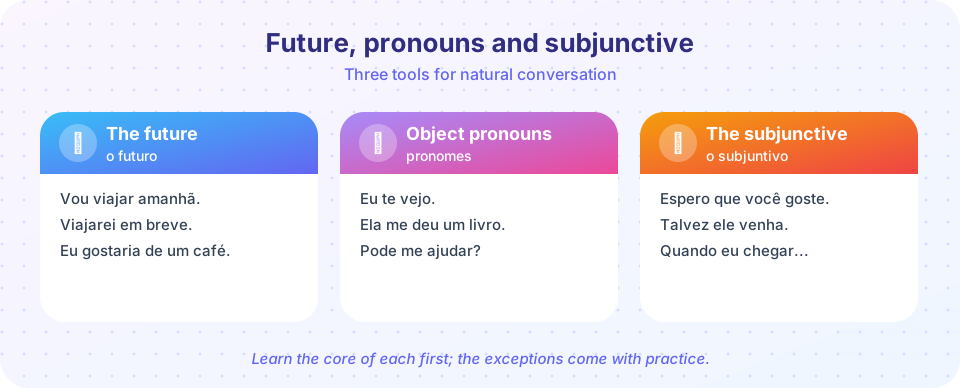
You can now describe the present and tell stories about the past. This chapter opens three new doors at once. First, the future: making plans, promises and predictions. Second, object pronouns: the small words (me, te, o, a, lhe) that let you say "I see you" or "She gave it to me" without repeating nouns. Third, the subjunctive, the mood Portuguese uses for wishes, doubts and things that have not happened yet.
All three look intimidating on paper, yet each has a simple core you can use immediately. For the future you only need "ir + infinitive", for pronouns you need the position rule "before the verb in Brazil", and for the subjunctive you need one recipe and a short list of triggers like "quero que" and "talvez". The lessons below teach those cores first and the exceptions later.
What you will learn
- What each lesson in the chapter will let you say.
- Why Brazilian Portuguese prefers "vou falar" to "falarei" in conversation.
- A preview of the pronoun and subjunctive forms.
- How to use the review quiz to find your weak spots.
Key terms
Futuro (future): what will happen. Pronome oblíquo (object pronoun): me, te, o, a, nos, os, as, lhe, lhes.
Subjuntivo (subjunctive): the mood of wishes, doubts, emotions and non-facts.
Modo (mood): the speaker's attitude to what is said: fact (indicative), wish or doubt (subjunctive) or order (imperative).
The chapter in four steps
Talking about the future
Object pronouns
The subjunctive
Review
Lessons in this chapter
- Talking about the future: "ir + infinitive" for everyday plans, the future simple (falarei) for writing and promises, the conditional (falaria) for polite requests, and the time words you need.
- Object pronouns: me, te, o, a, nos, os, as, lhe, lhes; where they go in Brazil and in Portugal; comigo, contigo and other prepositional forms.
- Subjunctive basics: the present subjunctive recipe, the triggers (quero que, talvez, espero que), commands, and a first look at "quando eu chegar".
- Chapter review: a recap table, a picture of the chapter and a ten-question quiz.
Why these three belong together
Every real conversation about plans uses all three. Look at this one:
| Portuguese | English |
|---|---|
| O que você vai fazer amanhã? | What are you going to do tomorrow? |
| Vou estudar de manhã. À tarde, vou encontrar uns amigos. | I am going to study in the morning. In the afternoon I am going to meet some friends. |
| Que legal! Espero que você goste do passeio. | How nice! I hope you enjoy the outing. |
| Obrigado! Se eu tiver tempo, eu te ligo. | Thanks! If I have time, I will call you. |
In four lines you see the immediate future ("vai fazer", "vou estudar"), the subjunctive ("espero que você goste", "se eu tiver") and an object pronoun ("te ligo"). You will be able to produce every sentence of this dialogue by the end of the chapter.
Study plan
Take the topics in order, but practice them together. After each lesson, write three sentences that use the new tool about your own life: your plans next week, who you call, what you hope for. The best practice is always personal. Say the sentences aloud and, if you can, to a language partner.
Try it
A preview deck with sentences from the chapter. Notice the three tools in each sentence.
Now a small Python preview that builds the three future forms of a verb. It uses only regular verbs, so try it with "falar", "comer" and "partir".
Press Run (or Ctrl + Enter) to see the result here.
Program input · what you'd type while the program runs
Type the answers before you press Run, one per line. Each time the program reads a line (with input()), it gets the next line from this box.
Check your understanding
Quick check · 4 questions
of 4 answered You scored / 4 · perfect!
-
1. Which is the most common way to say 'I am going to travel tomorrow' in Brazilian conversation?
'Ir + infinitive' is the everyday future in speech. 'Viajarei' is more formal and written. -
2. Where does the pronoun 'te' usually go in everyday Brazilian speech?
Brazilian speech puts the pronoun before the verb. The hyphenated order is typical of European Portuguese. -
3. What does the subjunctive express?
The subjunctive marks non-facts: wishes, doubts, emotions and uncertain events. -
4. In 'Espero que você goste', which word is the subjunctive?
'Goste' is the present subjunctive of gostar, triggered by 'espero que'.
Summary
- Chapter 7 covers the future, object pronouns and the subjunctive.
- Everyday future: "ir + infinitive"; written future: -ei, -ás, -á, -emos, -ão.
- Object pronouns (me, te, o, a, lhe) go before the verb in Brazilian speech.
- The subjunctive follows triggers like "espero que" and "talvez".
Next: Talking about the future
Track your progress
Create a free account to tick off lessons and pick up where you left off on any device.
of Portuguese for Beginners lessons completed