


















Lesson 13 of 48 · Nouns, Articles and Adjectives
Gender and Plurals in Portuguese Nouns
Predict the gender of Portuguese nouns from their endings, learn the key exceptions, handle nouns for people, and form every plural, including -ão words.
In English, a word like "book" has no gender and one simple plural. In Portuguese, every noun is masculine or feminine, and the plural depends on how the word ends. This sounds like a lot of memory work, but the endings follow reliable patterns. With a few dozen rules and exceptions you can handle thousands of nouns.
This lesson gives you the gender hints, the exceptions that matter most, the way to form feminine nouns for people, and a complete set of plural rules, including the three-way puzzle of words ending in -ão. Learn to use the article every time, and gender will feel natural within weeks.
What you will learn
- How noun endings predict gender, and the exceptions to remember.
- How to make the feminine of nouns for people and animals.
- How to form plurals for every common ending.
- The three plurals of words ending in -ão.
Key terms
Masculine (masculino) and feminine (feminino): the two noun classes. The article o marks masculine and a marks feminine.
Common-gender noun: one noun form used for both sexes; only the article changes: o artista, a artista.
Singular / plural: one thing / more than one.
Stressed syllable: the syllable said with emphasis; it decides some plural endings.
Gender from endings
The basic pattern
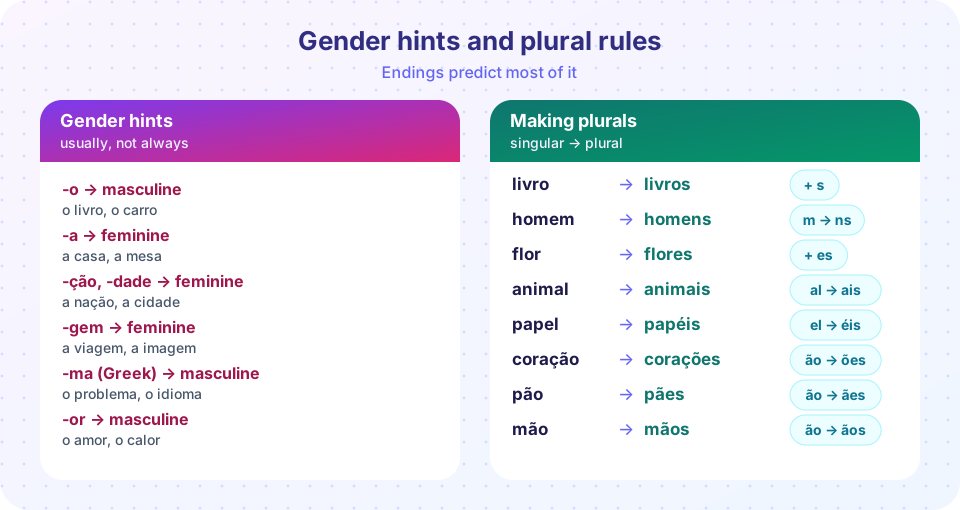
Most nouns ending in -o are masculine, and most nouns ending in -a are feminine:
| Masculine | Feminine |
|---|---|
| o livro (the book) | a casa (the house) |
| o carro (the car) | a mesa (the table) |
| o amigo (the male friend) | a amiga (the female friend) |
| o gato (the male cat) | a gata (the female cat) |
Exceptions you need
Some very common words break the rule.
Masculine words ending in -a: o dia (the day), o mapa (the map), o planeta (the planet). Many words of Greek origin ending in -ma are masculine: o problema, o tema, o sistema, o idioma, o programa, o clima, o cinema. Not every -ma word is masculine, though: a cama (the bed) and a forma (the shape) are feminine.
Feminine words ending in -o: a mão (the hand, also an exception to the -ão hint), a foto (the photo), a moto (the motorbike). The last two are shortened forms of fotografia and motocicleta, which are feminine.
Endings that predict gender
| Ending | Usually | Examples | Exceptions |
|---|---|---|---|
| -ção, -são | feminine | a nação, a televisão, a decisão | o coração, o sabão |
| -dade, -tude | feminine | a cidade, a verdade, a atitude | |
| -gem | feminine | a viagem, a imagem, a coragem | o personagem |
| -ez, -ice | feminine | a rapidez, a velhice | |
| -or | masculine | o amor, o calor, o professor | a flor, a dor, a cor |
| -ão (other) | masculine | o pão, o limão, o avião | a mão, a razão, a opinião |
| -l | masculine | o animal, o hotel, o jornal | a capital (city), a catedral |
| -ema, -oma | masculine | o problema, o idioma |
The hints work in most cases, and they will help you guess a new word correctly more often than not. For words with no clear ending, such as a luz (light), o mar (sea), a noite (night), o leite (milk), a árvore (tree), only the article tells you. This is why you should learn a luz, not just luz.
Groups with a fixed gender
Languages and colors are masculine: o português, o inglês, o azul, o vermelho. The days Monday to Friday are feminine in their full form because feira is feminine (a segunda-feira), while sábado and domingo are masculine (o sábado).
Nouns for people and animals
The gender of a noun for a person usually matches the person's sex. There are four common patterns:
- -o becomes -a: o menino / a menina (boy / girl), o médico / a médica, o gato / a gata, o amigo / a amiga.
- Add -a to a consonant ending: o professor / a professora, o cantor / a cantora, o português / a portuguesa (the accent disappears), o espanhol / a espanhola.
- One form for both genders: only the article changes: o estudante / a estudante, o artista / a artista, o colega / a colega, o turista / a turista, o jovem / a jovem.
- Different words: o homem / a mulher, o pai / a mãe, o irmão / a irmã, o avô / a avó, o rei / a rainha, o ator / a atriz.
A few nouns have one grammatical gender whatever the person: a pessoa (the person), a criança (the child), a vítima (the victim) are always feminine.
Same word, different meanings
A few nouns change meaning with gender: o capital is money and a capital is a capital city; o cabeça is a leader and a cabeça is a head. Do not worry about them yet, but notice them when they appear.
Making plurals
The plural depends on the last letter or letters.
| Singular ends in | Rule | Example |
|---|---|---|
| a vowel | add -s | livro → livros, casa → casas, táxi → táxis |
| -m | change to -ns | homem → homens, jardim → jardins |
| -r, -z | add -es | flor → flores, mulher → mulheres, luz → luzes |
| -s (unstressed last syllable) | no change | o lápis → os lápis, o ônibus → os ônibus |
| -s (stressed last syllable) | add -es | país → países, mês → meses, português → portugueses |
| -al, -el, -ol, -ul | drop l, add -ais, -eis, -ois, -uis | animal → animais, papel → papéis, lençol → lençóis, azul → azuis |
| -ão | -ões (most) | coração → corações |
| -ães (a few) | pão → pães, cão → cães, capitão → capitães | |
| -ãos (a few) | mão → mãos, irmão → irmãos, cidadão → cidadãos |
Two notes help. First, when portuguesa or meses appear, the written accent from the singular (português, mês) disappears, because the stress is now on a different syllable. Second, words ending in unstressed -il or -el, such as fácil and nível, change differently (fáceis, níveis); you will meet them later.
The three -ão plurals
The -ão ending is the hardest plural to predict, because the same singular ending leads to three plurals. The simplest strategy is to remember that -ões is the default for the large majority of words, and to memorize two short lists:
- -ães: pão, cão, capitão, alemão (German), escrivão
- -ãos: mão, irmão, cidadão (citizen), órgão, cristão, chão, grão
All other words use -ões: coração → corações, lição → lições, avião → aviões, limão → limões, botão → botões, estação → estações, nação → nações.
Pronunciation changes in some plurals
In some words with a stressed o, the plural has an open vowel: o ovo ("OH-voo") but os ovos ("AW-voos"); o novo but os novos; o olho (eye) but os olhos. This is natural to learn by listening.
Learning gender in practice
Gender is easier to learn than it sounds if you use a few habits. First, always meet a noun with its article: say a mesa, o carro, a flor out loud until the pair feels like one word. Second, group new words by ending. When you meet a verdade, a cidade, and a universidade, you notice that -dade words behave alike, and your memory stores the pattern once instead of three times.
Third, learn nouns inside short phrases, such as o livro interessante and a revista interessante ("the interesting book" and "the interesting magazine"). The adjective interessante does not change, but the article does, and the phrase reminds you of both rules. Fourth, expect to make mistakes and treat them as information. An English speaker who says o mão will be understood perfectly, and one correction ("a mão") is usually all it takes to fix the word for good.
Finally, trust the endings but check the exceptions. If a noun is new and you must guess, use its ending: -o is masculine, -a is feminine, -ção and -dade are feminine, and -or is masculine. You will be right most of the time, and the rest you will learn from listening.
Common misconceptions
"Every word ending in -a is feminine." O dia, o mapa, o problema are masculine.
"The plural of every word is just +s." Words in -m, -r, -z, -l and -ão follow their own patterns.
"Mão is masculine because it ends in -o." Mão ends in -ão and is feminine: a mão, as mãos.
"You can make any plural by adding -es." Only after -r and -z (and stressed -s).
Try it
The first tool is a plural quiz. Pick the right plural for each noun.
The second tool is a plural maker. It applies the rules in the table and then checks its answers against a list of known plurals.
Press Run (or Ctrl + Enter) to see the result here.
Program input · what you'd type while the program runs
Type the answers before you press Run, one per line. Each time the program reads a line (with input()), it gets the next line from this box.
Check your understanding
Quick check · 6 questions
of 6 answered You scored / 6 · perfect!
-
1. Which noun is masculine?
Problema is a Greek-origin -ma word and is masculine. Mão is feminine and cidade ends in -dade, also feminine. -
2. What is the plural of 'homem'?
Words ending in -m change to -ns: homem → homens. -
3. What is the plural of 'animal'?
Words in -al drop the l and add -ais: animal → animais. -
4. What is the plural of 'pão'?
Pão belongs to the short list with -ães: pão → pães. -
5. How do you say 'the female student'?
Estudante is a common-gender noun; only the article changes. -
6. What is the plural of 'lápis'?
Nouns ending in unstressed -s do not change in the plural: os lápis.
Summary
- Nouns in -o are mostly masculine and in -a mostly feminine; learn the exceptions o dia, o mapa, o problema, a mão.
- -ção, -dade, -gem are usually feminine; -or, -l, -ão are usually masculine.
- People: -o → -a, consonant + a, common gender (o/a estudante), or different words.
- Plurals: vowel + s; -m → -ns; -r, -z + es; -al → -ais; -el → -éis; unstressed -s unchanged.
- -ão gives -ões (most), -ães (pães, cães), or -ãos (mãos, irmãos).
Track your progress
Create a free account to tick off lessons and pick up where you left off on any device.
of Portuguese for Beginners lessons completed