


















Lesson 14 of 48 · Nouns, Articles and Adjectives
Articles and Contractions: o, a, um, uma, do, na, ao
Learn the definite and indefinite articles in Portuguese, when to use them, and the contractions do, da, no, na, ao, à and pelo, with clear examples and practice.
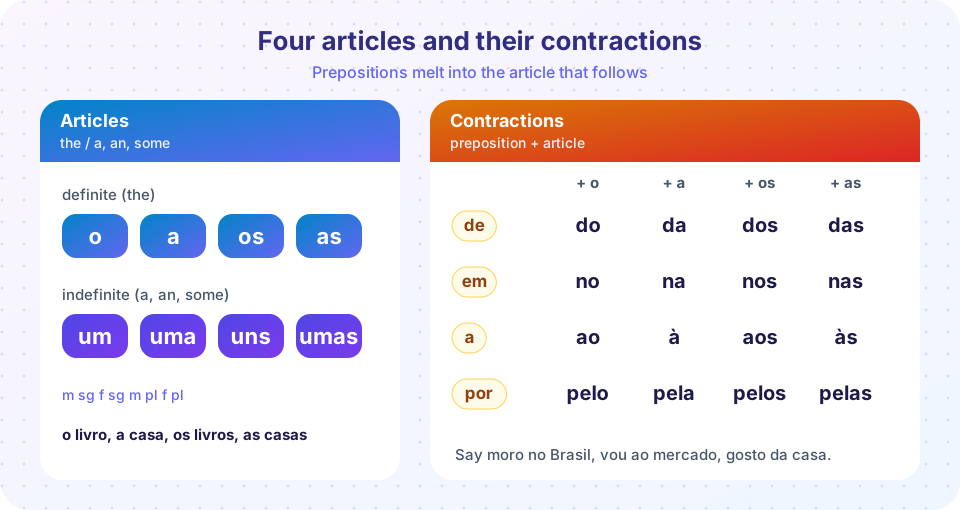
Articles are the smallest words in a sentence and among the most important. In English there is one definite article, "the", and two indefinite ones, "a" and "an". Portuguese has four of each, because the articles must match the gender and number of the noun: o livro, a casa, os livros, as casas.
The second half of this lesson covers a feature that surprises beginners: when a preposition such as de ("of, from") or em ("in, on") meets an article, the two words melt into one. De + o becomes do, and em + a becomes na. You will see contractions in nearly every sentence from now on, so it pays to learn them early.
What you will learn
- The definite articles o, a, os, as and indefinite um, uma, uns, umas.
- When Portuguese uses an article and English does not.
- The contractions of de, em, a, and por with articles.
- How to say that something belongs to someone: o livro da Ana.
Key terms
Definite article: points to a specific thing: o livro (the book).
Indefinite article: introduces a thing that is not specific: um livro (a book), uns livros (some books).
Preposition: a small word that links nouns: de (of, from), em (in, on), a (to, at), por (through, by, for).
Contraction: two words joined into one, such as do from de + o.
The articles
| Masculine singular | Feminine singular | Masculine plural | Feminine plural | |
|---|---|---|---|---|
| the | o | a | os | as |
| a, an, some | um | uma | uns | umas |
Examples: o livro / os livros, a casa / as casas, um carro / uns carros, uma flor / umas flores.
The indefinite plurals uns and umas mean "some" or "a few": Tenho uns amigos no Brasil ("I have some friends in Brazil"). They also mean "about" before numbers: uns dez minutos ("about ten minutes").
When to use an article
Portuguese uses the definite article more than English does. The most important cases:
General statements with a subject:
- O amor é lindo. (Love is beautiful.)
- Os brasileiros gostam de futebol. (Brazilians like football.)
- A vida é boa. (Life is good.)
In English there is no "the" here, but in Portuguese there is. This applies when the noun is the subject of the sentence.
Countries, many of them: o Brasil, o Canadá, o Japão, a França, a Argentina, a Alemanha, os Estados Unidos. Some countries and nearly all cities take no article: Portugal, Angola, Moçambique, Cuba, São Paulo, Lisboa. A few cities do: o Rio de Janeiro, o Porto. There is no complete rule, so learn each country with its article.
Times of the week: Na segunda-feira vou ao banco. ("On Monday I go to the bank.")
People's names: Many speakers put an article before a first name in casual speech: a Maria, o João. This is common in many regions of both Brazil and Portugal; it is optional and slightly informal, so you can leave it out.
When Portuguese leaves the article out
With professions, nationalities, and religions after ser, there is no indefinite article: Sou professor. (I am a teacher.) Ela é médica. (She is a doctor.) Eles são brasileiros. (They are Brazilian.) When you add an adjective, the article comes back: Ela é uma médica excelente.
After gostar de with a general noun, the article is not necessary: Gosto de café. (I like coffee.) but Gosto do café da minha avó. (I like my grandmother's coffee.), where do is de + o, because the coffee is specific.
Contractions
A contraction happens when a preposition ending in a vowel meets an article that starts with a vowel. The four prepositions that contract most often are de, em, a, and por.
| Preposition | + o | + a | + os | + as |
|---|---|---|---|---|
| de (of, from) | do | da | dos | das |
| em (in, on) | no | na | nos | nas |
| a (to, at) | ao | à | aos | às |
| por (through, by) | pelo | pela | pelos | pelas |
The patterns are simple:
- de + article: d + article (do, da, dos, das).
- em + article: n + article (no, na, nos, nas).
- a + o/os gives ao/aos; a + a/as gives à/às (the crase, shown with a grave accent).
- por + article: pel- + article (pelo, pela, pelos, pelas).
With the indefinite articles, em and de also contract in speech: num / numa (em + um / uma) and dum / duma (de + um / uma). In Brazil you will often hear num and numa, and write them, although em um is also correct. Dum is more common in Portugal.
Examples in sentences
- Moro no Brasil. (I live in Brazil. em + o)
- Sou do Canadá. (I am from Canada. de + o)
- Sou da Inglaterra. (I am from England. de + a)
- Vou ao mercado. (I am going to the market. a + o)
- Vou à praia. (I am going to the beach. a + a)
- Ele fala das crianças. (He talks about the children. de + as)
- Passo pelo parque. (I walk through the park. por + o)
- Obrigado pelo convite. (Thank you for the invitation. por + o)
- Estou numa loja. (I am in a shop. em + uma)
Ownership with de
English uses an apostrophe and s. Portuguese uses de plus the owner, and the article contracts: o livro da Ana (Ana's book, literally "the book of the Ana"), a casa dos meus pais (my parents' house), o carro do João (João's car).
When there is no contraction
The contraction does not happen when the a or o is not an article. With a city name that takes no article, a and em stay separate: Vou a Lisboa. (I am going to Lisbon.) Moro em São Paulo. (I live in São Paulo.) With a country that takes an article, the contraction appears: Vou ao Brasil. Moro no Brasil.
In European Portuguese you may also see a before an infinitive, as in Estou a falar ("I am speaking"). Here a is not an article at all, so it never contracts.
Common misconceptions
"Portuguese has no 'the' where English does not." Portuguese uses o/a before general subjects: O amor é lindo.
"Contractions are optional." In standard Portuguese, de + o is always do and em + o is always no. (Exceptions are rare, such as when the article belongs to a following verb or a title.)
"À and a are the same." They are different: a is the preposition "to", and à is a + a. Vou à praia has the contraction; Vou a Lisboa has none.
"A profession needs um/uma." Not after ser with a bare noun: Sou professora.
Try it
The first tool is a contraction builder. Pick a preposition and an article, and see the result with an example.
The second tool fills in the right contraction for a list of sentences. It uses the table from this lesson, and it does not understand meaning, so it relies on you to give the right preposition and article.
Press Run (or Ctrl + Enter) to see the result here.
Program input · what you'd type while the program runs
Type the answers before you press Run, one per line. Each time the program reads a line (with input()), it gets the next line from this box.
Check your understanding
Quick check · 6 questions
of 6 answered You scored / 6 · perfect!
-
1. What is 'de + o'?
De + o contracts to do: Sou do Brasil. -
2. Which sentence is correct for 'I am going to the beach'?
Praia is feminine, so a + a = à: Vou à praia. -
3. How do you say 'Ana's house'?
Use de + owner, with the contraction: a casa da Ana. -
4. Which is correct for 'I am a teacher'?
After ser, professions and nationalities usually have no indefinite article. -
5. What does 'uns' mean in 'uns dez minutos'?
Uns before a number means about: uns dez minutos is about ten minutes. -
6. Which sentence is correct?
Brasil takes an article (em + o = no). Lisboa takes none, so a Lisboa has no contraction.
Summary
- The articles are o, a, os, as (the) and um, uma, uns, umas (a, some); uns means "about" before numbers.
- Portuguese uses o/a for general subjects, many countries, and often with names.
- Professions and nationalities after ser have no indefinite article: Sou professora.
- De, em, a, por contract with articles: do, da, no, na, ao, à, pelo, pela.
- Possession uses de: o livro da Ana; cities without an article do not contract: Vou a Lisboa.
Track your progress
Create a free account to tick off lessons and pick up where you left off on any device.
of Portuguese for Beginners lessons completed