


















Lesson 25 of 48 · Daily Life and Questions
Food, Restaurants and Shopping in Portuguese
Order food politely, ask prices, buy things, ask for the bill and pay in Portuguese with the key phrases, vocabulary and cultural tips for Brazil and Portugal.
Food is the fastest way into any culture, and in the Portuguese-speaking world meals are a social event. A Brazilian lunch might be a plate piled with rice, beans and grilled meat, a Portuguese one a bowl of soup followed by cod, and both are served with a smile and a lot of conversation. In this lesson you will learn how to order, ask for prices, shop and pay without sounding rude and without being lost when someone asks you a question back.
The key lesson is about politeness through the verb. Portuguese speakers soften requests by choosing a different form of the verb, not just by adding "please". You will see the same idea again in the chapter on past tenses, where "queria" comes from the imperfect.
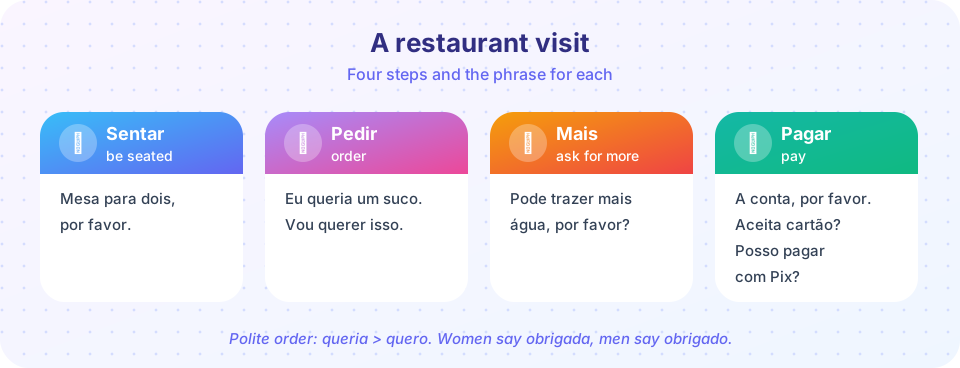
What you will learn
- Order food and drink politely with "queria", "vou querer" and "gostaria de".
- Name common foods, drinks and meals, and handle quantities.
- Ask prices and shop: "Quanto custa?", "Posso experimentar?", "Aceita cartão?".
- Ask for the bill and understand how paying works in Brazil.
Key terms
Cardápio (Brazil) or ementa (Portugal): the menu.
Garçom (Brazil) or empregado de mesa / senhor (Portugal): the waiter.
Conta: the bill. Gorjeta: the tip. Troco: the change you get back.
Pix: the instant payment system used across Brazil, launched by the central bank in 2020.
Meals and food words
The day has three main meals and a snack: café da manhã (breakfast, Portugal: pequeno-almoço), almoço (lunch, the main meal for many Brazilians), lanche (afternoon snack) and jantar (dinner).
| Food | Portuguese |
|---|---|
| bread / cheese | o pão / o queijo |
| rice / beans | o arroz / o feijão |
| meat / chicken / fish | a carne / o frango / o peixe |
| egg / salad / potato | o ovo / a salada / a batata |
| fruit / apple / banana | a fruta / a maçã / a banana |
| coffee / milk / tea | o café / o leite / o chá |
| juice / water / beer | o suco / a água / a cerveja |
| dessert / cake | a sobremesa / o bolo |
In Portugal "juice" is sumo, and "ice cream" is gelado where Brazilians say sorvete. Water is "água com gás" (sparkling) or "água sem gás" (still). A small black coffee in Brazil is a cafezinho, in Lisbon a bica.
Typical Brazilian dishes to recognize: feijoada (black bean and pork stew), pão de queijo (cheese bread), coxinha (fried chicken croquette), moqueca (fish stew), brigadeiro (chocolate sweet) and açaí na tigela (açaí bowl). In Portugal: bacalhau (salt cod), pastel de nata (custard tart) and francesinha (a meaty sandwich from Porto).
Ordering: three levels of politeness
There are three ways to ask for something, from most direct to most polite.
| Phrase | Meaning | When |
|---|---|---|
| Eu quero um café. | I want a coffee. | Direct. Fine with friends, blunt with strangers. |
| Eu queria um café. | I would like a coffee. | The standard polite order. |
| Eu gostaria de um café. | I would like a coffee. | Very polite, a little formal. |
In Brazilian restaurants you will often hear Vou querer ("I will have") as the normal way to commit to a dish: "Vou querer o prato do dia" (I will have the dish of the day). It sounds natural and polite even though the verb is the future.
Make requests with Pode (can you) or Poderia (could you): "Pode me trazer a conta?" (Can you bring me the bill?), "Poderia trazer mais água?" (Could you bring more water?). The word me (to me) goes before the infinitive in everyday Brazilian speech; Portugal places it after in writing ("trazer-me").
Useful reactions: Pode ser (that works), Só isso (just that), Mais alguma coisa? (anything else?), Para mim, não, obrigado (not for me, thank you), Está uma delícia! (it is delicious).
Say thank you with obrigado if you are male and obrigada if you are female. This is gender of the speaker, not of the person you speak to.
Quantities and containers
Portuguese says a little of with um pouco de and uses a partitive pattern for amounts:
- um quilo de arroz (a kilo of rice), meio quilo (half a kilo), duzentos gramas de queijo (200 g of cheese)
- um litro de leite, uma garrafa de água, uma lata de refrigerante
- uma fatia de bolo (a slice of cake), um copo de suco (a glass of juice), uma xícara de café (a cup of coffee)
- um pedaço de pão (a piece of bread), uma porção de batata frita (a portion of fries)
Do not add "some" in Portuguese: "Quero pão" already means "I want (some) bread", and the same noun without an article means an unspecified amount.
To say you are hungry or thirsty, use the verb ter and the nouns: Estou com fome (I am hungry), Estou com sede (I am thirsty), Estou satisfeito/satisfeita (I am full). Remember "Estou cheio" can also mean you are fed up, so prefer "satisfeito".
At the restaurant
Here is a complete dialogue. Read the Portuguese aloud, then the English.
| Portuguese | English |
|---|---|
| Boa noite! Mesa para quantas pessoas? | Good evening! A table for how many people? |
| Para duas, por favor. | For two, please. |
| Aqui está o cardápio. | Here is the menu. |
| O que vocês recomendam? | What do you recommend? |
| Recomendo a moqueca de peixe. Serve duas pessoas. | I recommend the fish moqueca. It serves two. |
| Então vamos querer a moqueca e uma água sem gás. | Then we will have the moqueca and a still water. |
| Mais alguma coisa? | Anything else? |
| Só isso, obrigada. | Just that, thank you. |
| A conta, por favor. | The bill, please. |
| Aqui está. A taxa de serviço já está incluída. | Here it is. The service charge is already included. |
| Posso pagar com Pix? | Can I pay with Pix? |
| Claro. | Of course. |
A few cultural facts. Many Brazilian restaurants add a service charge of about 10% to the bill, often marked as "serviço" or "taxa de serviço". It is customary but optional, so read the bill before you tip again. Lunch counters called restaurante por quilo let you fill a plate and pay by weight. In a typical prato feito (set lunch plate) you receive rice, beans, a protein and sides at a fixed price. In Portugal, bread, olives and butter that arrive unasked (the couvert) are charged if you eat them.
Shopping
For shopping the same frames apply. A few that come up daily:
| Portuguese | English |
|---|---|
| Estou só olhando, obrigado. | I am just looking, thanks. |
| Quanto custa isto? / Quanto é? | How much is this? |
| Quanto custam estes? | How much are these? |
| É muito caro. / É barato. | It is very expensive. / It is cheap. |
| Tem desconto? | Is there a discount? |
| Tem um tamanho maior / menor? | Do you have a bigger / smaller size? |
| Posso experimentar? | Can I try it on? |
| Aceita cartão? / Posso pagar com cartão? | Do you accept cards? |
| Pode embrulhar para presente? | Can you gift-wrap it? |
| Preciso de uma sacola? | Do I need a bag? |
| Pode parcelar? | Can I pay in installments? |
Note custa (singular, one thing) versus custam (plural, several things). "Preciso de" (I need) always takes de: "Preciso de uma camiseta" (I need a T-shirt). Brazil is famous for paying in installments, "em três vezes sem juros" (in three installments without interest).
Where to shop: o mercado or o supermercado (supermarket), a feira (open-air market with fruit and vegetables), a padaria (bakery), o açougue (butcher, Portugal: talho), a farmácia (pharmacy) and a banca de jornal (newsstand).
Common misconceptions
"Eu quero" is polite enough. It is grammatical, but with strangers it sounds demanding. Use "queria" or "vou querer".
"Estou cheio/cheia" is the same as "I am full". It can sound crude or mean you are fed up. Say "Estou satisfeito/satisfeita".
You must tip separately. Check first: the 10% service charge is often already on the bill.
"Obrigado" changes with the person you thank. It changes with the person who speaks: men say obrigado, women say obrigada.
Try it
First, a gap-fill for restaurant sentences. Pay attention to accents and to the gender of the thing you thank for.
The second TryIt computes a restaurant bill in Brazilian format, with a 10% service charge, and splits it between friends. It uses exact decimals so cents are never wrong.
Press Run (or Ctrl + Enter) to see the result here.
Program input · what you'd type while the program runs
Type the answers before you press Run, one per line. Each time the program reads a line (with input()), it gets the next line from this box.
Finally, match the foods and drinks.
Check your understanding
Quick check · 5 questions
of 5 answered You scored / 5 · perfect!
-
1. Which request is the standard polite way to order a juice?
'Eu queria' (I would like) with 'por favor' is polite. 'Eu quero' is grammatical but blunt with strangers. -
2. A woman thanks the waiter. What does she say?
'Obrigado/obrigada' agrees with the gender of the speaker, so a woman says 'obrigada'. -
3. What is the best way to say you are full after a meal?
'Estou cheio' can also mean you are fed up, so 'satisfeito' is the safer, politer choice. -
4. Which is correct?
'Custam' agrees with the plural subject 'sapatos' (shoes), and 'estes' is also plural. -
5. What does 'taxa de serviço' on a Brazilian bill usually mean?
It is the waiter's service charge, usually about 10%, normally already added to the bill.
Summary
- Meals: café da manhã, almoço, lanche, jantar. Learn core food words with their articles (o pão, a água).
- Order politely with "queria", "vou querer" or "gostaria de"; "quero" is direct.
- Use "pode/poderia" to request, and "um pouco de", "um quilo de", "uma fatia de" for quantities.
- "Quanto custa/custam?", "Aceita cartão?", "Posso experimentar?" cover most shopping.
- Ask for the bill with "A conta, por favor"; a 10% service charge is often included; Pix is common in Brazil.
- Men say obrigado, women say obrigada.
Next: Places and directions
Track your progress
Create a free account to tick off lessons and pick up where you left off on any device.
of Portuguese for Beginners lessons completed