


















Lesson 4 of 48 · Getting Started
Study Plan and Habits for Learning Portuguese
Build a realistic Portuguese study plan: daily habits, spaced review, the four skills, free practice ideas, and how to start speaking early.
Most people do not fail at languages because they lack talent. They fail because their plan is too big, too vague, or too lonely. A few small habits, repeated for months, are enough to take you from your first Olá to real conversations. This lesson gives you a plan you can actually keep.
You will learn how memory works well enough to use it, how to balance listening, speaking, reading, and writing, what a good week looks like, and how to find people to talk to. None of this needs money or special software. It needs fifteen to thirty minutes on most days, and a little honesty about what is working.
What you will learn
- Why short, spaced reviews beat one long session.
- How to share your time among listening, speaking, reading, and writing.
- A weekly plan for the first month, and how to adjust it.
- Free ways to hear and use real Portuguese from day one.
- How to measure progress without waiting for fluency.
Key terms
Spaced repetition: reviewing material at increasing gaps (a day, three days, a week, and so on) just as you are about to forget it.
Retrieval practice: trying to recall something from memory instead of rereading it.
Input: language you hear or read. Output: language you speak or write.
CEFR: the Common European Framework of Reference, which labels ability from A1 (beginner) to C2 (near-native).
How memory really works
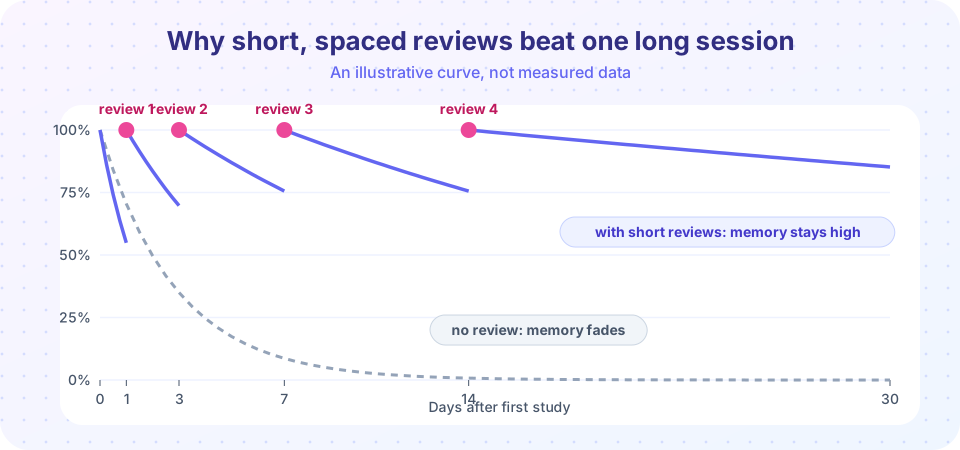
In 1885 the German psychologist Hermann Ebbinghaus tested his own memory by learning lists of nonsense syllables and checking how many he could still recall after different delays. He found that forgetting is fastest right after learning and then slows down. Researchers since have repeated the basic pattern with many materials, and they have also found something practical: when you review information shortly before you would forget it, the memory lasts longer each time. That is the spacing effect.
A second finding matters just as much. Trying to recall an answer strengthens memory more than rereading it. Teachers call this the testing effect or retrieval practice. If you cover the English and try to remember obrigado, you learn more than if you stare at the pair for a minute.
Put together, the findings suggest a simple rule: study a little, test yourself, and come back later. The chart above shows the idea with a typical set of review days: 1, 3, 7, 14, and 30. The numbers in it are illustrative, not a promise, but the shape is real. A word you meet once and never see again is mostly gone in a week. A word you review five times over a month usually stays.
The four skills
Language use has four parts, and a balanced plan touches all of them every week.
| Skill | What it is | Example activity |
|---|---|---|
| Listening | Understanding spoken Portuguese | A short podcast or song, with the transcript |
| Speaking | Producing speech aloud | Reading examples aloud, talking to a partner |
| Reading | Understanding written Portuguese | Lesson dialogues, signs, menus, simple news |
| Writing | Producing text | Three-sentence diary, messages to a partner |
Beginners tend to over-read and under-speak, because reading feels safe. Speaking feels risky, so it gets skipped, and then it stays weak. Plan speaking time on purpose, even if the only listener is you.
A first-month plan
Here is a flexible plan of about 25 minutes a day, five days a week. Adjust the minutes to your life, but keep the pattern.
| Day | Main task (15 min) | Extras (10 min) |
|---|---|---|
| Monday | New lesson: read and try the practice | Say all examples aloud twice |
| Tuesday | Re-read the lesson's examples; redo the quiz without looking | Flashcard review |
| Wednesday | New lesson | Listen to ten minutes of Brazilian music or a podcast |
| Thursday | Review Wednesday; write three sentences using new words | Flashcard review |
| Friday | Review the week; play the practice games | Record yourself reading a dialogue |
| Weekend | Optional: a conversation, a film, a recipe in Portuguese | Free time |
Two principles make this plan work. First, review is part of the plan, not a bonus; skipping it is the main reason beginners forget things. Second, a missed day is not a failure. Just continue the next day. A habit survives one gap; it rarely survives guilt.
How many words should you learn a day?
Five to ten new words a day is enough, and fewer is fine. Learn words in phrases (Tudo bem?, Eu quero um café, Onde fica o banheiro?), not as isolated items, because phrases carry grammar, rhythm, and context. If you add 10 new words a day with five reviews each, you will have about 50 reviews to do daily once the system fills up. That is why the Python practice below counts the load for you, and why five new words a day is a comfortable start.
Free ways to meet real Portuguese
- Music. Brazilian popular music is varied and easy to find. Look up lyrics, read them while listening, and pick one line to learn each day.
- Podcasts and videos for learners. Search for beginner Brazilian Portuguese with transcripts. Slow speech and clear subtitles are best at first.
- Films and series. Watch with Portuguese subtitles when you can; English subtitles are fine at the start, but avoid relying on them forever.
- Apps and tools. Flashcard apps with spaced repetition do the scheduling for you. Pick one and stay with it.
- Language exchange. Many websites and apps match you with someone who wants to practice English while you practice Portuguese. Be cautious online: use the platform's own chat, share only what you would tell a stranger, and never send money or personal documents.
- A tutor. A paid tutor gives feedback that apps cannot. Even one half-hour a week helps, and a tutor can correct your pronunciation.
Start speaking in week two
You do not need to know much to speak. In your second week you can already say Oi, tudo bem?, Meu nome é..., Eu sou de..., Obrigado, and Até logo. Say them to a friend, a teacher, or a mirror. The goal is not perfection but the habit of making sounds with your mouth in Portuguese. People are usually delighted when a learner tries.
Measuring progress
Fluency is too far away to be a useful measure. Use smaller goals:
- Can-do statements: "I can introduce myself." "I can order a coffee." "I can tell the time."
- Streaks and totals: days studied, cards reviewed, minutes of listening.
- Recordings: record yourself saying the same short dialogue now and in a month. The difference is usually obvious and encouraging.
On the CEFR scale, this course targets the beginner levels, A1 and the start of A2: understanding and using familiar everyday expressions and simple sentences. That is a real, useful goal, and reaching it takes most learners a few months of steady work.
Common misconceptions
"I should wait until I know more before I speak." You learn to speak by speaking. Start early with small phrases.
"Rereading my notes is studying." It feels productive, but recalling from memory works better. Cover and test yourself.
"Immersion is the only way." Living in Brazil helps, but a good routine of listening, speaking practice, and spaced review at home can take you a long way.
"If I miss a day, I have failed." One missed day changes almost nothing. Quitting changes everything.
Try it
The first tool is a planner. Move the sliders to match your week and see your weekly minutes, with a reminder if one skill is missing.
The second tool builds a review calendar and counts your daily review load. It only does arithmetic on dates; it does not know how fast you personally learn.
Press Run (or Ctrl + Enter) to see the result here.
Program input · what you'd type while the program runs
Type the answers before you press Run, one per line. Each time the program reads a line (with input()), it gets the next line from this box.
Check your understanding
Quick check · 5 questions
of 5 answered You scored / 5 · perfect!
-
1. What does the spacing effect say?
Reviews just before forgetting, spaced further apart each time, strengthen memory more than one long session. -
2. What is retrieval practice?
Recalling an answer strengthens memory more than rereading it. -
3. When does this lesson suggest you start speaking?
You can say greetings and introductions in week two, and speaking early builds the habit. -
4. What should you do if you miss a study day?
A single gap hardly matters; quitting does. Resume the plan the next day. -
5. What does CEFR level A1 describe?
A1 is the first beginner level on the six-level CEFR scale, which ends with C2.
Summary
- Short, spaced reviews (days 1, 3, 7, 14, 30) beat one long session.
- Testing yourself beats rereading.
- Balance listening, speaking, reading, and writing every week.
- Fifteen to thirty minutes a day is enough; a missed day is no failure.
- Start speaking in week two, find free input such as music, and use small can-do goals to track progress.
Next: Chapter 1 review
Track your progress
Create a free account to tick off lessons and pick up where you left off on any device.
of Portuguese for Beginners lessons completed