


















Lesson 11 of 48 · Sounds, Greetings and Basics
Chapter 2 Review: Sounds, Greetings and Basics
Review Portuguese vowels, consonants, stress, greetings, numbers 0-100, days, months and time with a one-picture summary, a dialogue, two games and a ten-question quiz.
Chapter 2 gave you the tools to speak: sounds, stress, accent marks, greetings, polite phrases, numbers, days, months, and the time. That is enough for a short, friendly conversation in a café, at a bus stop, or on the phone. This review ties it all together.
Read the recap, study the picture, try the memory game and the stress checker, read the dialogue aloud, and then take the quiz. If a question trips you up, the explanation names the lesson to revisit.
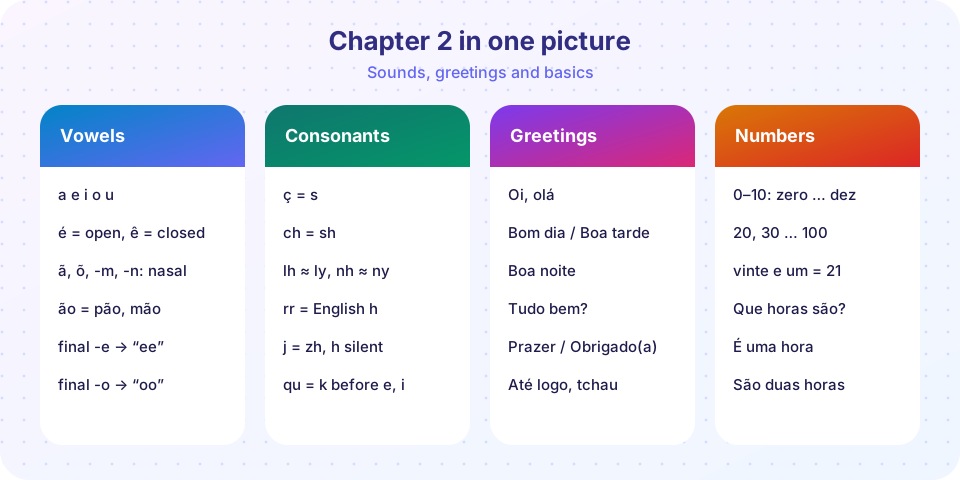
What you will review
- Open, closed, and nasal vowels, and the unstressed endings.
- Special consonants and the four stress rules.
- Greetings, introductions, politeness, and goodbyes.
- Numbers, days, months, dates, and the time.
Chapter recap
| Lesson | Key ideas |
|---|---|
| Vowels and nasal sounds | Seven oral vowels; é/ó open, ê/ô closed; final -a, -e, -o sound like "uh", "ee", "oo" in Brazil; nasal vowels with tilde or m/n; ão, ãe, õe. |
| Consonants, stress and accents | c, g hard or soft; ç = s; ch, lh, nh, rr; silent h; t, d before "ee" become "ch, j" in most of Brazil; four stress rules; accent marks. |
| Greetings and introductions | Oi, Olá, Bom dia, Boa tarde, Boa noite; Tudo bem?; Meu nome é...; Sou do/da/de...; obrigado/obrigada; Tchau, Até logo. |
| Numbers, days and time | 0-20, the tens, e between tens and units, cem/cento; days and months in lowercase; Que horas são?; É uma hora, São duas horas. |
A dialogue in a café
Read it aloud twice: first looking at the Portuguese, then trying to remember it while looking at the English.
| Portuguese | English |
|---|---|
| Cliente: Bom dia! Um café, por favor. | Good morning! A coffee, please. |
| Garçom: Pois não. Tudo bem? | Of course. How are you? |
| Cliente: Tudo bem, e você? | Fine, and you? |
| Garçom: Tudo ótimo! Aqui está. | Great! Here you are. |
| Cliente: Obrigada! Que horas são? | Thank you! What time is it? |
| Garçom: São nove e meia. | It is half past nine. |
| Cliente: Obrigada. Até logo! | Thank you. See you later! |
| Garçom: De nada. Até logo! | You're welcome. See you later! |
Pois não is a polite phrase that a waiter or shop assistant uses to say "Yes, how can I help?" or "Certainly." The customer says obrigada because she is a woman. In Portugal, um café is usually a small, strong espresso, which people in Lisbon often call uma bica.
A short pronunciation drill
Read this list aloud slowly, then at normal speed, and check each word against the rules from the chapter: pão, mãe, limões, café, você, avô, maçã, chave, filho, banho, carro, queijo, gente, hoje, música, português, animal, noite, dia. As you read, say the reason for each sound: pão has a nasal diphthong, maçã has a cedilla, gente has a soft g before e, música has an accent because the stress is on the third-to-last syllable, and dia and noite have the "j" and "ch" sounds in most of Brazil.
Common misconceptions to check
"If I can read the word, I can say it." Only if you know the rules: c, g, s, r, x, the nasal vowels, and the stress rules. Revisit the vowel and consonant lessons when a word surprises you.
"Accent marks are optional." They change the sound or the meaning (avó and avô; pode and pôde).
"Hours are always são." One o'clock, noon, and midnight use é: É uma hora, É meio-dia, É meia-noite.
How to use this review
Treat this review as a speaking exercise, not only a reading one. Say the dialogue aloud, then close the page and say it again from memory, changing the details: use your own name, a different time, and another city. Record yourself on a phone if you can, and listen back for the sounds that were hardest: the nasal vowels, the rr, the stress.
Here is a can-do checklist for the chapter. Can you pronounce pão, limão, maçã, chave, filho, and gente without looking at a guide? Can you find the stressed syllable of a new word using the four rules? Can you greet someone at three different times of day? Can you say your name and where you are from? Can you count from 0 to 100, say today's date, and ask Que horas são? If one of these is shaky, go back to that lesson and practice it for five minutes a day for a week. Small, repeated practice is exactly the kind of study this course recommends.
Try it
The first tool is a memory game. Turn over two cards: if a Portuguese phrase matches its English meaning, the pair stays.
The second tool applies the four stress rules to a list of words. It checks only the spelling: it cannot hear a word, so it is a study aid.
Press Run (or Ctrl + Enter) to see the result here.
Program input · what you'd type while the program runs
Type the answers before you press Run, one per line. Each time the program reads a line (with input()), it gets the next line from this box.
Check your understanding
Quick check · 10 questions
of 10 answered You scored / 10 · perfect!
-
1. Which word has an OPEN stressed vowel?
The acute accent in avó marks an open vowel; the circumflex in avô and você marks closed vowels. -
2. How do you pronounce 'ch' in 'chave'?
Ch in Portuguese is sh: chave is SHAH-vee. -
3. Where is the stress in 'falam' (they speak)?
Words ending in -am are stressed on the second-to-last syllable: FA-lam. -
4. What does the cedilla do in 'maçã'?
The ç is always an s sound, here before a. -
5. Which greeting do you use at 8 p.m. when you arrive?
Boa noite is the evening greeting. -
6. A man thanks a woman. What does he say?
Obrigado agrees with the speaker; a man says obrigado. -
7. How do you say 42?
Tens come first: quarenta e dois. -
8. Which sentence is correct for 3:30?
Use são with the hour plural: São três e meia. -
9. What is 'Tuesday' in Portuguese?
Terça-feira is Tuesday; quarta is Wednesday and sexta is Friday. -
10. In most of Brazil, how is 'dia' pronounced?
D before an ee sound becomes j in most of Brazil.
Summary
- Brazilian vowels are pure; accents tell you open (é, ó), closed (ê, ô), or nasal (ã, õ) sounds.
- Consonants such as c, g, s, r, x depend on context; ç, ch, lh, nh, rr have fixed sounds.
- Stress follows the ending of the word, and accent marks flag exceptions.
- You can greet, introduce yourself, thank, apologize, say goodbye, count to 100, and tell time.
Track your progress
Create a free account to tick off lessons and pick up where you left off on any device.
of Portuguese for Beginners lessons completed