


















Lesson 48 of 48 · Projects and Practice
Further Study: Where to Go After Portuguese for Beginners
Plan your next steps in Portuguese: the grammar still to learn, how to practice listening, speaking, reading and writing, exams, and related language tracks.
You have reached the end of this course. You can introduce yourself, handle daily situations, describe the past and the future, use object pronouns, recognize the subjunctive and understand how informal speech and the two main varieties differ. In terms of the common European framework, that is roughly the A2 level, with some taste of the next one. The honest next step is not another textbook chapter. It is using the language with real people, and growing your listening and vocabulary at the same time.
This lesson helps you plan what to do next: which grammar remains, how to organize your weekly practice, what exams exist, and how this course connects to other languages on the site. It ends with a self-assessment checklist and a study-time planner.
What you will learn
- Which grammar topics come after this course.
- A balanced weekly routine across listening, speaking, reading and writing.
- Which exams exist, and what level they test.
- How Portuguese relates to Spanish, French and German.
Key terms
QECR / CEFR: the Common European Framework of Reference for Languages, with levels A1 and A2 (basic), B1 and B2 (independent), C1 and C2 (proficient).
Infinitivo pessoal (personal infinitive): an infinitive that agrees with its subject, a special feature of Portuguese.
Imersão (immersion): surrounding yourself with the language.
Troca de idiomas (language exchange): swapping practice time with a native speaker.
What grammar comes next
You now know the core. The topics below are what an intermediate course adds:
| Topic | What it does | Example |
|---|---|---|
| Por vs para | Two prepositions that both translate "for" | Obrigado por tudo. Isto é para você. |
| Pretérito mais-que-perfeito | Past before a past | Quando cheguei, ele já tinha saído. |
| Imperfeito do subjuntivo | Hypotheticals and past wishes | Se eu tivesse tempo, eu viajaria. Eu queria que você viesse. |
| Passive voice | ser + participle, or se | A casa foi construída em 1950. Vende-se casa. |
| Relative pronouns | que, quem, onde, cujo | O livro que eu li. A amiga cujo irmão mora aqui. |
| Reported speech | Telling what someone said | Ele disse que ia chegar tarde. |
| Infinitivo pessoal | Infinitive with person endings | É importante estudarmos. Para eles chegarem cedo. |
| Pronoun combinations | me + o = mo, te + a = ta, lhe + o = lho (mainly Portugal) | Deu-mo ontem. |
| More verbs | haver, ver, vir, pôr, the rest of the irregulars | Haverá muita gente. |
The personal infinitive is one of the language's signature features. It adds endings to the infinitive when the subject changes: falar, falares, falar, falarmos, falarem. "Para nós chegarmos cedo, vamos sair agora" means "For us to arrive early, we will leave now". It is easy to learn once you meet it, and Brazilians use it constantly in writing and in careful speech.
A balanced weekly routine
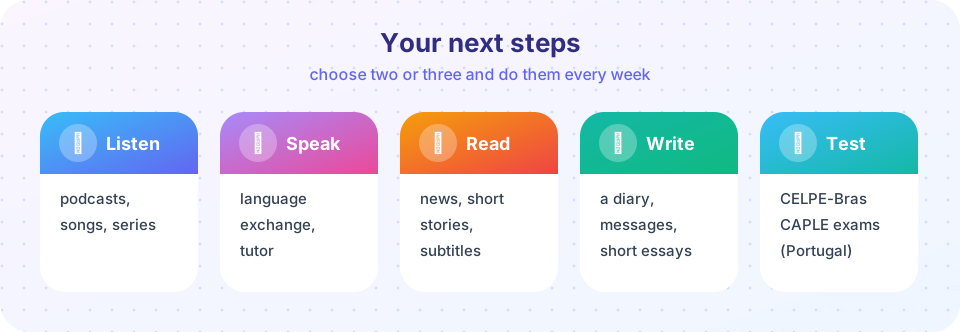
Skills grow best when you work on all four every week. Here is a sample schedule for about five hours a week:
| Skill | Weekly time | Ideas |
|---|---|---|
| Listening | 90 minutes | Podcasts for learners, songs with lyrics, series with Portuguese subtitles, short news clips. Replay and shadow a minute at a time. |
| Speaking | 90 minutes | A language exchange partner, a tutor, or talking aloud to yourself; record and listen. |
| Reading | 60 minutes | Graded readers, news headlines, short stories, recipes, social media. |
| Writing | 30 minutes | A diary, messages to a partner, short texts corrected by a native speaker. |
| Review | 30 minutes | Flashcards and the drills from this chapter. |
Start with comprehensible input: audio and texts where you understand most of the words. Too hard and you will quit; too easy and you will not grow. Switch between Brazilian and European audio only once you are comfortable with one.
Tools and habits
- Dictionaries. Use a good online dictionary that gives gender, examples and variety: Priberam (European Portuguese) and Michaelis (Brazilian Portuguese) are well known.
- Flashcards. Use spaced repetition, with sentences, not isolated words.
- Notebook. Keep a "phrases I heard" list, and every week turn five of them into sentences of your own.
- Language exchange. Offer English or your language in return. Prepare three topics and three questions before each session.
- Consistency. Twenty minutes every day beats three hours on Sunday.
Exams and certificates
| Exam | Country | What it tests |
|---|---|---|
| CELPE-Bras | Brazil | A certificate for non-native speakers, issued by the Brazilian government; it certifies intermediate to advanced levels |
| CAPLE exams (CIPLE A2, DIPLE B1, DEPLE B2, DAPLE C1, DUPLE C2) | Portugal | Certificates from the University of Lisbon's CAPLE, aligned with the European framework |
If you plan to study or work in a Portuguese-speaking country, check whether you need a certificate and at which level. Requirements change, so confirm with the institution.
Portuguese and other languages
If you speak Spanish, much of Portuguese will look familiar, but with differences in sounds, spelling and false friends. If you plan to learn another Romance language, you can follow up with:
Portuguese shares a large part of its vocabulary with Spanish, French and Italian, because all descend from Latin, but pronunciation differs a lot. Do not rely on cognates blindly; some "false friends" will bite you (Portuguese esquisito means strange, not exquisite).
A sample three-month plan
| Month | Goal | Weekly actions |
|---|---|---|
| 1: consolidate | Make the basics automatic | Daily 20-minute drills; two short conversations; one recording of your introduction |
| 2: expand | Reach intermediate grammar | Learn por/para and the pluperfect; read one short story or news article a week; keep an error log |
| 3: use it | Speak and understand real Portuguese | Three conversation sessions a week; watch a series with Portuguese subtitles; write a weekly summary |
Adjust the plan to your time. The important rule is regularity: a small amount every day beats a long session once a week.
Common misconceptions
"I must finish grammar before I speak." No. Speak now, with mistakes. Grammar sticks better when you need it.
"Immersion means moving abroad." You can immerse at home: change your phone language, watch series, join a group.
"Fluent means perfect." Fluency is about communicating comfortably, not about never making mistakes.
"Cognates make Portuguese easy for Spanish speakers." They help, but pronunciation, false friends and spelling still need study.
Try it
First, a can-do checklist. Tick the statements that are true for you today. The page shows the percentage and suggests the next focus. Nothing is saved: it is a snapshot you can repeat in a month.
The second TryIt is a Python time planner. Enter your daily minutes and it divides them among the skills using the weights from the table. Change the weights to match your goals.
Press Run (or Ctrl + Enter) to see the result here.
Program input · what you'd type while the program runs
Type the answers before you press Run, one per line. Each time the program reads a line (with input()), it gets the next line from this box.
Check your understanding
Quick check · 4 questions
of 4 answered You scored / 4 · perfect!
-
1. What is the 'infinitivo pessoal'?
The personal infinitive adds endings to the infinitive when the subject changes. -
2. Which exam is run by the University of Lisbon's CAPLE?
CAPLE offers CIPLE, DIPLE, DEPLE, DAPLE and DUPLE; CELPE-Bras is the Brazilian certificate. -
3. Which approach to study is recommended?
Balanced practice across all four skills works best. -
4. What does 'comprehensible input' mean?
Material slightly above your level, mostly understood, helps you grow.
Summary
- After this course you are around A2: the next steps are practice with real people and intermediate grammar (por/para, pluperfect, imperfect subjunctive, passive, relatives, personal infinitive).
- Balance listening, speaking, reading, writing and review every week.
- Exams: CELPE-Bras (Brazil) and the CAPLE exams (Portugal).
- Related tracks: Spanish, French and German for Beginners.
- Speak now, make mistakes, and keep going.
You have finished the second half of Portuguese for Beginners. Return to the course page to review any lesson, or start a language exchange today.
Track your progress
Create a free account to tick off lessons and pick up where you left off on any device.
of Portuguese for Beginners lessons completed