


















Lesson 32 of 48 · Past Tenses
Chapter 6 Review: Past Tenses
Review the Portuguese pretérito perfeito and imperfeito with a recap table, a one-picture summary, a story to retell and a ten-question mixed quiz.
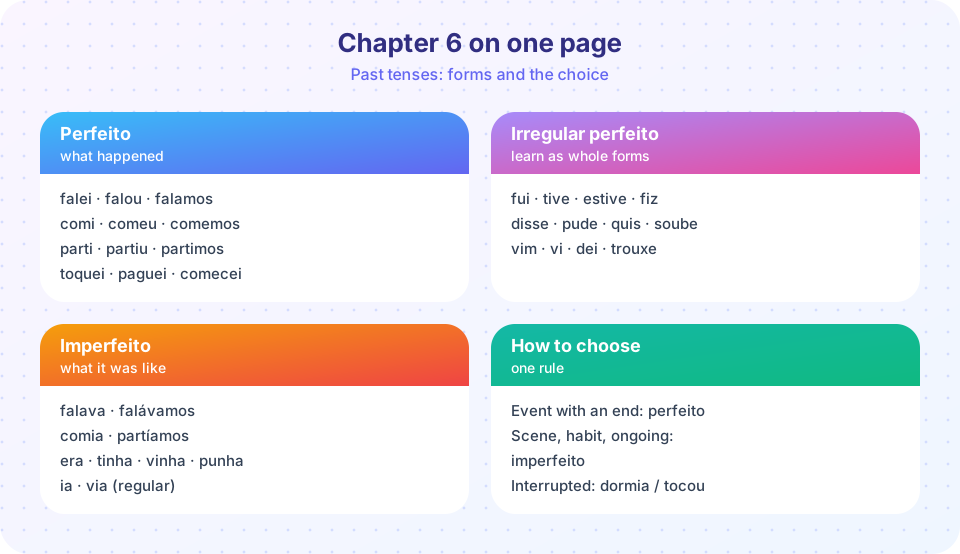
This chapter gave you the two everyday past tenses of Portuguese and the rule that connects them: events are dots, background is a band. Before you move on to the future, take a few minutes to review. The recap table below lists every pattern, the picture shows the chapter at a glance, and the quiz mixes forms and choices.
If you hesitate on a question, go back to the lesson named in the table. Past tenses become automatic only after many short practice sessions, so repeat this review in a few days.
What you will learn
- Check that you can form both past tenses without notes.
- Practice choosing between perfeito and imperfeito in a story.
- Identify which topic to revisit.
Recap table
| Topic | What to remember | Example | Lesson |
|---|---|---|---|
| Perfeito, -ar | -ei, -aste, -ou, -amos, -aram | falei, falou, falaram | The pretérito perfeito |
| Perfeito, -er / -ir | -i, -este/-iste, -eu/-iu, -emos/-imos, -eram/-iram | comi, comeu; parti, partiu | same |
| Spelling (eu) | -car → -quei, -gar → -guei, -çar → -cei | toquei, paguei, comecei | same |
| Irregular perfeito | ser/ir fui, ter tive, fazer fiz, dizer disse, poder pude | fui ao cinema | same |
| Imperfeito, -ar | -ava, -avas, -ava, -ávamos, -avam | falava, falávamos | The pretérito imperfeito |
| Imperfeito, -er / -ir | -ia, -ias, -ia, -íamos, -iam | comia, partíamos | same |
| Irregular imperfeito | ser era, ter tinha, vir vinha, pôr punha | era, tinha | same |
| Choosing | Event = perfeito; scene, habit, description = imperfeito | Dormia quando tocou | Perfeito or imperfeito? |
| Meaning shifts | sabia/soube, conhecia/conheci, queria/quis | Soube ontem | same |
| Earlier past | tinha + participle | Já tinha saído | same |
A story to retell
Read the story, then try to retell it aloud without looking. The background verbs are imperfeito, the events perfeito.
| Portuguese | English |
|---|---|
| No sábado passado, eu acordei cedo porque fazia sol. | Last Saturday I woke up early because it was sunny. |
| Eu tinha vontade de ir à praia, então liguei para a minha irmã. | I felt like going to the beach, so I called my sister. |
| Ela ainda dormia, mas aceitou o convite. | She was still sleeping, but accepted the invitation. |
| Nós pegamos o ônibus e chegamos às dez. | We took the bus and arrived at ten. |
| A praia estava cheia e a água era quente. | The beach was crowded and the water was warm. |
| Ficamos lá até as quatro e depois fomos comer um pastel. | We stayed there until four and then went to eat a pastel. |
How to use this review
Past tenses reward repetition. Start by saying the recap examples aloud, then retell the story from memory using the same verbs. Do the gap-fill and the drill generator next: run the script twice with different seeds so that you meet new combinations. Finally take the quiz, and for every miss, write one new sentence of your own using the same form. Five minutes of this daily is better than an hour once a week.
Common misconceptions
"I must memorize all the irregular verbs at once." No. Start with fui, tive, fiz, disse, estive, pude and era, tinha. They cover most of what you will say.
"Eu and ele forms differ in the imperfeito." They do not (falava, comia). Use the subject pronoun to clarify.
"The perfeito is always for short actions." It is for finished and counted events, however long.
"Tinha saído" is too advanced for me. It is just tinha + participle, a useful extra past.
Try it
First, a mixed gap-fill about the story above.
The Python TryIt is a drill generator. It picks a verb and a tense and prints a prompt; run it, say the answer aloud, and then read the answer line. Change the seed to get a new set.
Press Run (or Ctrl + Enter) to see the result here.
Program input · what you'd type while the program runs
Type the answers before you press Run, one per line. Each time the program reads a line (with input()), it gets the next line from this box.
Check your understanding
Quick check · 10 questions
of 10 answered You scored / 10 · perfect!
-
1. What is 'eles' + 'comer' in the perfeito?
-er verbs use -eram in the perfeito (comeram); comiam is imperfeito. -
2. Which is the imperfeito of 'nós' + 'ser'?
'Éramos' is the imperfeito; 'fomos' is the perfeito (of ser or ir). -
3. Choose the best sentence for 'Last year we traveled to Salvador.'
A specific finished event in the past ('last year'): perfeito. 'Viajamos' is also the nós perfeito. -
4. Which form of 'pagar' is right for 'I paid'?
-gar verbs change to -guei in the eu form. -
5. What does 'Eu soube' mean?
'Soube' is the perfeito of saber and means 'found out'. -
6. Which tense sets the scene in 'Chovia muito'?
'Chovia' is the imperfeito of chover: a description of conditions. -
7. Which is correct: 'He was reading when I arrived'?
Ongoing action (lia) interrupted by an event (cheguei). -
8. How do you say 'I was ten years old'?
Age is a description and uses ter: tinha. -
9. Which verb pair is identical in the perfeito?
Ser and ir share fui, foi, fomos, foram. -
10. What does 'Eles já tinham saído' mean?
'Tinham saído' (tinha + participle) means had left.
Summary
- Perfeito: -ei/-aste/-ou/-amos/-aram and -i/-este/-eu/-emos/-eram (-iste/-iu/-imos/-iram for -ir).
- Imperfeito: -ava... and -ia...; irregular only ser, ter, vir, pôr.
- Event with an end → perfeito; scene, habit, description, ongoing → imperfeito.
- Watch meaning shifts: sabia/soube, conhecia/conheci, queria/quis, podia/pude.
- Use tinha + participle for an earlier past.
Track your progress
Create a free account to tick off lessons and pick up where you left off on any device.
of Portuguese for Beginners lessons completed