


















Lesson 28 of 48 · Past Tenses
Past Tenses in Portuguese: Chapter Overview
Preview chapter 6 of Portuguese for Beginners: the pretérito perfeito and imperfeito, when to choose each, with a timeline picture and a first dialogue.
So far you have mostly talked about the present: what you are, what you have, what you do. Now you will learn to talk about what happened. Telling stories, explaining why you are late, remembering your childhood, asking "What did you do yesterday?": all of that needs the past tenses.
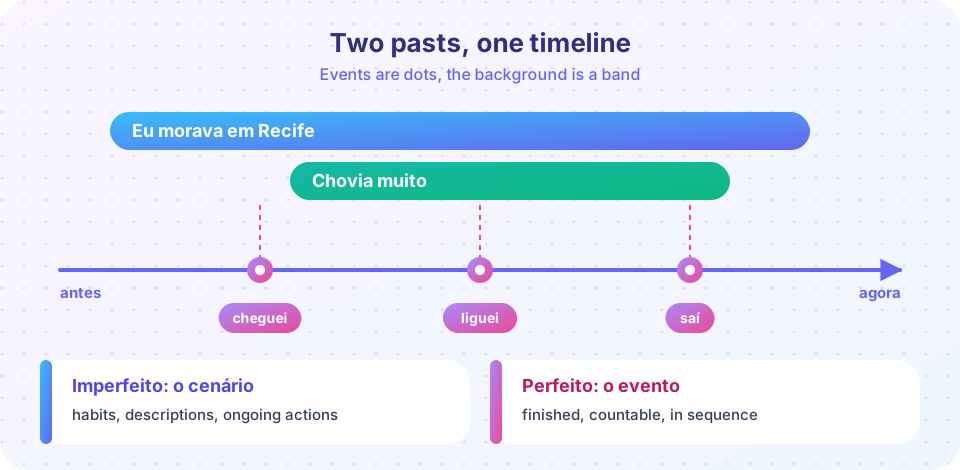
Portuguese has two everyday past tenses, and the most important idea of this chapter is that they answer two different questions. The pretérito perfeito (the simple past) tells you what happened: finished events, one by one. The pretérito imperfeito describes what things were like: the background, habits and situations that were going on. English mixes both ideas into one form ("I walked", "I used to walk", "I was walking"), but Portuguese asks you to choose.
What you will learn
- What the two main past tenses are for, and how the chapter is organized.
- The picture to keep in your head: events are dots, background is a band.
- A first look at forms such as "falei", "comi" and "falava", which you will build in the next lessons.
- How to study verb conjugations without drowning in tables.
Key terms
Pretérito perfeito: the simple past for completed events (falei, comi, parti).
Pretérito imperfeito: the past for habits, descriptions and ongoing situations (falava, comia, partia).
Radical (stem) and terminação (ending): a regular verb is a stem plus an ending, and the ending shows tense and person.
Marcador de tempo (time marker): words like ontem, sempre or de repente that hint at the tense.
Four steps through the chapter
The simple past
The imperfect
Choosing
Review
Lessons in this chapter
- The pretérito perfeito: regular endings for -ar, -er and -ir verbs, spelling changes, and the key irregular verbs (ser/ir, ter, fazer, estar and more).
- The pretérito imperfeito: the endings, the only four irregular verbs, and how to describe habits, ages, weather and childhood.
- Perfeito or imperfeito?: the decision rule, the "interrupted action" pattern, and verbs that change meaning (sabia versus soube).
- Chapter review: a recap table and a ten-question quiz.
The picture to remember
Imagine a film. The imperfeito is the set and the soundtrack: it was raining, I was living in Recife, my grandmother always cooked on Sundays. The perfeito is what the camera catches against that background: the phone rang, I arrived, the rain stopped. When you speak, ask yourself: Is this a single event with an end, or a scene I am describing?
Portuguese uses time words that match each idea:
| With the perfeito | With the imperfeito |
|---|---|
| ontem (yesterday), anteontem | sempre (always), todo dia (every day) |
| na semana passada (last week) | normalmente, geralmente |
| de repente (suddenly), então (then) | quando eu era criança (when I was a child) |
| uma vez (once), duas vezes (twice) | naquela época (at that time) |
| há dois anos (two years ago) | todos os verões (every summer) |
A first dialogue
Both tenses appear in this short conversation. Do not worry about the forms yet; notice the shape of the story.
| Portuguese | English |
|---|---|
| O que você fez ontem? | What did you do yesterday? |
| De manhã fui ao mercado e à tarde estudei português. | In the morning I went to the market and in the afternoon I studied Portuguese. |
| E à noite? | And in the evening? |
| Jantei com meus pais. Quando eu era criança, a gente sempre jantava junto. | I had dinner with my parents. When I was a child, we always had dinner together. |
"Fui", "estudei" and "jantei" are the perfeito: finished events. "Era" and "jantava" are the imperfeito: the habit and the childhood setting.
How to study conjugations
Past-tense tables look scary, but a regular verb has only five person forms in each tense (eu, tu, você/ele/ela, nós, vocês/eles; in most of Brazil tu is rare, so you mostly use four), and almost every verb follows one of three patterns. Learn the patterns, then memorize about a dozen irregular verbs, which are the most frequent ones in the language. Three tips:
- Learn each verb as part of a sentence ("Ontem eu fiz um bolo"), not as a table row.
- Say the nós form aloud; it is where tenses blur ("falamos" can be present or past).
- Use a flashcard with the infinitive on one side and the "eu" form of both tenses on the other.
Try it
A preview of the forms you will build in this chapter. Flip each card and say the sentence.
Now a small Python preview that prints the regular endings. It is the pattern you will use throughout the chapter: change the verb and compare.
Press Run (or Ctrl + Enter) to see the result here.
Program input · what you'd type while the program runs
Type the answers before you press Run, one per line. Each time the program reads a line (with input()), it gets the next line from this box.
Check your understanding
Quick check · 4 questions
of 4 answered You scored / 4 · perfect!
-
1. What is the main difference between the perfeito and the imperfeito?
Both tenses are used everywhere. The perfeito reports completed events; the imperfeito sets the scene. -
2. Which tense fits 'Quando eu era criança, eu morava no Recife'?
'Era' and 'morava' describe a situation and a habit over time: imperfeito. -
3. Which time word usually goes with the perfeito?
'Ontem' (yesterday) marks a finished moment. 'Sempre' and 'todo dia' suggest habit. -
4. How many regular verb patterns (conjugations) does Portuguese have?
Regular verbs fall into -ar, -er and -ir groups.
Summary
- Portuguese has two everyday pasts: the perfeito for finished events, the imperfeito for background and habits.
- Picture a film: the imperfeito is the set, the perfeito is the action.
- Time markers (ontem, de repente versus sempre, naquela época) hint at the tense.
- Regular verbs follow three patterns; learn about a dozen irregular verbs well.
Next: The pretérito perfeito
Track your progress
Create a free account to tick off lessons and pick up where you left off on any device.
of Portuguese for Beginners lessons completed