


















Lesson 23 of 48 · Daily Life and Questions
Numbers, Time and Dates in Portuguese
Count from zero to a million in Portuguese, say prices in reais, tell the time, and name days, months and dates, with Brazilian and European notes.
Numbers are everywhere in daily life: prices at the market, the time of a bus, a phone number, the date of a party. Portuguese numbers are friendlier than they first look, because after twenty the system is very regular. In this lesson you will learn to count, to read prices, to tell the time the way Brazilians say it, and to write and say dates.
The reward is immediate. With the sentences from this lesson you can ask "Que horas são?" (What time is it?), understand "São doze reais" (That is twelve reais) and arrange to meet someone "na sexta-feira às oito" (on Friday at eight).
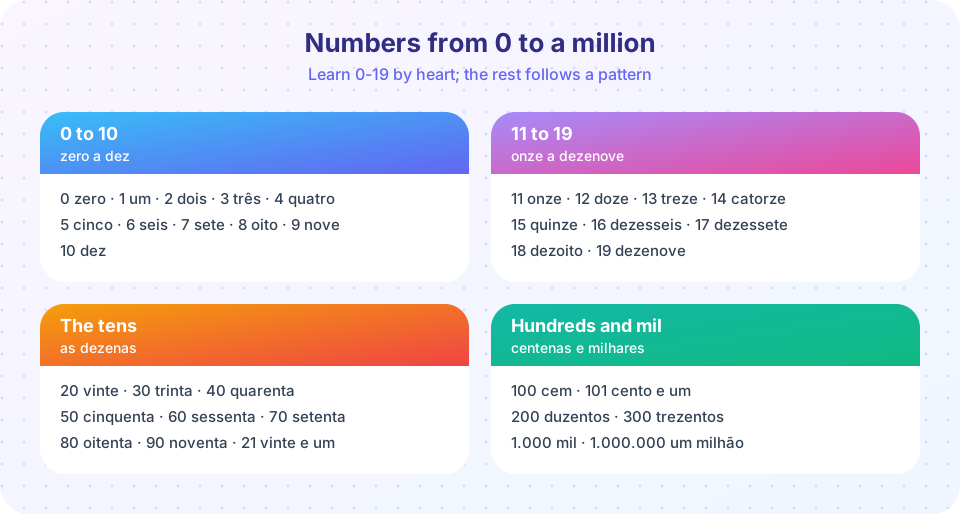
What you will learn
- Count from 0 to 999,999 and understand where the word "e" (and) goes.
- Say and read prices in reais and centavos.
- Tell the time and ask for it, including the half hour and "to the hour" forms.
- Name the days of the week and the months, and say a full date.
Key terms
Cardinal (número cardinal): a counting number such as dois, vinte, cem.
Ordinal (número ordinal): a ranking number such as primeiro, segundo, terceiro.
Hora (hour or "o'clock"): the same word means both. "São duas horas" is "It is two o'clock".
Real (plural reais): the Brazilian currency, written R$. One real has 100 centavos.
Counting from 0 to 20
Learn these by heart. Everything else is built from them.
| 0 zero | 1 um / uma | 2 dois / duas | 3 três | 4 quatro |
|---|---|---|---|---|
| 5 cinco | 6 seis | 7 sete | 8 oito | 9 nove |
| 10 dez | 11 onze | 12 doze | 13 treze | 14 catorze |
| 15 quinze | 16 dezesseis | 17 dezessete | 18 dezoito | 19 dezenove |
Two numbers have gender. "Um" and "dois" change to "uma" and "duas" before feminine nouns: "um livro" (a book) but "uma casa" (a house); "dois livros" but "duas casas". Also from the hundreds: "duzentos livros", "duzentas casas".
Portugal spells 16, 17 and 19 as dezasseis, dezassete, dezanove. Both countries accept "catorze" and "quatorze" for 14. In Brazilian phone numbers people often say "meia" (half a dozen) instead of "seis" to avoid confusion with "três" and "seis" on a bad line.
The tens and the word "e"
| 20 vinte | 30 trinta | 40 quarenta | 50 cinquenta | 60 sessenta |
|---|---|---|---|---|
| 70 setenta | 80 oitenta | 90 noventa | 100 cem |
To make numbers between the tens, join the tens and the units with e (and): vinte e um (21), trinta e cinco (35), noventa e nove (99). There is no hyphen.
Hundreds and thousands
The hundreds are single words that agree in gender: 200 duzentos, 300 trezentos, 400 quatrocentos, 500 quinhentos, 600 seiscentos, 700 setecentos, 800 oitocentos, 900 novecentos. The special case is 100: it is cem when it stands alone ("cem reais") and cento when more follows ("cento e vinte", 120).
Again e joins the parts: cento e um (101), duzentos e cinquenta (250), trezentos e quarenta e dois (342).
For thousands use mil, which never changes: mil (1,000), dois mil (2,000), vinte e cinco mil (25,000), cem mil (100,000). One million is "um milhão" and two million "dois milhões".
Where does "e" go after "mil"? The rule is simple: put e after "mil" only if what follows is less than 100 or a round hundred.
| Number | In Portuguese | Why |
|---|---|---|
| 1,001 | mil e um | remainder 1 is under 100 |
| 1,100 | mil e cem | remainder is a round hundred |
| 1,250 | mil duzentos e cinquenta | remainder 250 is neither |
| 2,500 | dois mil e quinhentos | round hundred |
| 3,456 | três mil quatrocentos e cinquenta e seis | neither |
In writing, Brazilians use a period for thousands and a comma for decimals, the opposite of English: R$ 1.250,50 means one thousand two hundred fifty reais and fifty centavos.
Prices in reais
Say the reais, then "e" and the centavos: R$ 12,50 is "doze reais e cinquenta centavos", and in a shop people simply say "doze e cinquenta". One real is "um real" and the plural is "reais". Coins and notes are "moedas" and "notas". If you do not catch a price, ask "Pode repetir, por favor?" (Can you repeat, please?) or "Quanto é?" and ask them to type it on the calculator.
Telling the time
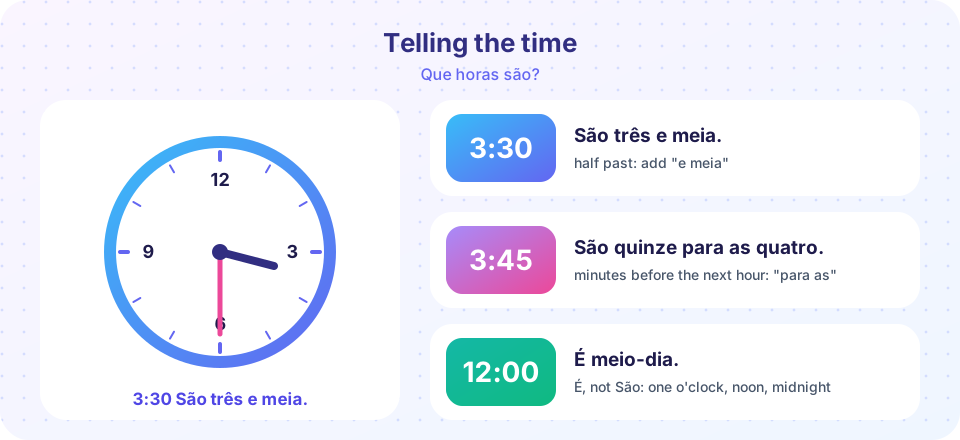
Ask: Que horas são? Literally "What hours are they?". The answer uses "são" (plural) for most hours and "é" for one o'clock, noon and midnight.
- 1:00 É uma hora.
- 2:00 São duas horas.
- 12:00 É meio-dia. (midday)
- 00:00 É meia-noite. (midnight)
- 3:30 São três e meia. (half)
- 4:15 São quatro e quinze. (people also say "e um quarto")
- 5:10 São cinco e dez.
- 2:50 São dez para as três. (ten to three)
Notice that hours are feminine ("uma", "duas") because "hora" is feminine. For the minutes after the hour you add the number with e. For the minutes before the next hour Brazilians say "X para as Y": "quinze para as quatro" is 3:45. Portugal prefers "menos": "são quatro menos um quarto".
To say at a time, use à for one o'clock and às for the others, plus the part of the day: "às oito da manhã" (8 a.m.), "às três da tarde" (3 p.m.), "às nove da noite" (9 p.m.). Say "ao meio-dia" for at noon. Timetables, flights and tickets usually use the 24-hour clock: "o voo sai às 14h30" (the flight leaves at 14:30).
Days, months and dates
The days of the week are not capitalized in Portuguese, and Monday to Friday end in "-feira":
segunda-feira, terça-feira, quarta-feira, quinta-feira, sexta-feira, sábado, domingo.
In everyday speech people drop "-feira": "na terça" (on Tuesday), "na sexta" (on Friday). To say on a day, use na with feminine weekdays and no with sábado and domingo: "na segunda", "no sábado".
The months are also lowercase: janeiro, fevereiro, março, abril, maio, junho, julho, agosto, setembro, outubro, novembro, dezembro. The seasons are primavera (spring), verão (summer), outono (autumn) and inverno (winter), and remember that the seasons are reversed south of the equator: in Brazil December is summer.
Ask the date with Que dia é hoje? (What day is it today?) or Qual é a data de hoje? Answer: "Hoje é dia 14 de novembro." Use "de" between the day, month and year: "3 de maio de 2027". The first of the month uses the ordinal: "primeiro de maio". In numeric dates the order is day/month/year, so 05/03/2027 is 5 March, not 3 May.
Useful time words: hoje (today), amanhã (tomorrow), ontem (yesterday), agora (now), de manhã (in the morning), à tarde (in the afternoon), à noite (at night), esta semana (this week), fim de semana (weekend).
Common misconceptions
"Cem" and "cento" are the same. Not quite. "Cem reais" is right, but "cem e vinte" is wrong: it is "cento e vinte".
"Mil" takes a plural. It does not: "dois mil", never "dois mils". "Milhão" does change: "dois milhões".
"02/03" is 3 February. In Portuguese the day comes first, so 02/03 is 2 March.
Weekdays and months need capital letters. They do not, unlike English.
Try it
The first TryIt is a real Portuguese number speller written in Python. It implements the rules above, including cem versus cento and where "e" goes after "mil". It handles 0 to 999,999. Change the numbers at the bottom and compare with what you would say.
Press Run (or Ctrl + Enter) to see the result here.
Program input · what you'd type while the program runs
Type the answers before you press Run, one per line. Each time the program reads a line (with input()), it gets the next line from this box.
The second TryIt turns a time into a Brazilian sentence. It follows the "e" and "para as" patterns from the lesson.
Press Run (or Ctrl + Enter) to see the result here.
Program input · what you'd type while the program runs
Type the answers before you press Run, one per line. Each time the program reads a line (with input()), it gets the next line from this box.
Finally, match the days and months. Say each one aloud when you get it right.
Check your understanding
Quick check · 5 questions
of 5 answered You scored / 5 · perfect!
-
1. How do you say 120 in Portuguese?
100 is 'cem' only when nothing follows. With more, it becomes 'cento': cento e vinte. -
2. What does 'São dez para as três' mean?
'X para as Y' counts minutes before the next hour: ten minutes to three is 2:50. -
3. Which is correct for 1,250?
After 'mil' the 'e' is used only if the rest is under 100 or a round hundred. 250 is neither, so there is no 'e' after mil, but there is one inside 'duzentos e cinquenta'. -
4. What date is written 05/03/2027 in Brazil?
Brazilians write day/month/year, so 05/03/2027 is 5 March 2027. -
5. Which sentence is correct?
'Casa' is feminine, so the number must be 'duas'. The first sentence also needs 'uma' instead of 'um'.
Summary
- Learn 0-19 by heart; tens are vinte, trinta... noventa; join with "e": trinta e cinco.
- 100 is "cem" alone and "cento" before more: cento e vinte. Hundreds agree in gender.
- "Mil" never changes; after "mil" use "e" only if the rest is below 100 or a round hundred.
- Prices: "doze reais e cinquenta centavos"; Brazil writes R$ 1.250,50 (period for thousands, comma for decimals).
- "Que horas são?" gets "São duas e meia", "É meio-dia", "São quinze para as quatro".
- Weekdays and months are lowercase; dates run day, month, year.
Next: Asking questions
Track your progress
Create a free account to tick off lessons and pick up where you left off on any device.
of Portuguese for Beginners lessons completed