


















Lesson 22 of 48 · Daily Life and Questions
Daily Life and Questions: Chapter Overview
Preview chapter 5 of Portuguese for Beginners: numbers, time, questions, food, shopping and directions, the words you need to get through a normal day.
Up to now you have learned how to greet people, introduce yourself and describe the world with nouns, adjectives and present-tense verbs. This chapter puts those tools to work in the situations that fill an ordinary day: asking what time it is, counting money, ordering lunch, finding the bus stop and asking a stranger for help.
The chapter is built around one idea: most real conversations are questions and answers. If you can ask "Onde fica...?" (Where is...?), "Quanto custa?" (How much does it cost?) and "Que horas são?" (What time is it?), and if you can understand a short reply, you can survive in a Portuguese-speaking country. Every lesson here gives you ready-made sentence frames that you can adapt by swapping a word or two.
As in the rest of the course, the base is Brazilian Portuguese, which is spoken by about four out of five Portuguese speakers in the world. Where European (Portugal) usage differs in a way that would confuse you, a short note tells you. A course cannot replace speaking with people, so use these lessons to prepare, then try the phrases on a real person as soon as you can.
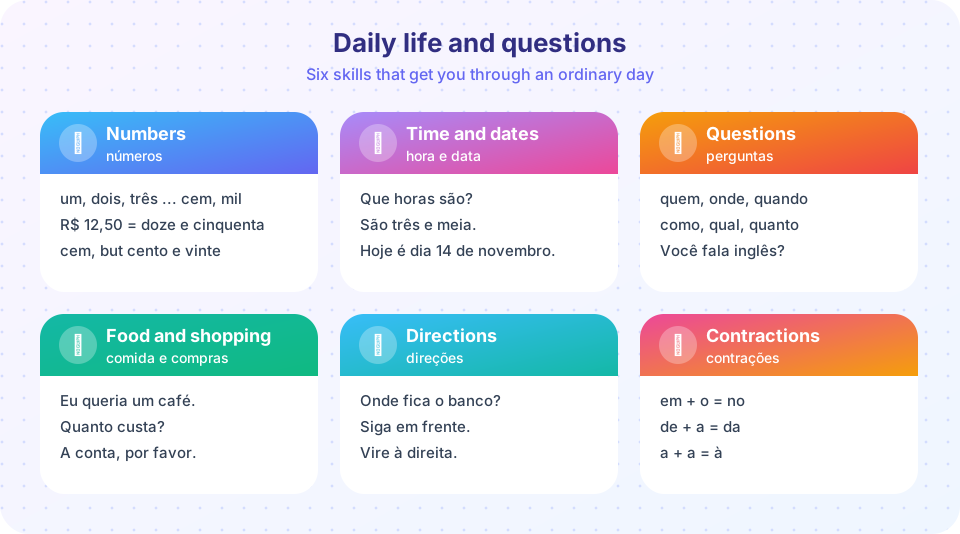
What you will learn
- How the chapter is organized and what each lesson will let you do.
- Which sentence frames you will use again and again (question words, "quero", "queria", "fica").
- How to study the chapter so the phrases stick.
- A first taste of the vocabulary through a flashcard deck.
Key terms
Palavra interrogativa (question word): a word like "onde" or "quando" that starts a question.
Frase pronta (ready-made phrase): a chunk you learn whole, such as "Quanto custa?", instead of building it word by word.
Registro (register): how formal your speech is. "Você poderia me ajudar?" is more polite than "Me ajuda?".
The chapter in five steps
Numbers, time and dates
Asking questions
Food and shopping
Places and directions
Review
What each lesson covers
- Numbers, time and dates: the numbers from 0 to a million, prices in reais, telling time, days, months and writing dates.
- Asking questions: the question words, how a statement becomes a question, and how to give short answers.
- Food and shopping: ordering politely in a restaurant, buying things, asking for the bill and paying.
- Places and directions: where things are, how to get there, public transport and the contractions (no, na, do, da, ao) that glue small words together.
- Chapter review: a recap table, a picture of the whole chapter and a ten-question quiz.
How to study this chapter
Short sessions beat long ones. Spend ten or fifteen minutes a day, and say every example out loud. Portuguese spelling is regular once you know the sounds, but your mouth needs practice with the nasal vowels in "não", "pão" and "bem" and with the "lh" and "nh" sounds in "filho" and "banho". Reading silently trains your eyes, not your mouth.
Three habits help a great deal:
- Learn chunks, not words. Memorize "Quanto custa isto?" as one unit. You will say it faster and sound more natural than if you assemble it from "quanto", "custar" and "isto".
- Swap one word at a time. Once you know "Eu queria um café", try "Eu queria uma água" and "Eu queria um suco". You are practicing the grammar without noticing.
- Say the answer before you look. In flashcards and quizzes, produce the Portuguese in your head or aloud first, then check.
A first dialogue
Here is a tiny conversation at a bakery (padaria) in São Paulo. You will be able to produce every line of it by the end of the chapter.
| Portuguese | English |
|---|---|
| Bom dia! O que vai ser? | Good morning! What will it be? |
| Bom dia. Eu queria um pão de queijo e um café, por favor. | Good morning. I would like a cheese bread and a coffee, please. |
| Mais alguma coisa? | Anything else? |
| Não, só isso. Quanto é? | No, just that. How much is it? |
| São doze reais. | It is twelve reais. |
| Posso pagar com cartão? | Can I pay by card? |
| Pode, sim. | Yes, you can. |
Try it
First, a flashcard deck with a taste of the chapter. Flip each card, say the Portuguese aloud, and use Listen if your browser offers a Portuguese voice.
Next, a small Python script that builds practice questions by combining a question word with an ending. Read the output aloud, then change the lists to make your own.
Press Run (or Ctrl + Enter) to see the result here.
Program input · what you'd type while the program runs
Type the answers before you press Run, one per line. Each time the program reads a line (with input()), it gets the next line from this box.
Check your understanding
Quick check · 4 questions
of 4 answered You scored / 4 · perfect!
-
1. Which sentence is the polite way to order a coffee in a Brazilian café?
'Eu queria' (I would like) plus 'por favor' is the standard polite request. A bare noun sounds abrupt. -
2. What does 'Onde fica o banco?' ask?
'Onde' means where, and 'ficar' is the everyday verb for being located. -
3. Which approach is recommended for memorizing 'Quanto custa?'
Chunks are faster to retrieve in a real conversation, and speaking aloud trains your mouth, not just your eyes. -
4. Which variety of Portuguese is the base of this course?
The course teaches Brazilian Portuguese first and adds notes where European Portuguese differs.
Summary
- Chapter 5 covers numbers and time, questions, food and shopping, and directions.
- Most real conversations are questions and answers, so you learn sentence frames you can adapt.
- Learn chunks, swap one word at a time and say everything aloud.
- Brazilian Portuguese is the base, with short notes on European differences.
Next: Numbers, time and dates
Track your progress
Create a free account to tick off lessons and pick up where you left off on any device.
of Portuguese for Beginners lessons completed