


















Lesson 12 of 48 · Nouns, Articles and Adjectives
Chapter 3 Overview: Nouns, Articles and Adjectives
Preview chapter 3 of Portuguese for Beginners: noun gender, plurals, articles, contractions, adjective agreement, possessives and demonstratives.
Every sentence you speak is built from things and the words that describe them: a casa (the house), um livro (a book), os amigos novos (the new friends). Chapter 3 teaches those building blocks. You will learn why every Portuguese noun is masculine or feminine, how to make plurals, how the little words o, a, um, uma work, and how adjectives change to match the nouns they describe.
This idea is called agreement, and it is the most important new habit for an English speaker. In English, "the beautiful houses" has no marks of gender or number except the s on "houses". In Portuguese, the article, the noun, and the adjective all change together: as casas bonitas. Once the pattern is automatic, a large part of Portuguese grammar falls into place.
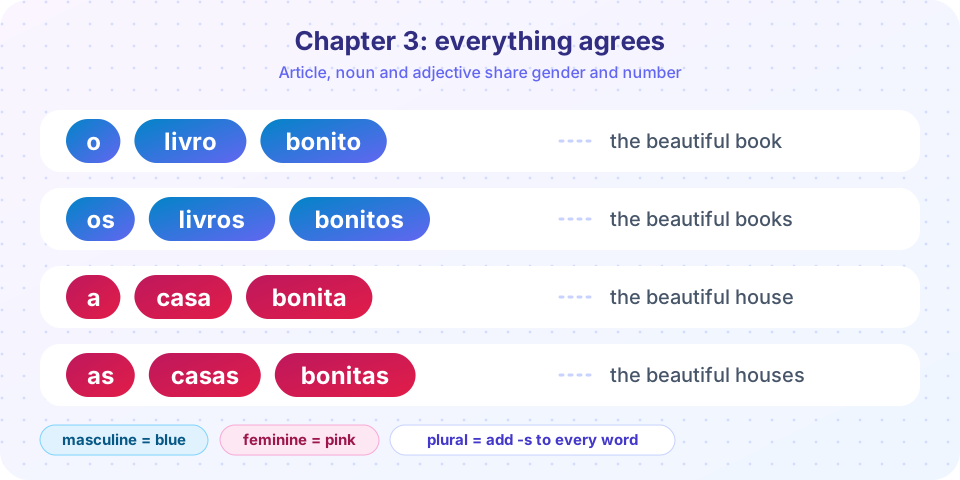
What you will learn
- Why every noun has a gender, and how to predict it.
- How to form plurals, including the -ão family.
- How to use o, a, os, as, um, uma, uns, umas, and contractions such as do and na.
- How adjectives agree and where they go.
- How to say "my", "your", "this", and "that".
Key terms
Noun (substantivo): a word for a person, place, thing, or idea: casa, livro, amor.
Gender (gênero): the masculine or feminine class of a noun. It has nothing to do with the thing's real sex, except for people and animals.
Article (artigo): a small word before a noun: the, a, an, some.
Adjective (adjetivo): a word that describes a noun: bonito, grande.
Agreement (concordância): matching gender and number across the words of a phrase.
The big picture
Three ideas run through the whole chapter.
1. Gender is a label. A table (a mesa) is feminine and a book (o livro) is masculine. There is no logic in the meaning; the label simply controls which articles and endings you use. The good news is that most nouns show their gender by their ending: words in -o are mostly masculine, and words in -a are mostly feminine. You will learn the main patterns and the exceptions.
2. Number is marked everywhere. To make a plural, you usually add -s to the noun, then to the article, then to the adjective: o livro bonito becomes os livros bonitos.
3. Learn the noun with its article. Do not learn "casa". Learn a casa. Then the gender comes with the word, and you will almost never need to think about it.
Meet the noun
Little words
Describing
The lessons in this chapter
| Lesson | What it covers |
|---|---|
| Gender and plurals | Gender hints from endings, exceptions, nouns for people, and every plural rule. |
| Articles and contractions | o, a, os, as, um, uma, uns, umas; do, da, no, na, ao, à, pelo; when to use an article. |
| Adjectives, possessives and demonstratives | Agreement, position, colors, meu/minha, este/esse/aquele. |
| Chapter 3 review | A one-picture summary and a ten-question quiz. |
A first look: a short dialogue
Two friends look at a photo. You have not learned all of the grammar yet, but see how the words change together.
| Portuguese | English |
|---|---|
| A: O livro é bonito? | Is the book beautiful? |
| B: Sim, o livro é bonito. | Yes, the book is beautiful. |
| A: E a casa? | And the house? |
| B: A casa também é bonita. | The house is beautiful too. |
| A: E os amigos? | And the friends? |
| B: Os amigos são simpáticos. | The friends are nice. |
Look at how bonito becomes bonita for a casa, and how é becomes são for the plural. The verb forms belong to chapter 4; the point for now is that the adjective changed to match the noun.
Common misconceptions
"Gender means the thing is male or female." For objects, gender is just a grammatical label. A pessoa ("the person") is feminine even when the person is a man.
"Only nouns have gender." Articles, adjectives, and many pronouns also change: that is agreement.
"I can skip gender; people will understand me." They usually will, but it sounds wrong, and the habit is easier to build early than to repair later.
"A noun ending in -a is always feminine." There are important exceptions, such as o dia (the day) and o problema (the problem). The next lesson lists them.
Try it
The first tool trains gender. Click o or a for each noun.
The second tool is a gender guesser that uses only the endings from the next lesson. Watch where it fails: the mistakes are the exceptions you must memorize.
Press Run (or Ctrl + Enter) to see the console output here.
No output.
Check your understanding
Quick check · 4 questions
of 4 answered You scored / 4 · perfect!
-
1. What does 'agreement' mean in Portuguese grammar?
Articles, nouns and adjectives share the same gender and number: as casas bonitas. -
2. Which is the best way to learn a noun?
The article carries the gender, so you learn both at once. -
3. How do you make 'o livro bonito' plural?
Every word in the phrase takes the plural: os livros bonitos. -
4. Is 'a pessoa' (the person) feminine only when the person is a woman?
Gender is grammatical: a pessoa is always feminine.
Summary
- Every noun is masculine or feminine; gender is a grammatical label.
- Articles, nouns, and adjectives agree in gender and number.
- Learn nouns with their articles: a casa, o livro.
- Plurals add -s (with some changes) to every word in the phrase.
- The chapter covers gender and plurals, articles and contractions, and adjectives with possessives and demonstratives.
Next: Gender and plurals
Track your progress
Create a free account to tick off lessons and pick up where you left off on any device.
of Portuguese for Beginners lessons completed