


















Lesson 38 of 48 · Conversation and Culture
Conversation and Culture: Chapter Overview
Preview chapter 8 of Portuguese for Beginners: informal Brazilian speech, differences between Brazil and Portugal, etiquette and holidays.
Grammar gets you sentences; culture gets you conversations. In this chapter you leave the textbook and listen to how Portuguese is spoken: the shortened words, the slang, the text-message abbreviations, the two big national varieties, and the habits that make a visit to a Portuguese-speaking country smoother, from how people greet each other to what you do at a Brazilian barbecue.
You will notice that real speech is faster and looser than classroom speech. "Você está" becomes "cê tá", "para" becomes "pra", and "não é?" becomes "né?". These forms are not "bad Portuguese": they are the language that people actually speak. Knowing them lets you understand what you hear, and knowing when to use them (and when not to) keeps you from sounding either like a textbook or like someone who is trying too hard.
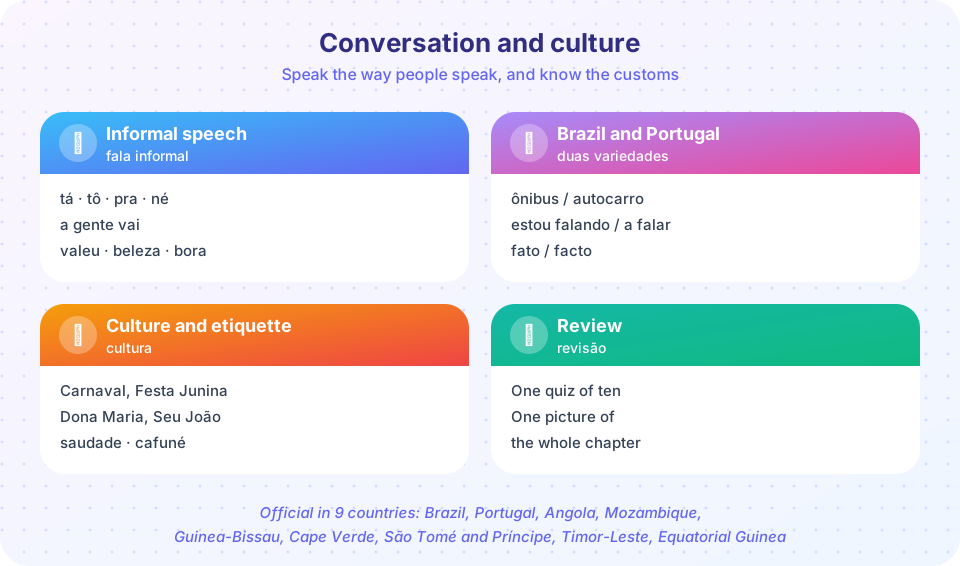
What you will learn
- How the chapter is organized, and what each lesson will add to your listening and speaking.
- Where Portuguese is spoken, and by roughly how many people.
- How to approach real, fast, informal Portuguese without panic.
- A few conversation habits that work in any dialect.
Key terms
Registro (register): the level of formality, from formal (o senhor) to casual (você, tu, a gente).
Variedade (variety): a national or regional form of the language, such as Brazilian or European Portuguese.
Sotaque (accent): the way a region pronounces the language. Gíria (slang): informal vocabulary.
CPLP: the Community of Portuguese-Speaking Countries, founded in 1996.
Portuguese in the world
Portuguese is an official language in nine countries: Brazil, Portugal, Angola, Mozambique, Guinea-Bissau, Cape Verde, São Tomé and Príncipe, Timor-Leste and Equatorial Guinea. Estimates put the number of speakers at around 260 million, with roughly four out of five of them in Brazil. It is also spoken in communities from Macau to Luxembourg to the United States.
Because of its size, Brazilian Portuguese dominates music, television, social media and most learning materials. That is why this course teaches it first. European Portuguese is spoken in a much smaller country but is the main written model in the Portuguese-speaking countries of Africa. You will see how to bridge the two in this chapter.
Lessons in this chapter
Informal speech
Brazil and Portugal
Culture
Review
- Informal Brazilian speech: spoken contractions, "a gente", slang, regional words and the abbreviations of WhatsApp.
- Brazil and Portugal: pronunciation, spelling, grammar and vocabulary differences and how to handle them.
- Culture and etiquette: greetings, forms of address, meals and tipping, holidays, music and the cultural ideas behind words like "saudade".
- Chapter review: a picture of the whole chapter and a ten-question quiz.
How to listen to real Portuguese
Real conversations are fast, and beginners often hear one long blur. Three habits help:
- Listen for chunks, not words. You will recognize "tudo bem", "quanto custa", "pode me ajudar" as units long before you can separate them.
- Use the shadowing method. Play a short clip, then repeat it as closely as you can, copying rhythm and melody. Even a one-minute clip a day trains your ear and mouth.
- Ask for repetition. "Pode repetir mais devagar?" (Can you repeat more slowly?) is never rude.
Remember the limit of every course like this one: it cannot replace speaking with people. Conversation exchanges, a tutor, or a language partner are the fastest way to turn what you have learned into something automatic.
A first conversation at a party
| Portuguese | English |
|---|---|
| Oi! Tudo bem? Eu sou o Lucas. | Hi! How is it going? I am Lucas. |
| E aí, Lucas! Eu sou a Camila. Você é de onde? | Hey, Lucas! I am Camila. Where are you from? |
| Sou de Curitiba, mas moro aqui há dois anos. E você? | I am from Curitiba, but I have lived here for two years. And you? |
| Eu sou daqui mesmo. Quer uma cerveja? | I am from here. Do you want a beer? |
| Quero, valeu! | Yes, thanks! |
Look at what is already informal: "E aí", "valeu", "daqui mesmo". By the end of the chapter you will understand every line and know which ones to keep for friends.
Try it
First, a deck of casual greetings and reactions. Say them aloud with a relaxed, friendly voice.
The second TryIt is a Python quiz about the Portuguese-speaking world. It lists the nine official-language countries with their capitals and quizzes you with a fixed seed. Change random.seed for a new quiz.
Press Run (or Ctrl + Enter) to see the result here.
Program input · what you'd type while the program runs
Type the answers before you press Run, one per line. Each time the program reads a line (with input()), it gets the next line from this box.
Check your understanding
Quick check · 4 questions
of 4 answered You scored / 4 · perfect!
-
1. In how many countries is Portuguese an official language?
Brazil, Portugal, Angola, Mozambique, Guinea-Bissau, Cape Verde, São Tomé and Príncipe, Timor-Leste and Equatorial Guinea. -
2. Which is a good way to practice listening to real speech?
Shadowing trains ear and mouth together. -
3. What does 'Valeu!' mean in casual Brazilian Portuguese?
'Valeu' is a casual way to say thanks. -
4. What is a 'registro' in language learning?
Register is how formal or casual you are speaking.
Summary
- Chapter 8 teaches real, informal Portuguese, the two main varieties and the cultural habits behind the language.
- Portuguese is official in nine countries and spoken by around 260 million people, mostly in Brazil.
- Listen for chunks, shadow short clips and ask for repetition.
- A course cannot replace talking with people.
Track your progress
Create a free account to tick off lessons and pick up where you left off on any device.
of Portuguese for Beginners lessons completed