


















Lesson 16 of 48 · Nouns, Articles and Adjectives
Chapter 3 Review: Nouns, Articles and Adjectives
Review Portuguese noun gender, plurals, articles, contractions, adjective agreement, possessives and demonstratives, with a summary picture and a ten-question quiz.
Chapter 3 gave you the grammar of things: how to name them, count them, point to them, and describe them. The big idea was agreement: articles, nouns, and adjectives share gender and number. With that habit, you can build phrases such as as minhas casas novas ("my new houses") without hesitation.
This review gathers the chapter's rules into one page. Study the picture, read the recap table, try the two tools, and then take the quiz. If you miss a question, the explanation tells you what to revisit.
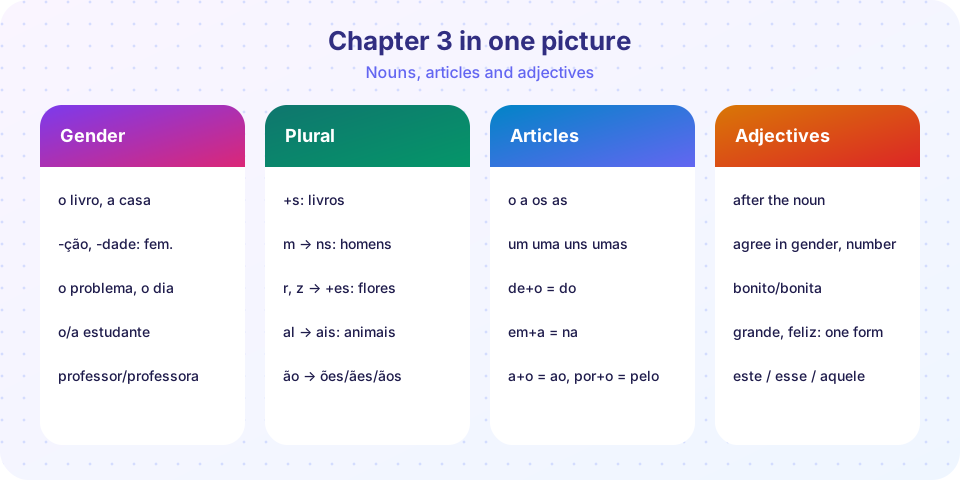
What you will review
- Gender hints and the main exceptions.
- Plural rules, including -m, -l, and -ão.
- Articles and the contractions do, da, no, na, ao, à, pelo.
- Adjective agreement, position, colors, possessives, and demonstratives.
Chapter recap
| Lesson | Key ideas |
|---|---|
| Gender and plurals | -o mostly masculine, -a mostly feminine; o dia, o problema, a mão are exceptions; -ção, -dade feminine; plurals: +s, -m → -ns, +es, -al → -ais, -ão → -ões/-ães/-ãos. |
| Articles and contractions | o, a, os, as; um, uma, uns, umas; article with general subjects and many countries; de/em/a/por + article; no article for a profession after ser. |
| Adjectives, possessives and demonstratives | Adjectives follow the noun and agree; -e/-l/-z adjectives have two forms; possessives agree with the thing owned; este/esse/aquele. |
The rules in one sentence each
- Learn every noun with its article: a casa, o livro.
- Make the plural on every word: as casas novas.
- When a preposition meets an article, they contract: em + a = na.
- Put the adjective after the noun and match it: uma casa nova.
- Match a possessive to the thing owned: minha casa; clarify seu with dele/dela.
- Choose este, esse, aquele by distance.
A dialogue at home
| Portuguese | English |
|---|---|
| Bia: Esta é a minha casa. | This is my house. |
| Leo: Que casa bonita! É nova? | What a pretty house! Is it new? |
| Bia: Não, é velha, mas é muito confortável. | No, it is old, but it is very comfortable. |
| Leo: E aqueles gatos, são seus? | And those cats over there, are they yours? |
| Bia: São os gatos da minha irmã. Eles são pretos. | They are my sister's cats. They are black. |
| Leo: Eles são muito simpáticos! | They are very friendly! |
Notice the agreement in casa bonita, casa nova, gatos pretos, gatos simpáticos, and the contraction in da minha irmã (de + a).
Common misconceptions to check
"The adjective always goes before the noun." It usually follows: gatos pretos.
"I can say em o and de a." No: use no and da.
"Seu is always his." It can be your, his, her, or their; use dele/dela when it matters.
"Mão is masculine." It is feminine: a mão, as mãos.
How to use this review
Grammar sticks best when you use it in your own sentences. After you read the recap, write five short sentences about your home or your family, such as Minha casa é pequena. Os meus gatos são pretos. Moro numa cidade grande. Check each one against the rules: Is the noun's gender right? Do the article and adjective agree? Did I contract em + uma?
Here is a can-do list. Can you give the gender of ten common nouns with their articles? Can you make the plural of flor, animal, homem, and coração? Can you say do, da, no, na, ao, à correctly in a sentence? Can you describe two things with agreeing adjectives, using at least one color? Can you point to something near you, near your listener, and far from both? If you can, the building blocks of the language are in place. If you cannot yet, the gap is almost always in gender and plurals, so reread that lesson and try the plural quiz again.
Try it
The first tool is a gap-fill game. Fill in the correct word to complete each sentence.
The second tool is an agreement checker. It knows a few nouns and adjectives and flags phrases where the article, noun, and adjective do not match. It is a teaching model, not a grammar checker.
Press Run (or Ctrl + Enter) to see the console output here.
No output.
Check your understanding
Quick check · 10 questions
of 10 answered You scored / 10 · perfect!
-
1. Which noun is feminine?
Mão is a feminine exception: a mão, as mãos. Mapa and dia are masculine exceptions to the -a hint. -
2. What is the plural of 'jornal'?
Words in -al become -ais: jornal → jornais. -
3. What is 'em + a'?
Em + a contracts to na: Moro na cidade. -
4. Which phrase is correct?
Casa is feminine, so the article and the adjective are feminine: uma casa nova. -
5. Which demonstrative means 'that over there' (far from both)?
Aquele/aquela/aquilo is for things far from both speaker and listener. -
6. How do you say 'I am a teacher' (a woman)?
After ser, a profession normally has no indefinite article. -
7. Which is correct for 'her book'?
Dela clearly means her, and the article follows the book: o livro dela. -
8. What is the plural of 'mão'?
Mão belongs to the -ãos group: mão → mãos. (Mães is the plural of mãe, mother.) -
9. Which sentence uses 'muito' correctly?
Muito before an adjective is an adverb and does not change. -
10. Which phrase is correct for 'I am from England'?
De + a = da, and Inglaterra is feminine.
Summary
- Learn nouns with their articles; most gender is predictable from endings, with exceptions to memorize.
- Plurals follow the last letter: +s, -ns, +es, -ais, -éis, -ões/-ães/-ãos.
- Prepositions contract with articles: do, da, no, na, ao, à, pelo.
- Adjectives follow the noun and agree; possessives agree with the thing owned.
- Este, esse, aquele show distance; isto, isso, aquilo are neutral.
Track your progress
Create a free account to tick off lessons and pick up where you left off on any device.
of Portuguese for Beginners lessons completed